Progressive Web Apps vs Native Apps: Which Should You Choose in 2026?
284 Views
Summarize Article



Summarize Article
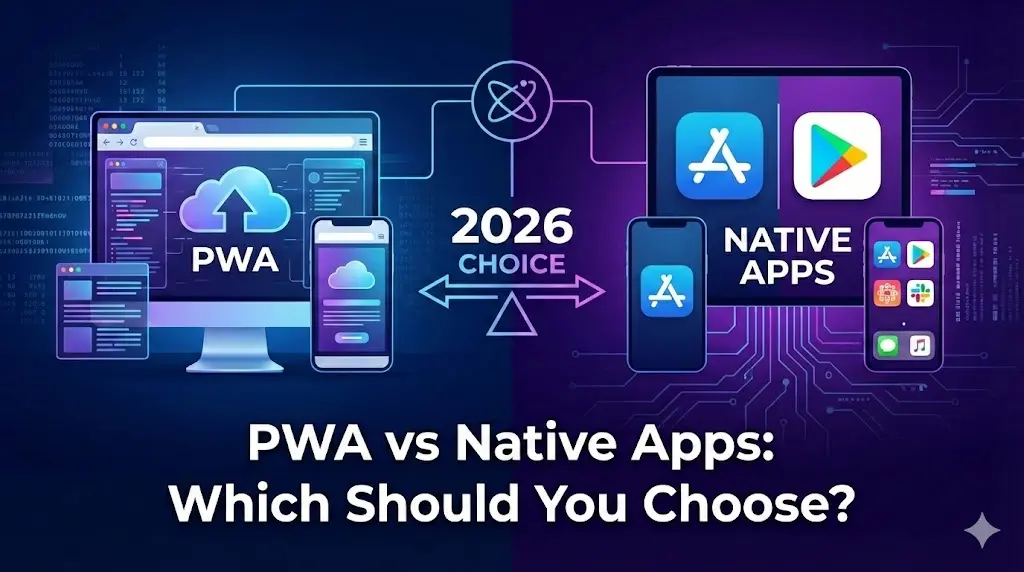
If you are planning an app in 2026, the real question is not “PWA or native” as a debate. The real question is what your users need on day one, and what your team can ship and maintain without burning out.
That is why progressive web apps vs native is a useful comparison. It pushes you to think about distribution, performance, offline use, device features, and long term cost, not just tech preference.
Let’s make this practical. You will see where a PWA is the smartest first move, where native is still the right call, and how many teams land in a blended path.
A Progressive Web App (PWA) is a website that behaves like an app. It loads fast, can work offline in parts, can be saved to a home screen, and can send notifications in some cases.
A native app is built specifically for iOS or Android using platform tools. It lives in the App Store or Google Play, and it can use almost every device feature with fewer limits.
So, progressive web app vs native is basically: web reach and speed to launch vs deeper device access and richer platform polish. If someone on your team still feels fuzzy on the basics, you can send them a short progressive web app guide for modern businesses before you get into build decisions.
This is the part teams skip, then regret later.
One public case study: AliExpress reported a 104% lift in new user conversion after its PWA launch, plus an 82% lift on Safari. It is a clean example of how lower install friction can matter in progressive web app vs native app choices.
A PWA is easy to share. Someone clicks a link and they are in. No install step, no store approval, and fewer drop offs. That matters a lot for ecommerce, content, and lead gen.
Native apps usually win on:
If your product needs those often, native pays off.
This is where decisions get real, fast.
PWAs can be cheaper to build because you maintain one experience that works across devices. Native usually means two codebases or a cross-platform setup plus platform work.
If you need traction quickly, a PWA often ships sooner. It also makes iteration easier because updates go live without app store review delays.
Native maintenance is heavier. You deal with OS updates, device differences, store policy changes, and more testing paths. PWAs also need testing, but the surface area is usually smaller.
If your roadmap is aggressive and your team is lean, the comparison progressive web apps vs native app often tilts toward a PWA at first.
This is where people get emotional, so let’s keep it grounded.
Research says 53% of mobile site visitors leave if a page takes over 3 seconds, and the average mobile landing page takes 22 seconds to fully load. Speed is not a “nice to have”. That is why progressive web apps vs native decisions often start with performance.
A well-built PWA can feel extremely fast, especially after the first load. Caching and smart loading patterns help a lot.
Native can still feel smoother in high-interaction screens, like video editing, complex gestures, and heavy real-time UI.
Twitter Lite is a good “low bandwidth” proof point: it reduced data use by up to 70%, and the PWA shipped at 600KB over the wire versus 23.5MB needed to install the native Android app.
PWAs can support offline modes using caching. Native apps can also do offline well, and usually with more control over storage and background sync.
If your users face weak signal often, both can work. The winner depends on how complex your offline logic is.
This is where progressive web app vs native app becomes obvious. Native has broader access to device capabilities. PWAs can access some features, but support can vary by platform and browser.
If your core value depends on deep device integration, native is still the safer bet.
This might be the biggest difference for many businesses.
A link is frictionless. Ads, SEO, email, social, and QR codes all work naturally. That matters for top-of-funnel growth.
App stores can bring discovery, trust signals, and easy billing flows. But they also add review cycles and policy constraints.
If your growth plan leans on web discovery and fast iteration, progressive web apps vs native apps often starts with a PWA.
| Area | PWA | Native App |
| Install friction | Low (link first, optional add-to-home) | Higher (store visit and install) |
| Updates | Instant web deploy | Store review and user updates |
| Performance ceiling | High for many use cases | Highest for complex UI and device-heavy tasks |
| Offline support | Good with service worker strategy | Very strong with full device control |
| Device feature access | Partial, varies by platform | Broad, consistent access |
| SEO and sharing | Strong | Limited |
| Long-term maintenance | Usually simpler | Usually heavier |
| Best fit | ecommerce, content, portals, MVPs | media-heavy apps, gaming, deep device apps |
Here are patterns that keep showing up.
If your product depends on quick adoption, you want the fewest steps between interest and usage. A PWA is great here.
Catalog browsing, search, product pages, tracking, support, and account features can work really well as a PWA.
A PWA makes it easier to ship v1, learn, and adjust. You can still move to native later once the product shape is clear.
If you want numbers and case studies to back that call in a stakeholder deck, you can pull a few talking points out of our 10 key benefits of progressive web apps breakdown.
This is why many teams lean toward progressive web apps vs native as a staged decision, not a forever decision.
Native is usually the right answer when the product needs deep capability and consistent polish.
Examples include heavy camera workflows, AR, Bluetooth device pairing, health sensors, and complex background tasks.
If your app is built around gestures, real-time UI, or high-frame-rate animation, native tends to win.
If you rely on push, home-screen presence, and deep OS integration as a main growth loop, native can be worth the investment.
A lot of successful teams do this:
This approach makes progressive web apps vs native apps feel less like a forced choice and more like a sequence.
If you like this path, your PWA should be built with a future native plan in mind. That means clean APIs, consistent design patterns, and analytics that track what users actually do.
If your team is stuck between speed and polish, WebOsmotic can run a short discovery that maps user journeys, feature needs, and platform constraints, then recommends a build plan that fits your timeline and budget.
After that, WebOsmotic can ship a PWA or native build with a clear measurement plan, so you are not guessing what worked once the product is live.
A PWA runs in the browser and can act like an app, while a native app is built specifically for iOS or Android and can use more device features with fewer limits.
For many stores, yes. PWAs can load fast, work well on mobile, and support key flows like browsing, cart, checkout, and order tracking with less install friction.
Not always. PWAs can feel very fast for many common flows. Native still tends to win in heavy interaction screens and advanced device-based features.
Yes, and it is common. Many teams validate demand with a PWA, then build native apps later for power users and deeper device features.
If your growth relies on links, SEO, and easy sharing, a PWA often helps more early. If your growth relies on app store discovery and strong OS integration, native can help more.