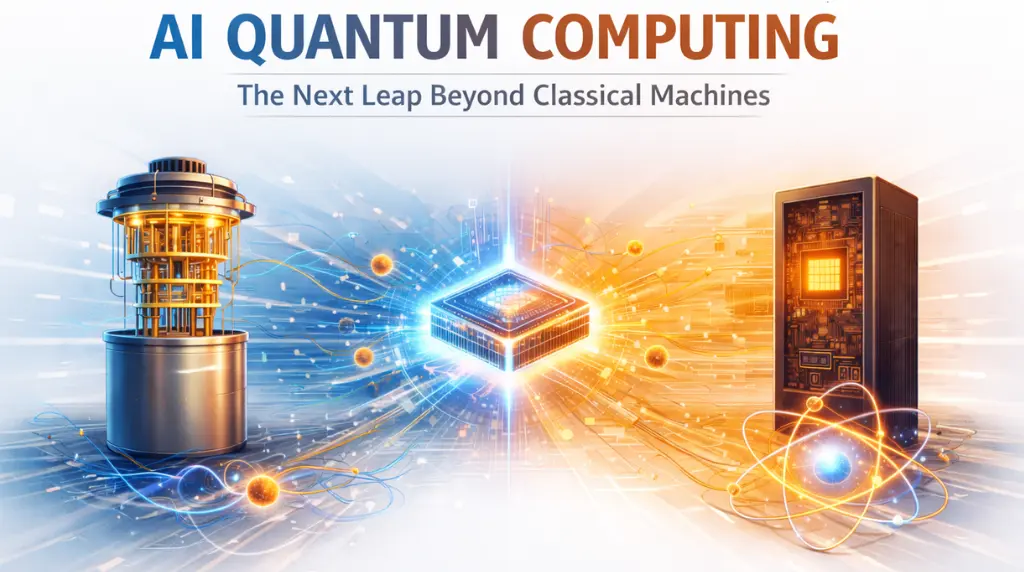
AI Quantum Computing: The Next Leap Beyond Classical Machines
274 Views
Summarize Article



Summarize Article
Quantum computing AI sounds like a mashup term. However, the answer is simple: use quantum computers for parts of work that feel painfully slow on normal computers.
After that, pair that with AI workflows people already use. You will see big promises online, but real progress today is more practical.
There is also a second angle that matters. AI can help researchers design better quantum experiments and spot errors earlier. So the relationship goes both ways.
This guide breaks it down in an easy way to help you understand everything about AI quantum computing and how it differs from AI.
Also, you’ll know where the combo helps, and what to expect if you are planning products or research.
Let’s begin.
A normal computer stores information as bits that are either 0 or 1. Quantum computers use qubits, which can act like they hold more than one state at once. Also, qubits can be linked in ways that create strong correlations.
You can also cherish IBM’s official quantum learning resources explaining superposition and entanglement in a practical way.
That does not mean a quantum computer is “faster at everything.” It means it can be good at some types of problems, mainly ones that involve complex probability patterns. For example, huge search spaces or certain math structures.
In real life, quantum computers also come with constraints:
So the key is picking the right task, not forcing every workload onto quantum hardware.
It helps to keep a clean separation in your head: Quantum computing vs AI is not a battle. They solve different layers of the problem.
A useful way to think about it:
You can also read our guide about types of artificial intelligence to understand AI thoroughly.
When people say AI quantum computing, they usually mean one of these:
You keep the machine learning goal, but use quantum circuits as part of the model, or as a feature mapping step. The hope is better representation of data or faster training on some tasks.
A lot of AI systems include optimization steps: selecting best actions, scheduling, routing, or portfolio-style allocation. If a quantum method helps with certain optimization, the AI pipeline benefits.
AI models can help calibrate qubits, detect noise patterns, and propose circuit changes. This is one of the most practical areas today because labs constantly fight instability.
If you are testing a hybrid prototype on real data, our machine learning development services can help you set up experiments and compare results cleanly.
Most quantum machine learning today is research or early prototyping. A common setup is “hybrid”:
This is also where tools matter. Libraries exist that make it easier to test ideas without building everything from scratch.
Still, there are real reasons results are mixed:
The arXiv quantum physics archive publishes ongoing peer-reviewed preprints on quantum machine learning and hardware benchmarks.
So, think of it as early-stage exploration. It is not a plug-and-play replacement for current ML stacks.
Here are areas where quantum plus AI has a clear story, even if timelines vary.
Many businesses have scheduling problems: shifts, fleet routing, warehouse picking, delivery sequencing. AI helps predict demand and constraints. After that, it implements optimization to pick the best plan. Quantum methods help explore options faster, but success depends on problem structure.
If you want a real-world view of routing and scheduling pain points, this AI logistics company guide shows where optimization work usually starts.
A major reason quantum computing exists is that nature is quantum. Simulating molecules is brutally expensive on classical systems as complexity grows. If quantum hardware scales and error control improves, it could help model chemical systems more directly.
AI already helps in drug discovery and materials screening. Pairing the two could mean: AI narrows candidates, quantum simulation checks the physics more accurately on a subset.
Some approaches treat a quantum circuit like a complex feature transformer. Then a classical learner works on top. In simple words: you let the quantum circuit “reshape” the data, hoping it becomes easier to separate. This can be interesting for certain structured data, but it is not a guaranteed upgrade.
Quantum is most likely to appear in the decision layer (optimization) or in specialized model submodules (quantum circuits as components). It is less likely to replace your entire model training pipeline. That framing keeps expectations realistic.
If you like architecture thinking, picture a modern AI system like this:
No. Quantum computing is a computing method while AI is a set of learning methods. In most setups, AI runs on classical hardware. On the other hand, quantum is tested as a helper step for a specific bottleneck.
Not today. Current quantum hardware is limited in scale and stability. Large model training depends on massive compute and data pipelines that quantum systems are not built to handle right now.
A constrained optimization problem is often the cleanest starting point. For example, scheduling or routing. You can compare a hybrid solver against classical heuristics using the same constraints and success metrics.
Both are useful only to clarify roles. Quantum computing is not a substitute for AI. Also, AI is not a substitute for quantum hardware. The better way is how they can complement each other in one workflow.