AI in B2B Sales: Agents, Predictive Scoring & Revenue
185 Views
Summarize Article



Salesforce reports 89% of sales teams use AI. Most teams still struggle because 73% of their leads are unqualified. AI in SaaS fixes this by turning raw data into clear choices. You stop the manual grind and use predictive lead scoring to find high-value accounts. This builds revenue intelligence and achieves 79% pipeline forecasting accuracy.
By using AI sales agents, you handle inbound qualification while your humans focus on closing. High-performing teams use AI in SaaS to ensure they only spend time on deals that close. This approach drives sales cycle reduction and improves ROI.
Most SaaS growth stalls because sales reps spend most of their time on junk leads. AI in SaaS solves this by vetting every prospect before they ever reach a human rep. You need to stop the manual guessing and use a system that prioritizes accounts based on hard math. This shift is the only way to achieve true sales productivity and predictable growth.
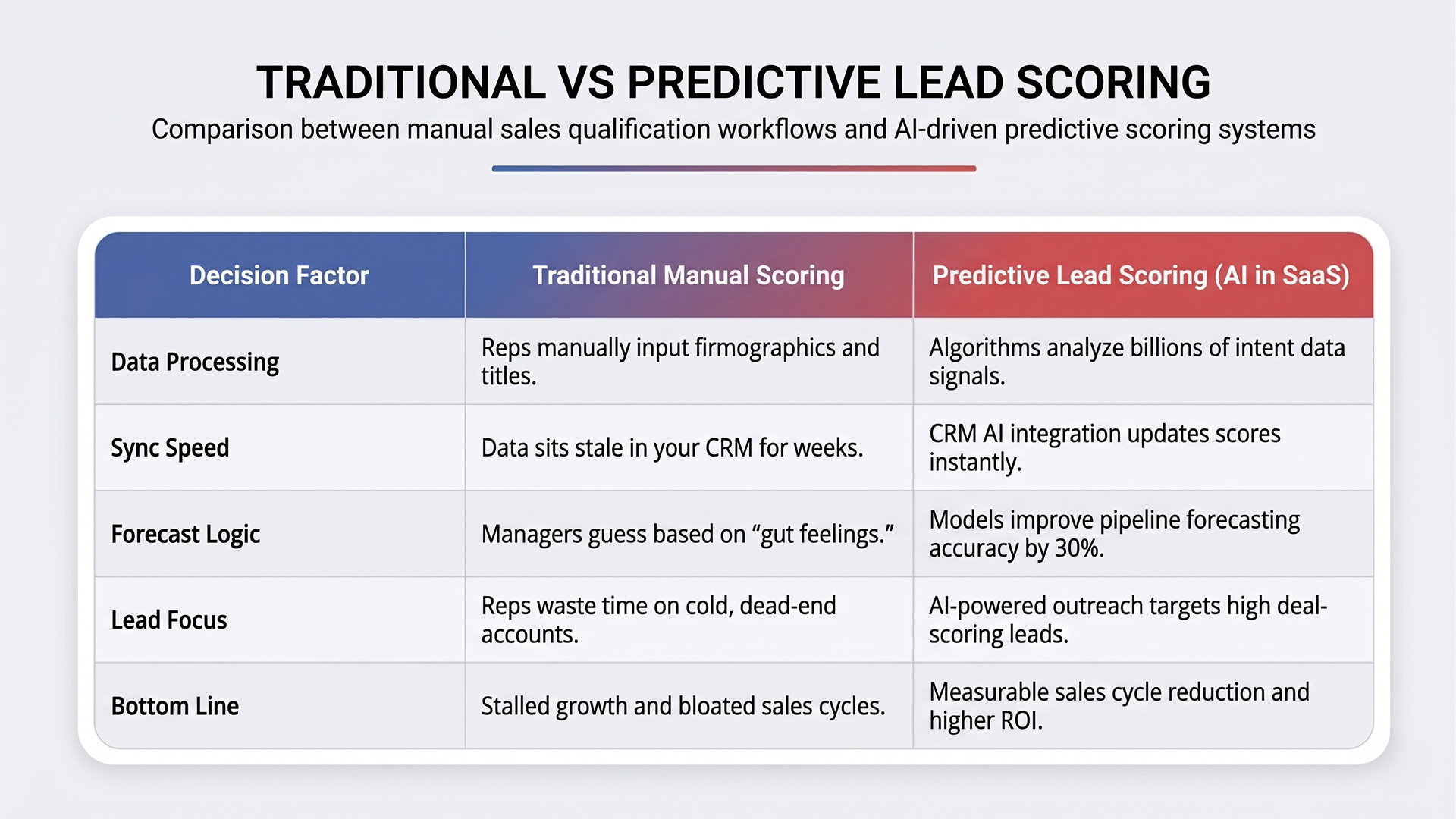
Traditional scoring usually relies on a simple job title or a single location. Predictive lead scoring looks at hundreds of signals across the web to find your next customer. AI in SaaS models analyzes how a lead interacts with your content and compares them to your best wins.
This creates a highly accurate deal scoring process. By using predictive lead scoring, you ensure your reps only talk to people ready to buy. This method directly improves your pipeline forecasting accuracy.
Comparison: Moving From Manual Guesswork to Machine Precision
If you only act when someone fills out a form, you often lose the deal to faster competitors. Intent data shows you which accounts are researching solutions right now. Using AI in SaaS to track these early signals gives you a massive advantage.
AI in SaaS allows your team to launch AI-powered outreach while the prospect is still in the research phase. Without these insights, your AI sales agents lack the context to stay relevant. Using AI in SaaS with a deep CRM AI integration makes these signals visible to everyone.
Fixing your lead quality creates the right environment for AI sales agents to expand your pipeline coverage.
Scaling a sales team used to require a massive hiring spree. Today, AI in SaaS allows you to expand your reach without the high costs of a large SDR team. AI sales agents act as an autonomous layer that handles the initial friction of every sales conversation.
This keeps your pipeline moving even when your human reps are sleeping. AI in SaaS tools ensures that every lead gets immediate attention.
By 2026, AI sales agents will have moved beyond simple chatbots. They now use intent data to decide who to contact and what to say. These agents can handle the entire inbound qualification process, reducing response times from 36 hours to under 30 seconds.
This immediate action creates a significant sales cycle reduction because prospects don’t have time to look at your competitors. AI in SaaS platforms now manages AI-powered outreach by crafting personalized messages based on a prospect’s recent LinkedIn activity or company news. B2B sales automation ensures that every interaction is recorded and every follow-up is sent on time. Using AI in SaaS this way keeps your outreach human-like but machine-fast.
While AI in SaaS is incredibly efficient, it cannot replace the nuance of human relationships. AI sales agents often fail when a deal involves multiple stakeholders with conflicting goals.
A machine cannot manage the social dynamics of a boardroom or handle a non-standard procurement request. High-performing teams use predictive lead scoring to identify which deals need a human touch early on.
This strategy allows your top closers to focus their energy where it matters most. Using AI in SaaS for the volume and humans for the strategy creates a balanced revenue engine. Better pipeline coverage is great, but it only matters if you can turn those signals into a reliable revenue forecast.
Most SaaS teams treat revenue forecasting as a guessing game. AI in SaaS turns these guesses into mathematical certainties by looking at what buyers actually do. You gain a clear view of your future revenue without relying on a rep’s gut feeling.
AI in SaaS helps you see the truth in your data. By connecting your pipeline directly to behavioral signals, you stop over-promising to the board and start hitting your numbers.
Manual roll-ups fail because they treat every deal in a specific stage the same way. AI in SaaS analyzes engagement signals to provide a dynamic win probability for every account. This improves pipeline forecasting accuracy by 25% or more.
Instead of a rep saying a deal looks “good,” deal scoring provides an objective health check based on recent interactions. B2B sales automation flags at-risk deals three weeks earlier than traditional methods. This early warning leads to a measurable sales cycle reduction because managers can jump in before a deal stalls.
Raw lead volume is a vanity metric. True revenue intelligence comes from tracking metrics that impact the bottom line. Use predictive lead scoring to measure the quality of your incoming pipe.
A seamless CRM AI integration ensures your AI sales agents and human reps work from the same live data. This focus on high-intent activity boosts sales productivity across the board. AI in SaaS ensures your AI-powered outreach targets the accounts most likely to close.
Building this infrastructure requires more than just buying a new tool; it requires a strategic deployment.
Many companies buy generic tools and wonder why their sales productivity stays low. WebOsmotic builds custom AI in SaaS solutions that fix the disconnect between your data and your deals. We move beyond basic templates to create specialized systems for revenue intelligence.
Our team handles everything from feasibility audits to full-scale deployment. By using a consulting-first approach, we ensure your AI in SaaS investment actually drives a return. This keeps your AI in SaaS strategy focused on outcomes.
WebOsmotic solves “tool fatigue” by building a unified system. This ensures your AI-powered outreach stays relevant.
Book your AI strategy session with WebOsmotic today to turn your raw data into revenue intelligence that actually closes deals.
Winning in 2026 requires shifting from volume-driven prospecting to high-precision revenue operations. You stop the “spray and pray” method by using AI in SaaS to identify buyers before they contact sales. Using AI sales agents allows human closers to focus on high-value deals. Predictive lead scoring keeps the funnel pure.
This infrastructure builds the revenue intelligence needed to scale without adding unnecessary headcount. WebOsmotic provides the technical foundation to bridge these complex data gaps through customized AI in SaaS engineering. You gain a highly efficient pipeline.
Connect with WebOsmotic to design a custom AI in a SaaS framework that turns your raw intent data into predictable ARR.
Traditional scoring uses static rules. Predictive lead scoring uses AI in SaaS to analyze intent data and behavioral signals. It provides accurate deal scoring, helping you focus on high-value accounts. This results in sales cycle reduction and higher win rates.
AI sales agents handle inbound qualification, scheduling, and AI-powered outreach. By using B2B sales automation, they manage top-of-funnel tasks without human help. This boosts sales productivity and ensures your CRM AI integration stays updated with every interaction and signal.
AI in SaaS replaces manual guesses with revenue forecasting based on live engagement. It improves pipeline forecasting accuracy by flagging at-risk deals early. Using revenue intelligence, you can predict ARR accurately while AI sales agents keep the data flowing.
Most modern platforms support CRM AI integration for AI in SaaS. Whether you use Salesforce or HubSpot, these tools connect with intent data and predictive lead scoring. This ensures your B2B sales automation workflows sync perfectly to drive sales productivity.
Teams using AI in SaaS for predictive lead scoring see 138% ROI. By automating AI-powered outreach and improving pipeline forecasting accuracy, you see immediate gains. These tools drive sales cycle reduction while revenue intelligence helps you scale your revenue faster.