AI in Ecommerce 2026: Recommendations, Pricing & Checkout
158 Views
Summarize Article



Summarize Article

89% of retailers have adopted AI, but adoption is not execution. AI in ecommerce contributes 25-35% of total revenue through AI product recommendations, and checkout AI tools lift conversions by 10-15%.
Nearly half of US shoppers say AI product recommendations influenced their last purchase, and traffic from AI engines to retail sites rose 4,700% year-over-year as of July 2025.
This guide breaks down exactly how AI in ecommerce is reshaping recommendations, pricing, and AI checkout optimization, and where the biggest gaps still exist.
AI product recommendations in 2026 continuously process real-time behavioral signals across each session, adapting product discovery to browsing history, purchase intent, device context, and timing. This makes static segment-based logic in AI in ecommerce platforms commercially obsolete.
The shift is structural, not incremental. Old recommendation logic placed users into demographic cohorts and served identical suggestions to every member of that group. AI in ecommerce today reads 40 to 100 in-session signals per user and rewrites the recommendation surface mid-visit as intent shifts.
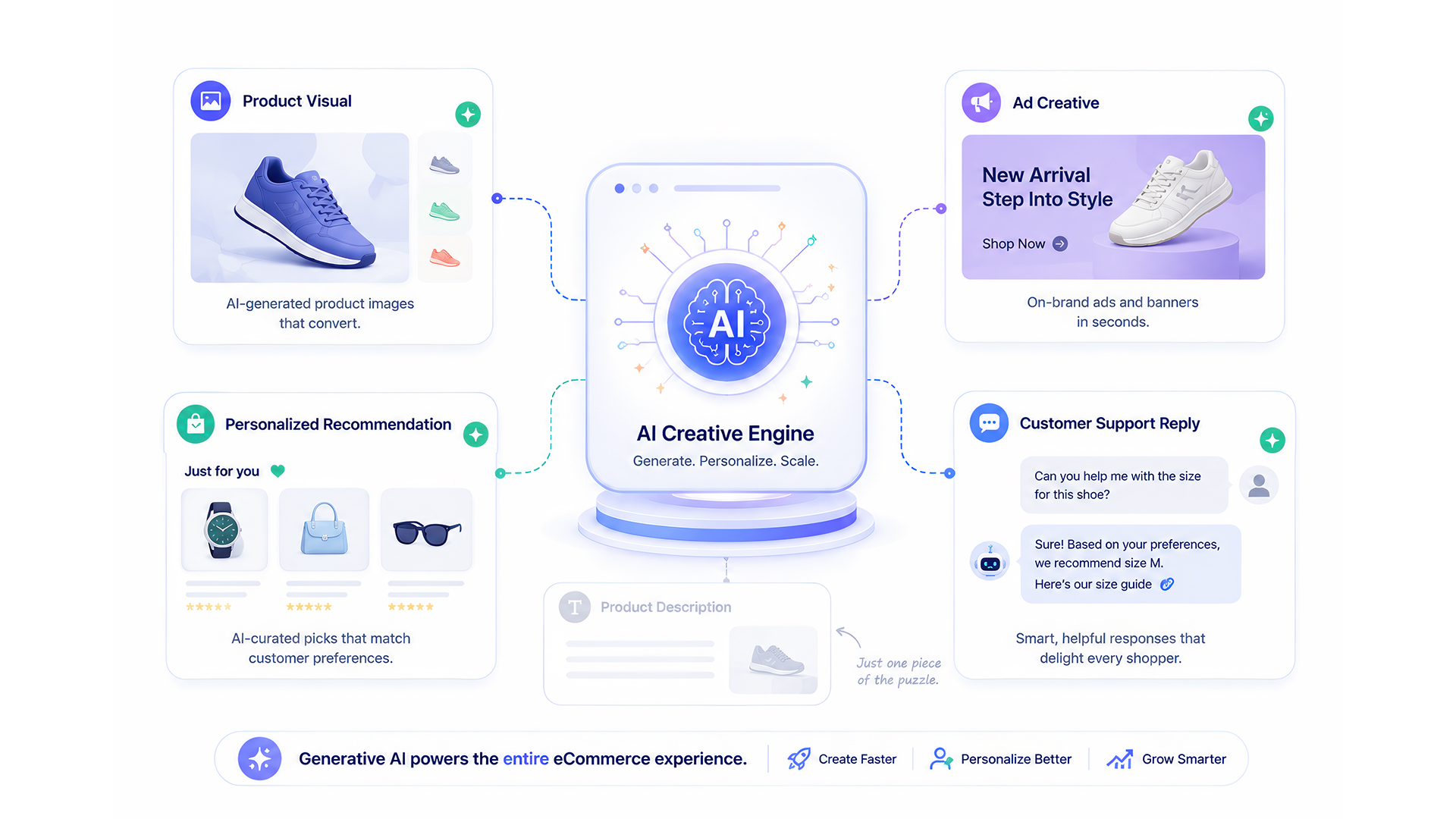
The recommendation surface in AI in ecommerce has expanded well beyond a homepage carousel. Personalized recommendations now power site search results, product-page cross-sells, cart-level upsells, post-purchase emails, and push notifications inside a unified logic layer. Retailers treating AI product recommendations as a homepage widget are losing revenue on every other surface.
Static cohort models batch-process customer history and recalculate weekly. That delay is the core problem with pre-AI personalization in ecommerce. AI in ecommerce recommendation engines interpret scroll depth, search phrasing, dwell time, and click patterns in real time, updating the recommendation output within the same visit.
A shopper who arrives browsing running shoes and pivots to recovery gear mid-session gets a different suggestion set by their third page view.
Most stores deploy recommendations at the discovery layer and leave the rest of the funnel unaddressed. The highest revenue opportunity across AI in ecommerce sits in the consideration and post-purchase layers.
The full-funnel view is what separates AI in ecommerce leaders, capturing recommendation-driven revenue from those still treating AI product recommendations as a single-page widget.
Most retailers still default to flat promotional discounts that erode margin without targeting conversion probability. The retailer running a blanket 20%-off sale gives margin away to buyers who would have converted at full price.
AI in ecommerce pricing replaces that blunt instrument with models that read competitor price changes, inventory velocity, demand signals, and session-level context to adjust prices in near real time.
AI in ecommerce pricing tools ingest five core input signals and output price changes in minutes, not days:
The output prevents a race to the bottom by optimizing for conversion probability rather than price parity alone. That distinction is what separates real-time pricing from basic repricing tools in AI in ecommerce platforms.
Blanket discounts apply a single reduction to every buyer regardless of their conversion sensitivity. A customer willing to pay full price receives the same discount as the one who needs an incentive to convert.
That gap is pure margin destruction, and it is the default state for most AI in ecommerce deployments that stop at promo calendars.
Quick-Glance: Pricing Approach Comparison
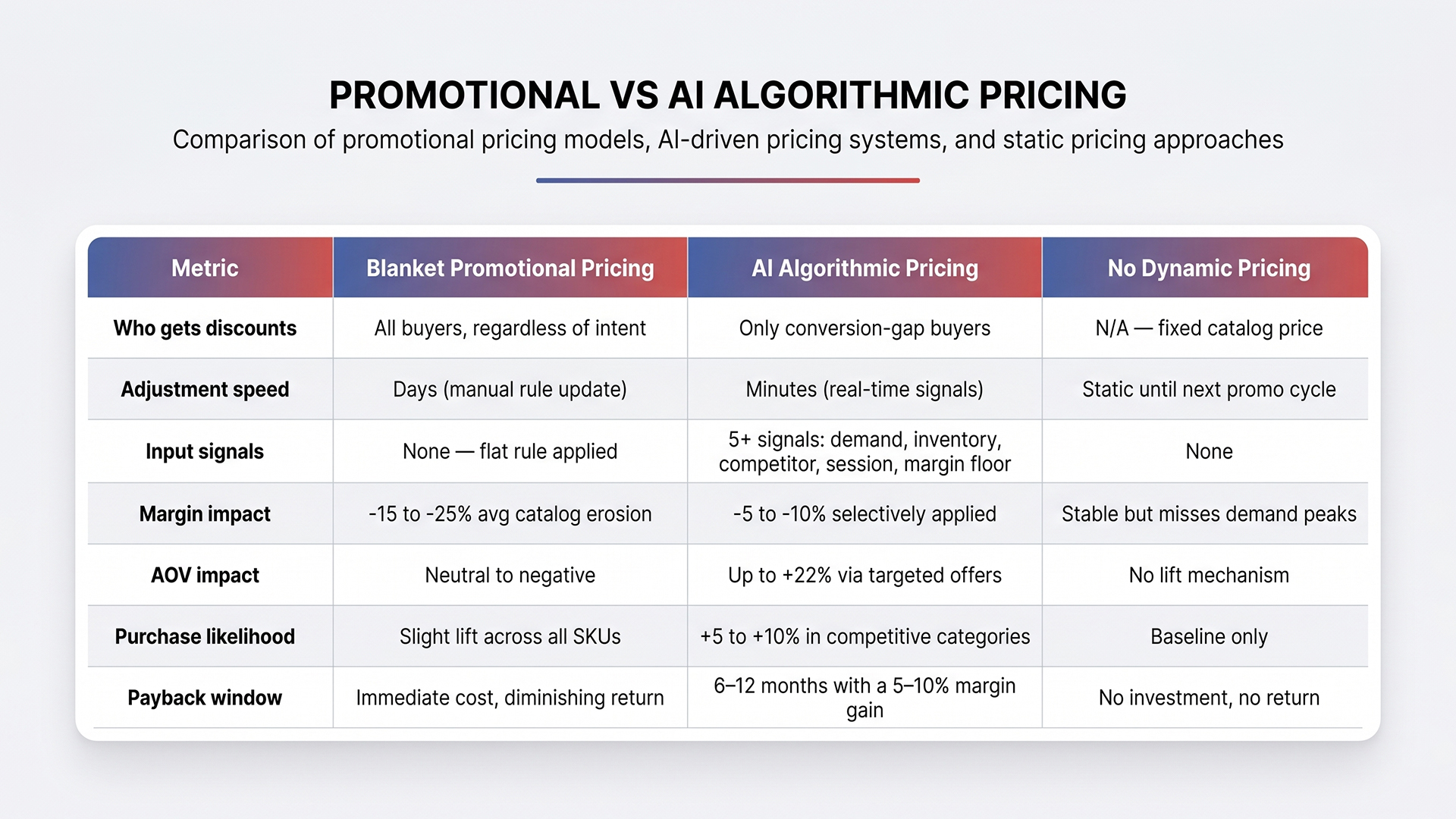
Algorithmic AI in ecommerce pricing identifies which buyers need a price nudge and extends the offer only to them. Selective discounting at the right moment costs less and converts more precisely than a catalog-wide sale.
AI checkout optimization addresses the most expensive problem in AI in ecommerce: a 70.19% average cart abandonment rate representing $260 billion in recoverable revenue. Chatbots assisting during checkout lift conversions by 10-15%, with the largest gains among first-time buyers.
Most abandonment recovery strategies are reactive: they send an email 30 minutes after the user has already left. AI checkout optimization moves the intervention earlier, detecting exit signals before the user acts on them. Mobile checkout compounds the problem: stores without AI-assisted one-tap checkout see mobile conversion rates more than 40% below desktop.
AI checkout optimization identifies behavioral exit signals before the user leaves: cursor velocity toward the browser tab, session inactivity thresholds crossing predictive models, and scroll reversal patterns. The intervention fires inside the session, not after it.
Recovery flows triggered in real time include:
Stores deploying full AI checkout optimization recover 15-20% of abandoned carts. That number compounds fast across high-traffic AI in ecommerce stores.
Agentic commerce is not theoretical. AI in ecommerce platforms already enables end-to-end transactions within chat interfaces, bypassing traditional checkout flows entirely. Fifteen percent of Shopify merchants are already experiencing this, with autonomous AI agents completing purchases on behalf of shoppers.
McKinsey estimates agentic commerce could orchestrate up to $1 trillion in US B2C retail revenue by 2030. The constraint is trust: only 14% of consumers currently authorize AI in ecommerce agents to purchase on their behalf.
For retailers, structured product data, clean APIs, and transparent pricing determine whether an AI shopping assistant recommends your store or bypasses it entirely.
AI in ecommerce has a 59-point trust gap: 73% of consumers use AI in ecommerce tools during shopping journeys, but only 14% trust AI in ecommerce agents to purchase autonomously. That gap is the deployment ceiling for AI checkout optimization and agentic commerce, and retailers who ignore it are building on a foundation that cannot scale.
Backend AI in ecommerce models, covering pricing, inventory, and logistics, faces no comparable trust barrier because shoppers never interact with them directly.
Retailers closing the trust gap are doing three things: publishing clear AI-use disclosures tied to specific touchpoints, embedding consent into personalization engine flows at the data layer, and separating backend AI in ecommerce from frontend AI in ecommerce. The frontend is where trust is built or destroyed, and the brands investing in that separation today will hold a durable advantage by 2028.
WebOsmotic builds production-ready AI in ecommerce systems for teams that need measurable revenue impact, not just feature deployment. Our engineering team covers the full cycle from AI product recommendations integration and dynamic pricing AI setup to AI checkout optimization flows and post-launch optimization.
For stores on Shopify, WooCommerce, or custom stacks, WebOsmotic audits current AI in ecommerce readiness, checkout UX gaps, and recommendation opportunities before any build begins.
Book a quick audit call to see exactly where your AI in the ecommerce stack is underperforming.
AI in ecommerce presents a three-layer revenue gap: AI product recommendations driving 25-35% of revenue but deployed at the surface level, AI in ecommerce pricing sitting below 15% retailer adoption despite 5-10% margin gains, and $260 billion in cart abandonment revenue sitting largely untouched without AI checkout optimization. Organizations using AI in ecommerce tools earn an average of $1.41 for every $1 spent. The ROI case is established. Execution is the remaining gap.
Book a WebOsmotic AI ecommerce audit to identify exactly where your AI in ecommerce recommendations, pricing, and AI checkout optimization stack is leaving revenue behind.
AI product recommendations in AI in ecommerce platforms use real-time behavioral signals, including browsing history, session depth, and purchase patterns, to personalize product discovery at every funnel stage. They contribute 25-35% of total AI in ecommerce revenue on average, and stores running these engines see 26% higher conversions and 35% longer session durations versus static cohort-based logic.
Fewer than 15% of retailers have deployed AI in ecommerce pricing because most face implementation complexity, legacy systems without real-time API hooks, and data architecture gaps. The 5-10% margin gain is documented, but reaching it requires clean inventory data, competitive price feeds, and a dynamic pricing AI engine that connects directly to the commerce platform.
AI checkout optimization identifies behavioral exit signals in-session before the user leaves, then fires personalized recovery flows including targeted discounts, low-stock urgency signals, and one-tap mobile checkout experiences. Stores with full AI checkout optimization recover 15-20% of abandoned carts. The $260 billion abandonment problem is recoverable with real-time in-session intervention rather than post-abandonment email sequences.
Agentic commerce means AI in ecommerce agents completing purchases autonomously on behalf of shoppers within chat interfaces or voice assistants. Fifteen percent of Shopify merchants already experience this. The barrier to mainstream adoption is consumer trust: only 14% of shoppers currently authorize AI in ecommerce agents to purchase on their behalf.
AI in ecommerce delivers an average $1.41 return per $1 spent, with most stores reaching satisfactory ROI within 2-4 years. Mid-size stores benefit most from phased rollouts: AI product recommendations first for immediate revenue attribution, AI checkout optimization second for conversion rate improvement, and dynamic pricing AI third once the data architecture supports real-time signal processing.
Standard segmentation batches customers into cohorts and recalculates weekly or monthly. AI in ecommerce personalization reads real-time signals and updates AI product recommendations mid-session without batch delay. Real-time predictive analytics ecommerce methods deliver 20% higher conversion rates than batch approaches, and AI-personalized emails generate 29% higher open rates and 41% higher click-through rates against generic segmented sends.