D2C Ecommerce in 2026: AI, Zero-Party Data & Lower CAC
943 Views
Summarize Article



Summarize Article
Key Takeaway: The average D2C ecommerce brand loses $29 on every new customer it acquires, with customer acquisition costs up 222% over eight years. Brands growing profitably in 2026 combine a zero-party data strategy with AI personalization to drive customer acquisition cost reduction without cutting reach.
The average D2C ecommerce brand now loses $29 on every new customer it acquires, and that math keeps getting worse. Customer acquisition costs have risen 222% over the past eight years, while only 28.2% of first-time buyers return for a second order.
The global D2C ecommerce market is projected to reach $6.82 billion in 2035, at a CAGR of 2.4%, but that headline growth masks a profitability problem most brands have not confronted. Returning customers already drive 60% of total D2C ecommerce revenue, yet most brands keep pouring budget into a paid acquisition model that no longer makes financial sense.
This guide explores how D2C ecommerce brands are using AI, zero-party data strategy, and smarter retention infrastructure to drive customer acquisition cost reduction and grow profitably in 2026.
Ecommerce CAC climbed roughly 60% over five years. Apple’s App Tracking Transparency gutted the targeting precision that made performance marketing viable at low cost for direct-to-consumer brands, and cookie deprecation compounded the damage by inflating reported customer acquisition costs by 25 to 45% across measurement systems.
Temu and Amazon’s aggressive ad-buying pushed Meta CPMs up 20% and Google CPCs up 12.88% year-over-year in 2025. Every dollar a D2C ecommerce brand spends acquiring a customer today buys less reach than it did 12 months ago, with no reversal in sight.
The D2C ecommerce brands paying the least for growth in 2026 built measurement maturity alongside channel diversification. The ones that stayed paid-social-heavy are effectively subsidizing the platforms’ growth on thinning margins.
Acquiring a new customer costs 5 to 7 times more than retaining one, while existing customers convert at 60 to 70% versus 5 to 20% for new prospects. The $29 net loss per new customer in D2C ecommerce becomes profitable only if that customer repurchases, but fewer than one in three do.
A D2C ecommerce brand sitting at a 28% second-purchase rate is running an unrecovered loss on more than 70% of its customer relationships. LTV optimization is the only lever that changes this math, not higher ad spend.
Luxury goods average $175 per customer, which ranges from $120 to $400, while food and beverage brands sit at $45 to $53. For high-CAC D2C ecommerce verticals, category-level benchmarks now determine whether a brand can profitably run paid channels at all.
A luxury D2C ecommerce brand cannot model new customer acquisition as a direct payback play without a strong retention marketing and LTV program underneath. The economics only work at scale when retention multiplies acquisition, not when they run as separate functions.
Zero-party data strategy built on quiz flows, preference centers, and declared intent captures what no algorithm can infer, and feeds directly into AI-powered personalization engines that drive consistent customer acquisition cost reduction by reducing wasted spend at every touchpoint.
Most D2C ecommerce brands still run entirely on behavioral inference, feeding AI models lower-quality inputs than competitors who ask customers what they want.
D2C ecommerce brands that collect and activate a zero-party data strategy output build predictive segments before a customer’s second purchase, not after. That upstream advantage is what makes customer acquisition cost reduction compound over time instead of resetting with every paid campaign.
Zero-Party Data Strategy: Quick-Glance Reference
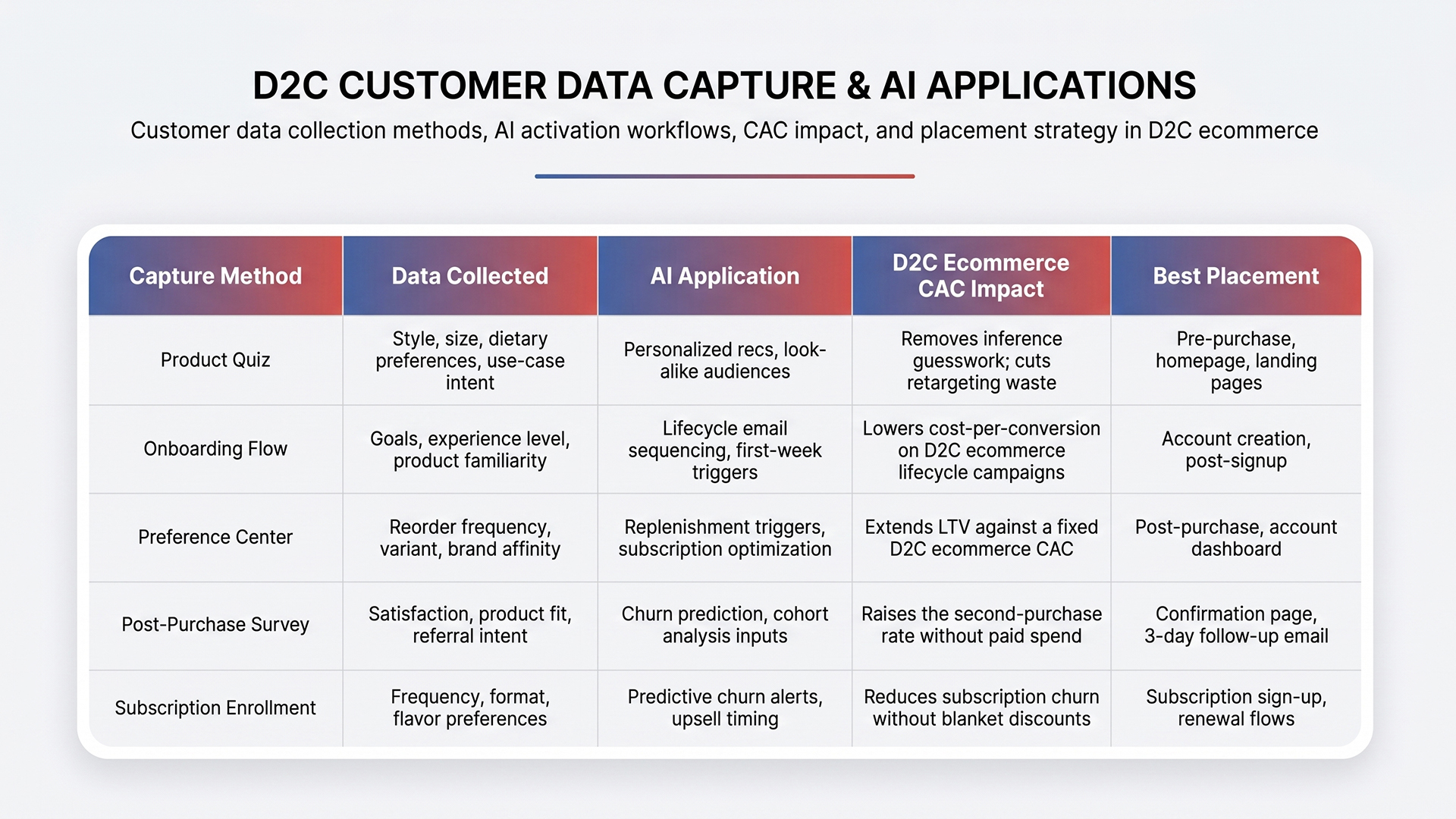
A product quiz replaces ad retargeting at a fraction of the spend and captures declared intent that no audience model can match. Placement matters: preference capture at account creation, post-purchase, and subscription ecommerce enrollment generates clean, consent-based segments that D2C ecommerce brands can feed into
AI personalization engines immediately. Brands using these flows report improved email click rates and meaningfully lower cost-per-conversion on lifecycle campaigns, because the inputs going into segmentation are accurate rather than inferred from passive browsing behavior.
Declared intent combined with behavioral signals produces significantly more accurate propensity models than either input alone. McKinsey’s research confirms personalization at scale delivers 5 to 15% revenue uplifts and 10 to 30% marketing efficiency gains.
D2C ecommerce brands implementing a zero-party data strategy across email, SMS, and on-site triggers report real-time AI-powered personalization delivering 20% higher conversion rates, with the top performers achieving 40% revenue increases and customer acquisition cost reduction of up to 50%. That 50% cost reduction is the payoff, not just better email open rates.
AI-powered discovery through ChatGPT, Perplexity, and Google SGE means D2C ecommerce brands now compete for visibility inside language models, shifting the top-of-funnel from keyword rankings to structured content citations inside agentic discovery tools.
Traffic to ecommerce sites driven by generative AI tools surged 4,700% year-over-year in 2025. Over 60% of Gen Z and Millennials say AI tools directly influence their shopping decisions, and product-related queries are among the fastest-growing categories across Perplexity and ChatGPT.
The structural implication for D2C ecommerce strategy is that discoverability is now split between two systems: traditional search and AI inference. The inputs required to win in each are fundamentally different, and most brands have only invested in one.
Answer Engine Optimization, built on schema markup, structured FAQs, and clear product specifications, determines which D2C ecommerce brands surface when AI tools answer shopping queries.
D2C ecommerce brands investing in AEO now build a compounding acquisition channel that drives consistent customer acquisition cost reduction over time, at a fraction of paid social CAC per visit.
The math on AEO versus paid acquisition is not close, and the gap between early movers and late adopters widens as AI discovery usage accelerates through 2027.
AI-driven email sequencing, replenishment triggers, and predictive churn alerts extend retention marketing reach without blanket promotional spend. Increasing retention by just 5% can lift profits by 25 to 95%, and a D2C ecommerce brand sitting at 28% second-purchase rates has significant headroom there.
Customers arriving via AI discovery channels have done more research before buying, so the post-acquisition experience must match that intelligence or churn spikes in the first 90 days.
Referral delivers $15 to $50 per customer across D2C ecommerce verticals, with referred customers carrying 16% higher LTV and a 4x referral rate, while community commerce compounds those gains quarterly without incremental media spend.
Community commerce, including Discord groups, ambassador programs, and brand challenges, creates an organic acquisition engine that grows without media spend. Influencer-generated content delivers roughly 30% lower cost per acquisition than brand-produced creative, per Impact.com’s 2026 data.
Referral programs fail when brands skip the LTV math on referred customers versus the incentive cost. The highest-converting mechanics in D2C ecommerce tie rewards to actions, such as first purchase or account creation, rather than time windows, and integrate directly with zero-party data strategy capture at sign-up.
A referral program that seeds the cohort analysis system while acquiring customers functions as a retention investment and an acquisition channel simultaneously, not a standalone tactic.
D2C ecommerce brands running Discord communities, WhatsApp groups, and private forums measurably reduce paid media dependency as trust in ad-based discovery declines.
Community participants generate UGC that outperforms brand creative in paid channels, directly closing the loop between owned community investment and paid social CAC efficiency.
Treating the community as a performance channel for D2C ecommerce, measured against blended CAC over 12 to 18 months rather than engagement metrics, consistently outperforms running it as a brand awareness exercise.
WebOsmotic audits the full acquisition-retention stack for D2C ecommerce brands: identifying where customer acquisition cost reduction is achievable, where zero-party data strategy is absent, and where AI-powered personalization can compress churn before it hits the LTV model.
Before recommending any channel mix change, WebOsmotic runs a CAC-to-LTV cohort analysis on actual customer data, so every decision is grounded in real unit economics rather than industry benchmarks.
With 1,000+ AI solutions delivered across ecommerce, healthcare, fintech, and logistics, and systems proven to cut over 80 staff hours per month for operational clients, their builds are production-ready from day one:
D2C ecommerce brands ready to stop bleeding on paid acquisition and start building a sustainable customer acquisition cost reduction infrastructure can start with a WebOsmotic CAC and retention audit.
Explore how WebOsmotic builds AI systems for D2C ecommerce.
The D2C ecommerce model still delivers 30 to 50% higher margins versus wholesale and direct ownership of customer data. But the acquisition-first playbook is broken, and D2C ecommerce brands still running it are funding platform growth on thinning margins.
Brands growing profitably in 2026 combine AI-driven discovery presence, zero-party data strategy, and community-backed referral to bring effective CAC down without cutting reach.
Advanced AI-powered personalization drives customer acquisition cost reduction of up to 50%. The execution gap, not the strategy gap, is what separates D2C ecommerce brands winning now from those still bleeding on paid.
Start with a WebOsmotic CAC audit before the next paid cycle. Book your audit here.
Zero-party data strategy means building on customer-declared preferences, including quiz answers, size inputs, and product affinities, rather than behavioral inference. As third-party cookies deprecate, this intentionally shared data replaces lost targeting precision, feeds directly into AI-powered personalization engines, and produces more accurate D2C ecommerce retention segments from the first interaction forward.
D2C ecommerce CAC has risen 222% over eight years, now averaging $68 to $84. Apple’s ATT, cookie deprecation, and ad auction inflation from Temu and Amazon destroyed the targeting economics that made paid social viable. Referral programs at $15 to $50 per customer deliver the most efficient customer acquisition cost reduction available right now. (Swell)
AI drives customer acquisition cost reduction for D2C ecommerce brands through three mechanisms: predictive segmentation that eliminates wasted spend on low-intent audiences, AEO visibility in AI discovery tools that build compounding organic reach, and retention marketing loops using replenishment triggers and predictive churn alerts that extend LTV against a fixed acquisition cost without incremental media spend.
A 3:1 LTV: CAC ratio is the minimum viable threshold for D2C ecommerce sustainability. Subscription ecommerce models amortizing acquisition cost across 18-month customer lifetimes can reach an effective monthly CAC of $17.67 or less. Cohort analysis by acquisition channel reveals that blended averages mask significant variation, with email-acquired D2C ecommerce customers often costing $12 versus $110 for paid social cohorts.
Referral programs deliver $15 to $50 per customer with 16% higher LTV. Email delivers 45:1 ROI in D2C ecommerce. AEO and organic search compound over time with declining marginal cost per customer, representing the most durable customer acquisition cost reduction available. Paid social CAC ranges from $20 to $175 or more, depending on the vertical, with no structural improvement expected in 2026.
Traffic from generative AI tools to D2C ecommerce sites surged 4,700% year-over-year in 2025. Brands investing in agentic discovery preparation, including schema markup, structured FAQs, and detailed product specs, are building a top-of-funnel acquisition channel that compounds without media spend. Buyers arriving via AI assistants have already compared alternatives, making post-acquisition retention marketing the critical determinant of whether that D2C ecommerce acquisition pays back.