SOC 2 Type I vs Type II: Pick the Wrong One, Lose the Deal
134 Views
Summarize Article



Summarize Article
Key takeaways
|
A procurement team at a mid-market financial services firm sends your team a security questionnaire. Buried in it, three items from the top, is a checkbox: SOC 2 Type II report required. Your company has a Type I. The deal stalls.
This scenario plays out across fintech, healthcare, logistics, and enterprise SaaS every week. The distinction between SOC 2 Type I and Type II is technical on paper and commercial in practice. Buyers who understand it use it as a filter. Vendors who misread it lose deals they should have won or, worse, rush into a Type I and spend the next twelve months explaining to prospects why it is not enough.
This post explains what each report covers, what the AICPA’s Trust Service Criteria require, how the audit timeline and cost differ between the two, and where audit-ready software changes the economics of the entire process.
| Building a product that needs to be SOC 2 ready? WebOsmotic engineers the security controls, access logs, and audit evidence infrastructure that SOC 2 auditors look for, so your team is not scrambling to retrofit compliance before a deal closes. |
SOC 2 stands for System and Organization Controls 2. It is a framework developed by the American Institute of Certified Public Accountants (AICPA) to evaluate how a service organisation manages and protects customer data. It is not a certification in the legal sense, but a third-party auditor’s attestation report, and that distinction matters when buyers are doing vendor due diligence.
The framework is built on five Trust Service Criteria. Security is the only one required in every SOC 2 engagement. The remaining four are scoped based on the nature of the services the organization provides and the commitments made to customers:
As EY notes, the AICPA has revised its Trust Service Criteria guidance over time to keep pace with evolving technology and regulatory requirements. Service organizations may need to update their controls and system descriptions to reflect the current criteria, particularly where AI, cloud, and third-party integrations have expanded their data surface since the original scope was defined.
The difference between SOC 2 Type I and Type II comes down to one dimension: time. Both reports use the same Trust Service Criteria. Both are conducted by an independent AICPA-accredited auditor. The auditor’s question, however, is fundamentally different in each case.
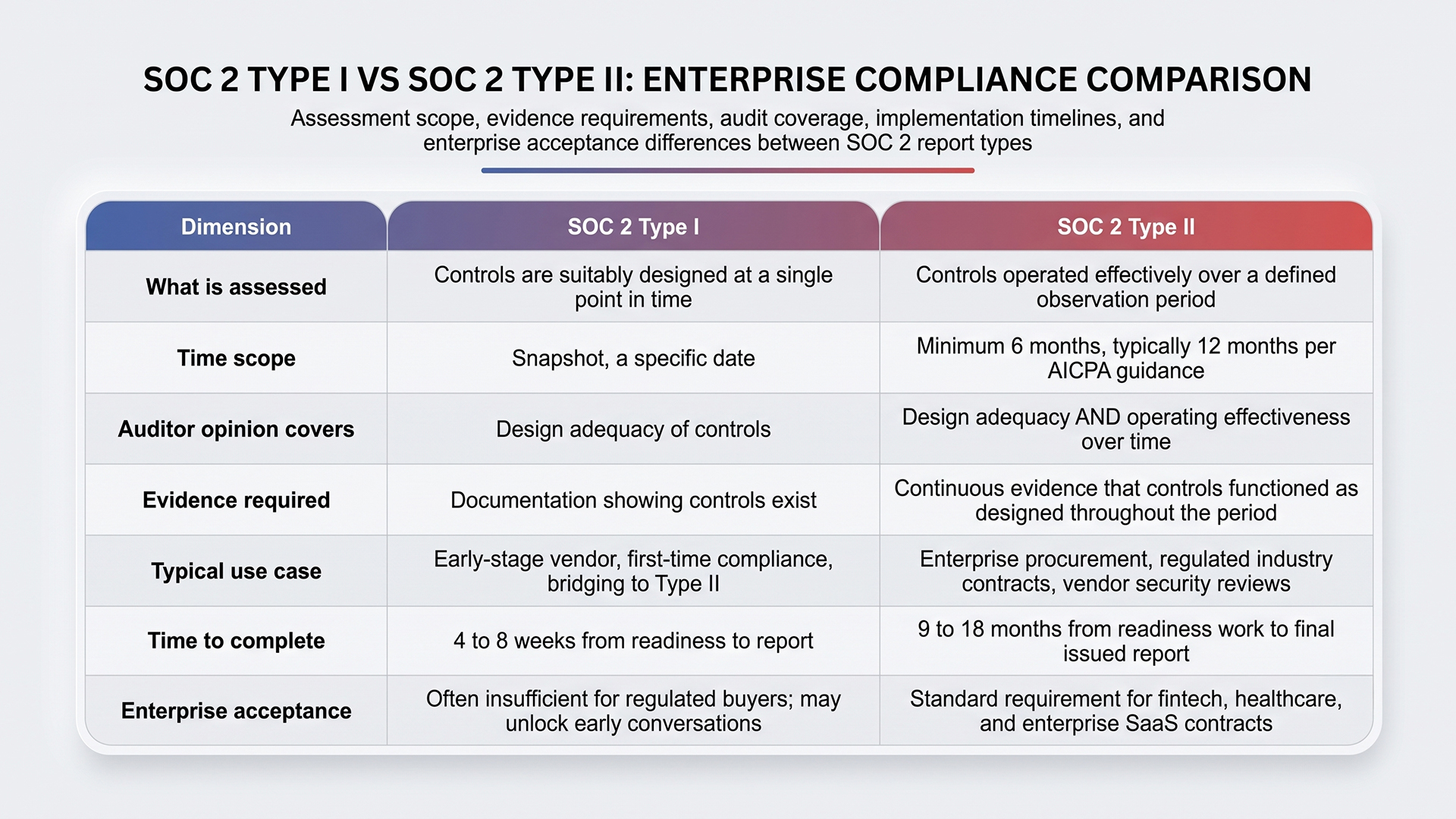
The practical consequence is straightforward. A Type I tells a buyer your controls are designed correctly today. A Type II tells them your controls worked consistently for the last year. Enterprise procurement teams, particularly in financial services and healthcare, are trained to ask for Type II because design adequacy without operating evidence is not a meaningful security assurance. As Microsoft documents in its own compliance framework, SOC 2 Type II audits examine a rolling 12-month observation window, and Microsoft commissions a Type I only for new services issued since the last Type II audit, treating Type I as a bridge rather than a destination.
One of the most common planning mistakes is underestimating the SOC 2 audit timeline, particularly for Type II. Teams assume they can start the process when a deal is in late stages. By that point, it is usually too late to do anything meaningful except send a roadmap letter to the buyer.
The implication for sales and product teams: if enterprise contracts are in the pipeline for the next 12 to 18 months, SOC 2 Type II readiness work needs to start today.
SOC 2 compliance cost is highly variable, determined by four factors: the scope of Trust Service Criteria included, the complexity of the technical environment, the amount of manual versus automated evidence collection, and the auditor firm selected.
The cost framing that matters most for commercial teams: IBM’s 2025 Cost of a Data Breach Report puts the global average data breach cost at USD 4.44 million. The cost of a SOC 2 Type II programme is a fraction of a single breach event, before accounting for the commercial cost of losing a deal to a compliant competitor.
| SOC 2 readiness starts in the codebase, not the compliance portal WebOsmotic builds the access controls, audit logging, and infrastructure controls that make SOC 2 evidence collection systematic rather than manual. We work with SaaS and fintech teams across the observation period, not just at audit time. |
Understanding which report enterprise buyers require, and what they look for inside it, is more commercially useful than knowing the technical definition of each type. Procurement and security review teams at mid-market and enterprise companies follow a reasonably consistent pattern.
For SaaS and technology vendors targeting financial services, healthcare, or any enterprise with a formal vendor risk management programme, the question is not whether to pursue SOC 2 Type II. It is how quickly the observation period can begin. WebOsmotic’s software development practice for clients in fintech and healthcare is specifically structured to embed the controls and logging architecture that makes Type II evidence collection systematic rather than a manual scramble at audit time.
The phrase audit-ready software describes a product and infrastructure design philosophy where compliance evidence is a byproduct of normal operations rather than a separate exercise that happens before the auditor arrives. For SOC 2, this distinction determines whether the observation period is manageable or punishing.
WebOsmotic’s engineering teams are experienced in building SaaS and fintech products for clients who enter regulated markets. Audit-ready architecture is embedded in the custom software development process from sprint one, not bolted on when a compliance deadline appears.
| Ready to build a product that passes SOC 2 without stopping to retrofit it? WebOsmotic works with SaaS founders, CTOs, and product engineering teams to build audit-ready infrastructure from day one. Whether you are starting a new product or preparing an existing one for Type II observation, we can help you get there faster. |
Can a SOC 2 Type I report be used to win enterprise deals?
It depends on the buyer. A Type I may unlock early-stage vendor conversations and pilot agreements, but most enterprise procurement teams in regulated industries require a Type II before contract signature. The safest commercial position is to treat Type I as a bridge that keeps conversations alive while the Type II observation period runs, not as a final destination. Buyers who accept Type I typically expect a committed Type II delivery date in writing.
What is the minimum observation period for a SOC 2 Type II audit?
The AICPA sets the minimum observation period at six months. Most enterprise buyers, and most auditors, recommend a 12-month period. A six-month report is technically valid but carries less weight with sophisticated procurement teams who view it as the minimum threshold rather than evidence of a mature security programme. Microsoft’s own annual SOC 2 Type II audits use a 12-month rolling window as the standard.
Which SOC 2 trust service criteria does a SaaS product actually need?
Security is required in every SOC 2 engagement without exception. Beyond that, the criteria you include should reflect the actual commitments in your customer contracts and the nature of the data your product handles. A product with uptime SLAs should include Availability. A platform processing financial transactions should include Processing Integrity. Any product handling personal data where privacy commitments are made should include Privacy. Scoping too narrowly relative to your actual data flows will generate follow-up questions from enterprise buyers during security review.
How does audit-ready software reduce SOC 2 compliance cost?
Audit-ready software reduces cost in two ways. First, it eliminates the gap remediation phase that typically adds months and significant spend before the observation period can begin. Controls, logging, and evidence collection are built into the product from the start rather than retrofitted. Second, it reduces auditor fieldwork hours because evidence is structured, systematically collected, and easy to produce on request. Manual evidence reconstruction is the single largest driver of internal labour cost in a SOC 2 Type II audit.
Does SOC 2 compliance need to be renewed annually?
Yes. A SOC 2 Type II report covers a defined observation period. Enterprise buyers expect a report issued within the last 12 months. When an observation period ends, a new one begins for the subsequent annual report. Continuous monitoring tools and automated evidence collection make annual renewal significantly less disruptive than the first audit, but the programme requires sustained operational commitment rather than a one-time compliance sprint.
What is the difference between SOC 2 and ISO 27001?
Both address information security management, but they are structured differently. SOC 2 is a third-party attestation report under the AICPA framework, primarily used in the US market and increasingly required by US-headquartered enterprise buyers globally. ISO 27001 is a certifiable international standard from the ISO and IEC, more commonly required in European and APAC markets. Many vendors pursuing global enterprise sales pursue both. The controls overlap substantially, meaning a well-structured security programme can produce evidence for both frameworks from the same operational practices.