LangChain vs LangGraph: Stop Using the Wrong One
179 Views
Summarize Article



Key takeaways
|
LangGraph vs LangChain is a question that persists specifically because LangChain became the de facto framework for building with LLMs in 2023, offering the easiest way to connect foundation models to data and APIs. Within 18 months, production teams began running into its limits: agents that could not reliably persist state across failures, workflows that needed human review at specific checkpoints, and orchestration patterns that required more control than LangChain’s abstractions allowed.
LangGraph was built to address those limits. It is a low-level orchestration runtime, not a higher-level framework. Harrison Chase, LangChain’s founder, documented the evolution directly: LangGraph was lower level and more flexible than the original LangChain. It included a runtime that supported durability and statefulness, which turned out to be important for human-agent and agent-agent collaboration. It addressed the control concerns that teams had raised about LangChain.
The confusion between the two persists because they share a company, share much of the documentation, and are often described interchangeably in tutorials that use them at prototype scale where the differences do not yet matter.
LangChain’s own official documentation defines the distinction directly: LangGraph is a low-level orchestration framework and runtime for building, managing, and deploying long-running stateful agents. LangChain is a higher-level agent framework. LangChain 1.0 is built on top of LangGraph. The two are not alternatives. They are different layers of the same stack.
LangChain’s State of AI Agent Engineering report, based on a survey of 1,340 respondents in late 2025, confirmed that a significant cluster of production agent builders are building on LangChain and LangGraph. Respondents described internal agents for QA testing, internal knowledge-base search, SQL query generation, demand planning, customer support, and workflow automation, reflecting the breadth of use cases the two frameworks cover between them.
| Building an AI agent and not sure whether LangChain or LangGraph is the right foundation? WebOsmotic’s engineering team evaluates agentic framework choices against your specific workflow complexity, state requirements, and production reliability needs. We have shipped production LangGraph and LangChain systems across fintech, eCommerce, logistics, and healthcare. |
LangChain is an agent framework. It provides standard abstractions for connecting LLMs to tools, knowledge bases, and APIs through a consistent interface. Its primary value is developer velocity: teams can build a working RAG pipeline, a tool-calling agent, or a structured generation workflow in a fraction of the time it would take to wire those components together from scratch.
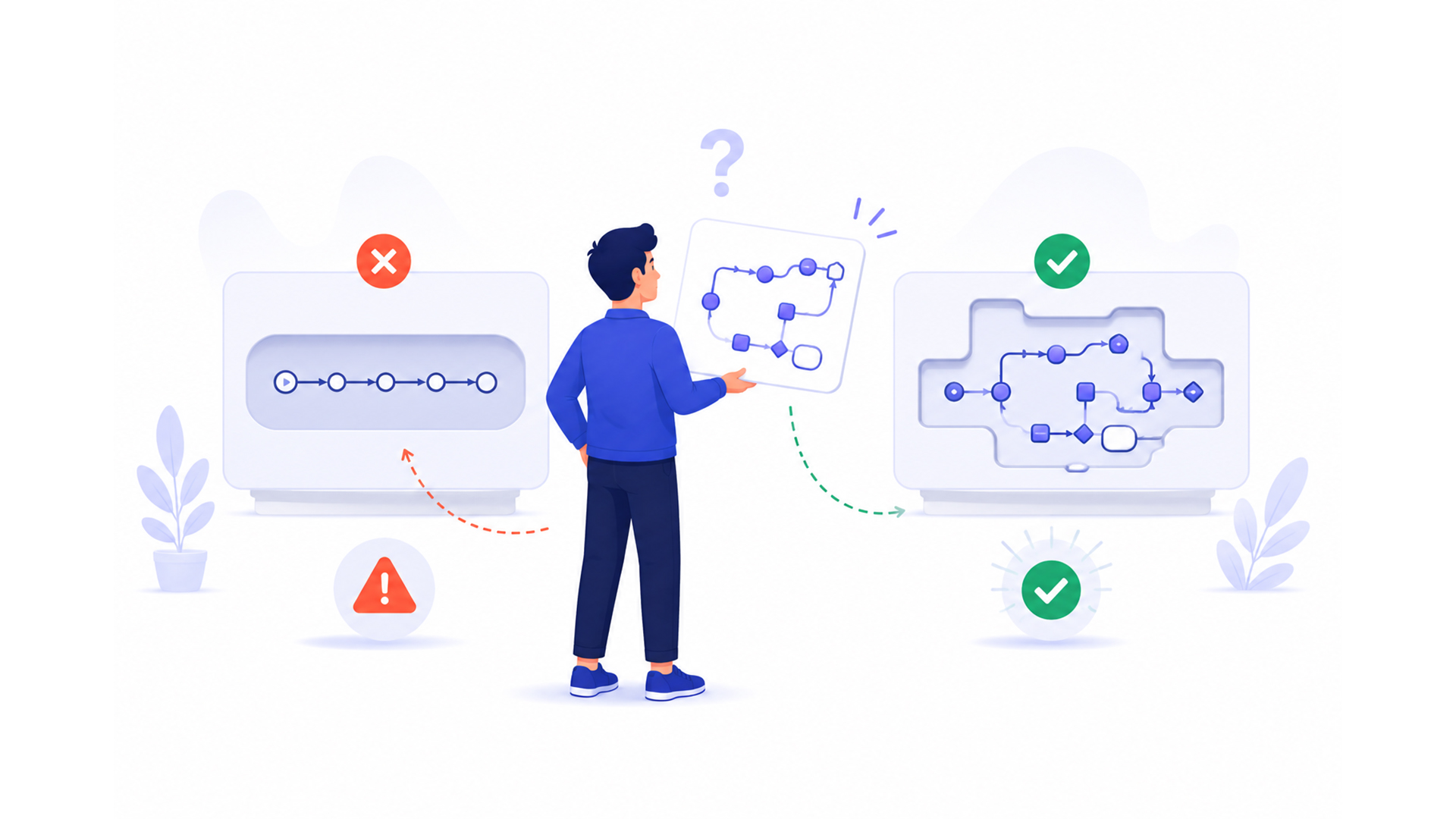
IBM’s LangGraph explainer describes it as a framework for building agent-based systems using a graph-based architecture, where AI agents act as nodes and their transitions are represented as edges. This allows for cyclical, conditional, and non-linear workflows that a sequential chain cannot represent. LangChain’s official documentation defines LangGraph as the low-level orchestration framework and runtime that LangChain itself is built on top of.
The choice between LangGraph and LangChain is not an either/or decision for most production systems. LangChain 1.0 is built on LangGraph. The question is whether you need to interact with LangGraph’s lower-level primitives directly or whether LangChain’s higher-level abstractions are sufficient for your use case.
| Requirement | Use LangChain | Use LangGraph directly |
| Workflow complexity | Straightforward, mostly linear agent or RAG pipeline | Complex, cyclical, or conditional workflows with branching logic |
| State persistence | Stateless or session-scoped memory is sufficient | State must persist across server restarts, failures, or long time periods |
| Human-in-the-loop | Not required or handled externally | Pause, inspect, and modify agent state as a first-class requirement |
| Multi-agent coordination | Single-agent workflows or simple handoffs | Agents modifying shared state, parallel execution, supervisor patterns |
| Development speed | Priority: get to production fast with standard components | Priority: precision and control over every step of agent behaviour |
| Production reliability | Standard retry logic is acceptable | Durable execution with guaranteed state recovery is required |
| Debugging | LangSmith observability is sufficient | Graph-level state inspection and step-by-step replay are required |
LangChain’s documentation states this directly: use LangGraph when you need fine-grained, low-level control over agent orchestration, durable execution for long-running stateful agents, and complex workflows combining deterministic and agentic steps. Use LangChain when you want to build agents quickly with standard abstractions and do not need complex orchestration.
LangChain has released LangGraph 1.0 and LangChain 1.0 as production-ready versions. LangGraph 1.0’s headline features are the production capabilities that were absent from LangChain’s original agent loop: durable state that survives server restarts, built-in persistence without custom database code, and human-in-the-loop patterns as a first-class API feature.
LangChain has also released Deep Agents, described as a batteries-included agent harness for complex, non-deterministic, long-running tasks. LangChain’s own guidance is explicit: use Deep Agents for complex autonomous tasks, use LangGraph when you need low-level control for stateful workflows, and use LangChain for standard agent loops without complex orchestration. These are three distinct tools for three distinct use cases on the same ecosystem.
LangGraph is not the only production-ready agentic framework. For teams making framework selection decisions, the relevant comparisons are:
WebOsmotic’s AI agent development practice selects between LangChain, LangGraph, the OpenAI Agents SDK, and CrewAI based on the workflow’s state requirements, production reliability needs, and the team’s existing familiarity with the ecosystem. The framework decision follows the architecture decision, not the other way around.
The choice between LangChain and LangGraph affects more than orchestration logic. It determines which production capabilities are available to your system by default and which require custom implementation.
| Ready to build a production AI agent on the right framework? WebOsmotic designs and builds LangGraph and LangChain agent systems for enterprise teams. We evaluate framework choice against your specific state, reliability, and workflow requirements before any code is written. We serve clients in fintech, eCommerce, logistics, and healthcare across India and the US. |
What is the difference between LangChain and LangGraph?
LangChain is a higher-level agent framework that provides standard abstractions for connecting LLMs to tools, knowledge bases, and APIs. LangGraph is a lower-level orchestration runtime that provides fine-grained control over agent state, durable execution, and complex conditional workflows. LangChain 1.0 is built on top of LangGraph. IBM describes LangGraph as more low-level and controllable than LangChain agents, providing centralized state management and enhanced observability. LangChain’s official documentation advises using LangGraph when you need durable execution for long-running stateful agents and complex workflows combining deterministic and agentic steps.
When should I use LangGraph instead of LangChain?
Use LangGraph directly when your workflow requires state that persists across server restarts or long time periods, human review or approval at specific points in the execution flow, multi-agent coordination where agents modify shared state, complex cyclical or conditional workflows, or step-by-step graph-level debugging in production. LangChain is sufficient for straightforward agent applications, standard RAG pipelines, and use cases where LangChain’s built-in abstractions cover all the required functionality without custom orchestration.
Is LangGraph better than LangChain?
They are not in competition. LangGraph is the infrastructure layer that LangChain runs on. Asking which is better is like asking whether a database engine is better than an ORM. For production AI agents with complex state and reliability requirements, LangGraph’s primitives are necessary. For faster development of standard agent applications, LangChain’s higher-level abstractions are more productive. LangChain’s own product guidance explicitly positions both for different use cases within the same ecosystem.
What is LangGraph’s durable state and why does it matter?
LangGraph’s durable state means your agent’s execution state persists automatically, so if a server restarts mid-conversation or a long-running workflow is interrupted, it resumes exactly where it left off without losing context or forcing users to start over. This is a production feature that LangChain’s original agent loop could not provide reliably. It is essential for workflows that run across multiple sessions, long-running background jobs, and any agent that needs to maintain context beyond a single conversation.
How does LangGraph compare to the OpenAI Agents SDK?
The OpenAI Agents SDK offers a lightweight, production-focused framework with three primitives: agents, handoffs, and guardrails. It prioritises simplicity and fast production deployment with strong built-in tracing. LangGraph offers more control: graph-based state management, durable execution, human-in-the-loop checkpoints, and the ability to build complex multi-agent coordination systems. The SDK is the right choice for teams wanting minimal abstraction overhead and simple handoff patterns. LangGraph is the right choice for workflows with complex state requirements or long-running agent tasks.
Does WebOsmotic build with LangGraph or LangChain?
WebOsmotic builds with both, selecting based on the specific requirements of the engagement. For straightforward RAG agents and tool-calling assistants where LangChain’s abstractions cover the full scope, we use LangChain. For multi-step workflows with state persistence requirements, human-in-the-loop checkpoints, or complex agent coordination patterns, we build on LangGraph directly. The framework selection is made at the architecture stage, before any code is written, based on a structured evaluation of state requirements, workflow complexity, and production reliability needs.