Ollama Production Deployment: When Local LLMs Actually Make Sense
264 Views
Summarize Article



Summarize Article
Key takeaways
|
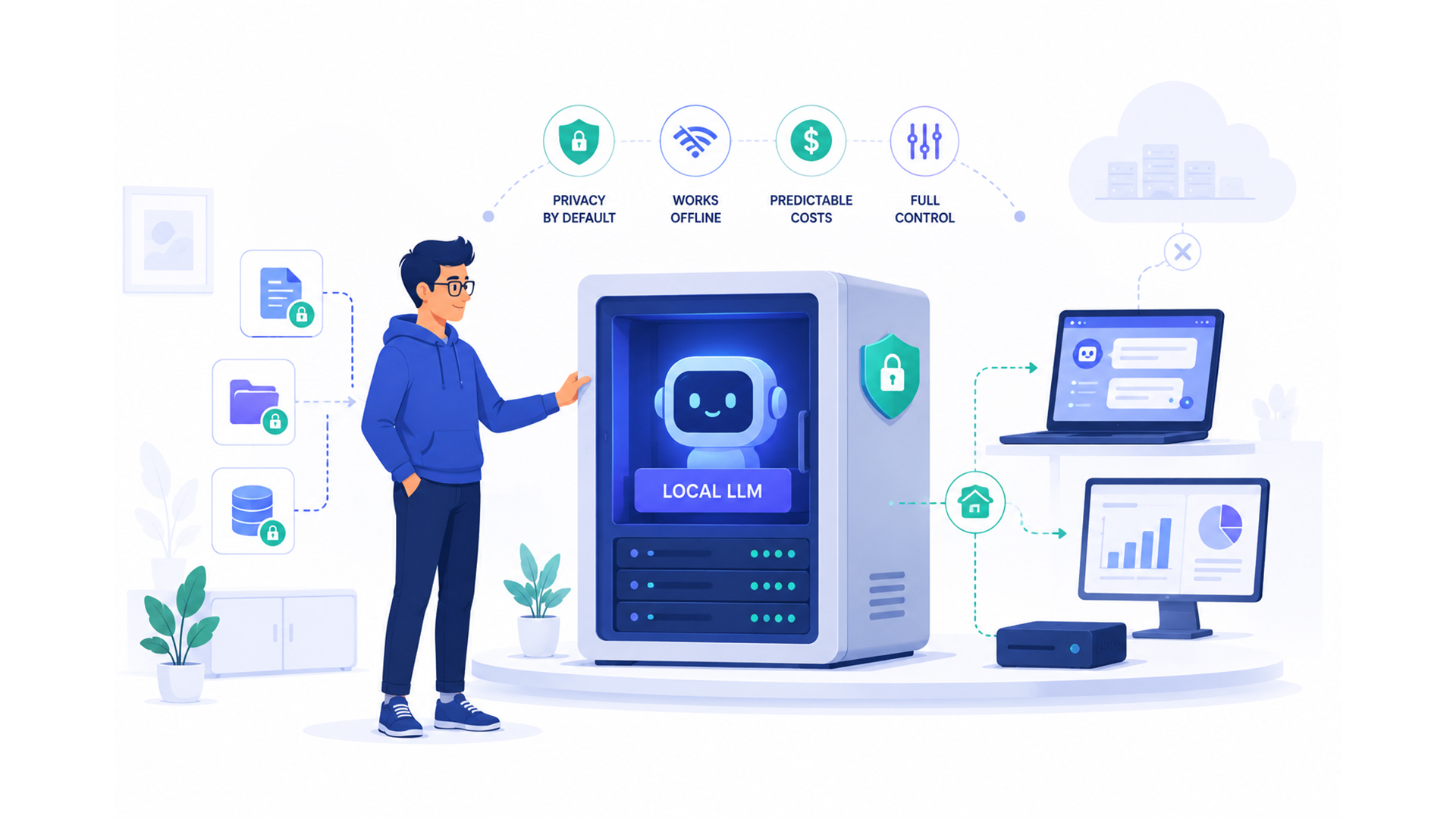
Ollama production deployment is almost never a capability decision. It is a control decision. An organization processing medical records, financial transactions, or legally privileged documents has requirements that a managed API, however performant, cannot satisfy: the data cannot leave the building, the model must be auditable, and the inference cost must be predictable regardless of usage volume.
Ollama makes the mechanics of local LLM deployment considerably simpler than they were two years ago. It wraps model downloading, quantization, serving, and an OpenAI-compatible API into a single binary that an engineer can have running in minutes. The question is not whether Ollama works on a laptop. It is whether the same architecture scales to production, survives concurrent load, integrates with enterprise authentication and compliance infrastructure, and performs adequately on the hardware your organization can actually provision.
IBM documents Ollama as particularly well-suited to tool calling architectures because it can access all the capabilities of a local environment, including data, programs, and custom software, without sending information to external servers. Microsoft’s .NET blog published a guide to running OpenAI’s open-weight GPT-OSS model with Ollama for building fast, private, and offline-capable AI features, confirming that Ollama is now part of the production integration stack at both major cloud vendors.
| Building a private AI system with local LLM requirements? WebOsmotic designs and deploys local LLM architectures with Ollama and enterprise alternatives for clients in healthcare, fintech, and logistics. We evaluate hardware requirements, compliance controls, and integration patterns at the architecture stage, before any infrastructure is provisioned. |
Ollama is an open-source platform that provides a command-line interface, a REST API with OpenAI-compatible endpoints, and a local model management system for running LLMs on personal devices and on-premise servers. It handles model download, quantization (converting models to GGUF format for efficient CPU/GPU inference), serving, and API access in a single lightweight process.
The conditions under which self-hosted local LLM deployment is the correct architecture are specific. Teams that evaluate Ollama as a cost-saving measure first, rather than a data sovereignty measure, often find the calculus reverses when they account for hardware, operations, and the falling price of managed APIs.
Gartner predicts that by 2030, performing inference on a 1-trillion-parameter LLM will cost providers over 90% less than it did in 2025. The managed API cost curve is falling rapidly. The cases where local deployment wins on economics are narrowing. The cases where it wins on sovereignty are not.
| Dimension | Ollama (local LLM) | OpenAI API (managed) |
| Data residency | All data stays within your infrastructure | Data sent to OpenAI’s servers. ZDR option available but data leaves the premises |
| Compliance posture | Full data sovereignty. Aligns with HIPAA on-prem requirements, GDPR data residency | BAA and ZDR available. Data handling governed by OpenAI’s terms |
| Hardware requirement | GPU with sufficient VRAM for the model size. A 70B model requires approximately 40GB VRAM | No hardware requirement. Inference runs on OpenAI’s infrastructure |
| Inference cost at volume | Fixed hardware cost amortised over usage. No per-token billing | Per-token billing. Batch API at 50% discount. Cost scales with usage |
| Model capability | Limited to open-weight models. Performance ceiling below GPT-5 on most benchmarks | Access to GPT-5, o-series reasoning, and the full OpenAI model family |
| Latency | Local inference: no network round-trip. P99 latency determined by hardware | Network round-trip adds 50-300ms. P99 latency depends on OpenAI infrastructure load |
| Operational burden | Full responsibility for model serving, updates, scaling, and failure recovery | Zero infrastructure management. OpenAI handles availability and performance |
| Model updates | Manual. Pull updated model versions. Re-evaluate after each update | Automatic. Model updates happen on OpenAI’s side, sometimes without notice |
| Multimodal capability | Varies by model. Llama 3.2 Vision, LLaVA support image input. Audio is limited | GPT-5 series: text, image, audio, video. Most complete multimodal support |
Ollama’s developer experience is excellent. Its production story has specific failure modes that teams encounter when moving from a single-machine deployment to a system handling concurrent users.
Both IBM and Microsoft have published production-grade guidance on Ollama integration that confirms its place in enterprise AI architectures.
WebOsmotic’s AI development practice for clients in healthcare and fintech evaluates Ollama alongside vLLM, managed cloud APIs, and hybrid architectures based on the compliance requirements, hardware constraints, and workload characteristics of each engagement.
| Evaluating local LLM deployment for a regulated industry or high-volume workload? WebOsmotic architects local LLM systems with Ollama and enterprise-grade alternatives for clients where data sovereignty, predictable cost, or air-gapped deployment are requirements. We scope hardware, compliance, and integration at the architecture stage. |
What is Ollama and how does it work?
IBM defines Ollama as a platform that offers open-source, local AI models for use on personal devices, enabling users to run LLMs directly on their computers without needing an account or sending data to external servers. It focuses on privacy, performance, and ease of use. Technically, it downloads open-weight models in GGUF quantised format, serves them via a local API on port 11434 with an OpenAI-compatible interface, and manages model lifecycle through a simple CLI. Applications written against the OpenAI client library can be redirected to Ollama with a single endpoint change.
When should I use Ollama instead of the OpenAI API?
Ollama is the right choice when data cannot leave your premises due to regulatory requirements, when you are operating in an air-gapped environment without internet access, when you need to serve a fine-tuned model trained on proprietary data, or when a predictable fixed infrastructure cost is more important than access to the latest frontier model capability. Gartner’s analysis of the LLM cost curve suggests that managed API pricing is falling rapidly toward 2030, which means cost alone is increasingly not a sufficient argument for self-hosted deployment. Data sovereignty and compliance requirements remain the strongest argument.
What are the hardware requirements for Ollama in production?
The hardware requirement depends entirely on the model size. A 7B model in 4-bit quantization requires approximately 4-6GB of VRAM or RAM. A 13B model requires approximately 8-10GB. A 70B model requires approximately 40GB of VRAM. Running on CPU is possible but typically 10-100x slower than GPU inference and unsuitable for latency-sensitive production workloads. Apple Silicon Macs, NVIDIA CUDA GPUs, and AMD GPUs are all supported. Microsoft documents that OpenAI’s 20B open-weight model runs on 16GB of RAM, making modern consumer hardware viable for smaller models.
Can Ollama handle concurrent production workloads?
Ollama processes one request at a time per loaded model instance by default. For concurrent users, requests queue behind the current inference. Teams running Ollama in production under concurrent load typically run multiple Ollama instances behind a load balancer, or migrate to a higher-throughput inference server like vLLM, which uses continuous batching to serve multiple requests simultaneously from a single GPU. Ollama is well-suited to single-user or low-concurrency deployments. High-concurrency production workloads require additional infrastructure.
Is Ollama suitable for HIPAA or GDPR-compliant deployments?
Self-hosted Ollama can be part of a HIPAA or GDPR-compliant architecture because all data stays within your infrastructure and no information is sent to external servers. However, Ollama itself does not provide authentication, encryption at rest, audit logging, or access controls. These must be added at the infrastructure layer: TLS termination for API traffic, network-level access controls, encrypted storage for model weights and inference logs, and IAM integration for who can invoke the API. IBM’s guidance on local AI deployment specifically frames Ollama as an answer to enterprise data privacy and compliance challenges, but the compliance controls are built around Ollama, not inside it.
How does WebOsmotic use Ollama in client projects?
WebOsmotic evaluates Ollama as part of the architecture decision for clients with data sovereignty requirements, air-gapped environments, or high-volume predictable workloads where self-hosted economics justify the operational investment. For clients in healthcare and fintech where data must remain on-premises, we design the full local LLM stack: hardware sizing, Ollama or vLLM for inference, RAG pipeline integration, authentication and access controls, monitoring, and model lifecycle management. For clients without hard data residency requirements, we typically recommend managed API paths that provide better capability and lower operational overhead.