Generative AI for eCommerce: Beyond Product Descriptions
177 Views
Summarize Article



Summarize Article
Key takeaways
|
Product description automation was the first wave. It is largely solved, widely deployed, and no longer a competitive differentiator. The generative AI ecommerce teams who implemented it in 2023 are not seeing it as an advantage in 2025, because their competitors implemented it too.
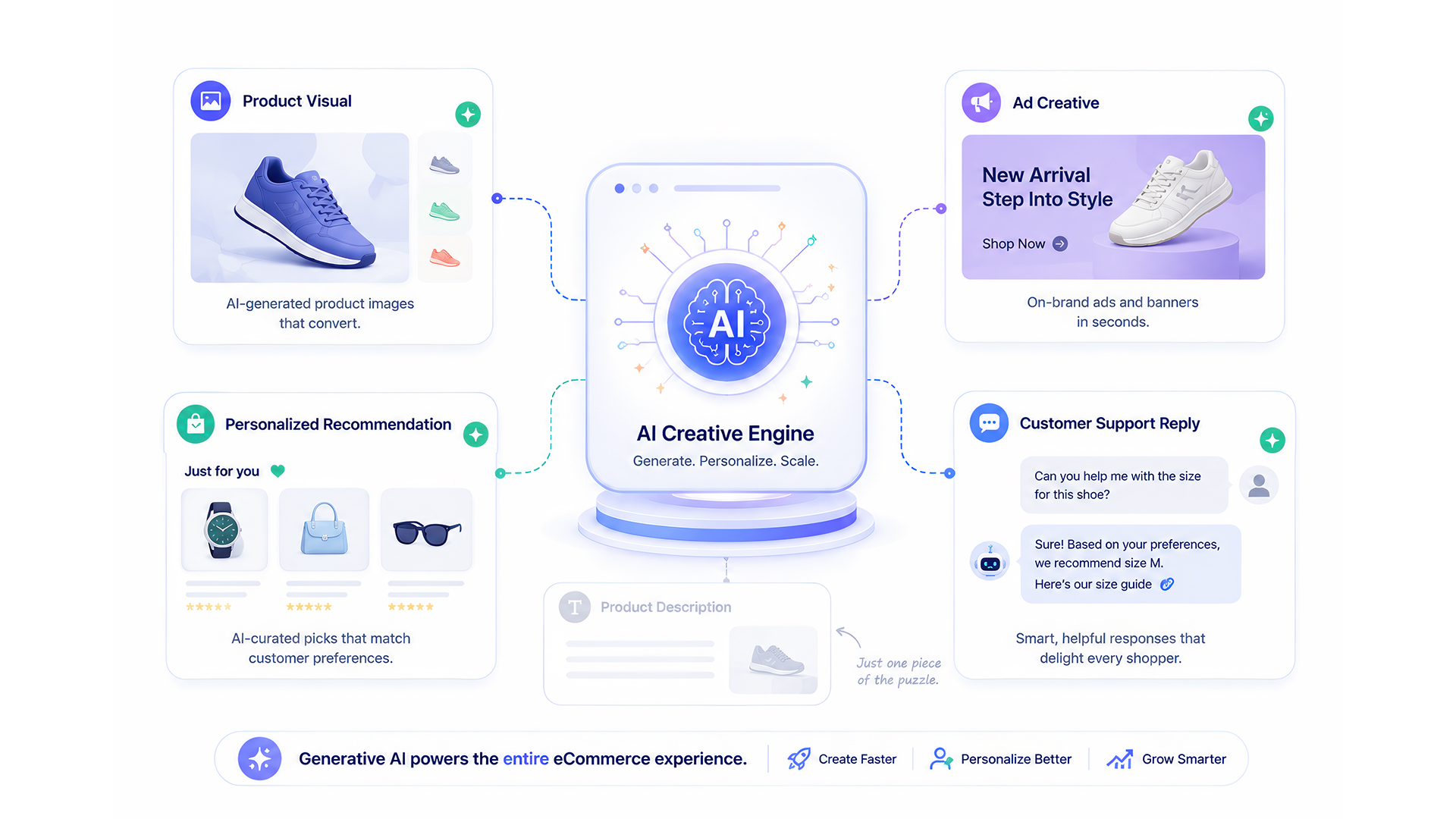
The generative AI investments that are producing measurable revenue impact are happening in the layers underneath the content: personalization at the individual session level, conversational search that replaces keyword matching, recommendations that reason about intent rather than recency, and post-purchase agents that reduce support cost while increasing lifetime value.
The IBM Institute for Business Value’s 2026 study, published in collaboration with the NRF, found that 45% of consumers now turn to AI for help during their buying journeys. Generative AI is reshaping the first steps of the shopping experience before a customer ever arrives at a brand’s website. The competitive surface has moved upstream, and the brands that are winning are the ones that show up in the AI-mediated research phase, not just the search engine results page.
The global AI in retail market was valued at USD 11.61 billion in 2024 and is projected to reach USD 40.74 billion by 2030. This post maps the generative AI use cases that are past the pilot stage and producing commercial results, explains the technical architecture behind each, and positions where WebOsmotic’s clients in D2C and eCommerce are deploying them.
| Building generative AI for an eCommerce or D2C brand? WebOsmotic designs and builds AI personalization engines, conversational search, product recommendation systems, and post-purchase agent workflows for eCommerce teams. We scope the architecture and ROI case before development begins. |
Traditional eCommerce personalization worked at the segment level: customers who bought X also bought Y. Generative AI enables personalization at the individual session level, reasoning about the specific combination of browser history, purchase intent signals, time of day, device type, and expressed preferences to generate a response unique to that session.
IBM documents that generative AI enables dynamic customer segmentation and profiling, activating personalized product recommendations, product bundles, and upsells that adapt to individual customer behaviour. The IBM IBV research found that three in five consumers would like to use AI applications as they shop, and that AI personalization has become prevalent enough that customers now expect tailored experiences rather than treating them as a premium.
McKinsey’s 2025 personalization research frames the shift: generative AI allows marketers to develop personalized content at scale at lower cost, but notes that most teams are piloting gen AI programs manually with one-off tools rather than automating or integrating to reduce operational bottlenecks. The teams outperforming are the ones that have moved from experimentation to systematic, automated personalization pipelines.
Search is the highest-intent moment in an eCommerce session. A customer who types something into the search bar is expressing a purchase intent. The quality of the results they receive determines whether they buy or leave.
Keyword-based search has a fundamental limitation: it matches tokens, not intent. A customer searching for ‘comfortable running shoes for flat feet’ will get every product with those words in the title or description, regardless of relevance. A customer searching for ‘something to wear to a casual outdoor wedding in July’ will get nothing, because no product is tagged that way.
The shift from collaborative filtering to generative AI in product recommendations changes both what can be recommended and why. Collaborative filtering recommends products because similar customers bought them. Generative AI recommendations can incorporate browsing context, semantic similarity, inventory constraints, margin targets, and explicit customer preferences expressed in natural language.
| Recommendation type | Traditional AI approach | Generative AI approach | Commercial advantage |
| Product-to-product | Customers who bought X bought Y | Semantic similarity between product embeddings plus session context and intent | Handles catalogue gaps and long-tail products with no purchase history |
| Cart recommendations | Rules-based: frequently bought together | Dynamic bundle generation reasoning over cart contents, product attributes, and customer history | Bundle copy explains the value; conversion rates higher than generic ‘others also bought’ |
| Personalized email | Static segmentation-based product blocks | Individually generated product grids based on each recipient’s recent behaviour | Higher CTR from relevance; no manual merchandising overhead |
| Post-purchase | None, or static cross-sell email | Agent-driven personalized replenishment and upsell based on purchase pattern and product lifecycle | Increases repeat purchase rate; reduces customer service load |
First-generation eCommerce chatbots were FAQ machines. They deflected tickets about order status and return policies, which reduced support cost but contributed nothing to revenue. Generative AI changes the chatbot’s role from cost centre to sales agent.
The post-purchase phase is where most eCommerce AI investment stops. It should not be. The customer has already identified their category preference, purchase cadence, and price point. The cost of acquiring their next purchase is near zero compared to the cost of acquiring them in the first place.
WebOsmotic builds the full generative AI stack for eCommerce and D2C clients, from personalization and search through to post-purchase agents. The AI development services are scoped around commercial outcomes: which AI investment produces measurable revenue impact at what cost, and in what sequence.
| Ready to move your eCommerce AI strategy past product description automation? WebOsmotic builds AI personalization engines, conversational search, product recommendation systems, and post-purchase agents for D2C and eCommerce brands. We work with teams across India and the US to scope and deliver production AI that generates measurable commercial impact. |
What is the most commercially valuable generative AI use case in eCommerce?
IBM’s research and McKinsey’s personalization analysis both point to AI-powered personalization as the highest-value use case, specifically because it operates at the individual session level rather than the segment level. IBM documents that generative AI activates dynamic customer segmentation and profiling, enabling personalized product bundles and upsells that adapt to individual behaviour and result in higher engagement and conversion. McKinsey frames the commercial advantage as the ability to develop personalized content at scale at lower cost, and identifies operational automation of personalization pipelines as the differentiator between teams that see revenue impact and teams that see pilot results only.
How does AI search in eCommerce differ from standard keyword search?
Standard keyword search matches query tokens against product title and description tokens. AI-powered semantic search converts queries and product data into vector embeddings and finds products by conceptual similarity, not word overlap. This means a query like ‘comfortable indoor shoes for someone who stands all day’ returns relevant results even if no product uses those exact words. Conversational search extends this further, allowing customers to refine queries through dialogue. IBM documents this as part of the broader shift where AI enables more natural interaction with data and workflows, which applies directly to product discovery in eCommerce.
What does a D2C brand need in place before deploying AI personalization?
Three foundational elements: a product catalogue with rich, structured attribute data for each product; a customer data layer that captures browse, purchase, and preference signals with sufficient volume to generate meaningful patterns; and a deployment architecture that can serve personalized responses at catalogue scale with acceptable latency. McKinsey’s personalization research notes that most teams are currently piloting gen AI manually with one-off tools, and the teams generating sustained commercial advantage are the ones that have moved from experimentation to integrated, automated personalization pipelines. The data infrastructure and the integration architecture are typically the constraints, not the AI capability itself.
What should eCommerce teams think about AI chatbot ROI?
First-generation chatbots are measured on cost deflection: how many support tickets were avoided. Generative AI chatbots should also be measured on revenue contribution: how many product-finder conversations resulted in a purchase, how often pre-purchase objection handling prevented an abandonment, and what the average order value is for sessions that included a chatbot interaction versus those that did not. IBM documents that AI chatbots can save costs by decreasing operational costs on customer service, fraud prevention, and clerical tasks, but the revenue contribution from AI-assisted conversions is often the larger number and is undertracked by teams that inherited their chatbot metrics from the FAQ-deflection era.
What AI eCommerce capabilities should a D2C brand prioritise first?
The sequence that generates the fastest commercial payback is: AI search first, because it improves the highest-intent moment in the session; then session-level recommendations, because they operate in the same session as search; then post-purchase replenishment and personalized outreach, because they leverage the customer data your brand has already paid to collect. Product description automation, content generation, and chatbot deployment are all valuable but typically generate ROI over a longer horizon and depend on the foundation that AI search and recommendations provide.
How does WebOsmotic build AI for eCommerce clients?
WebOsmotic scopes AI eCommerce engagements around commercial outcomes: identifying which use cases, given the client’s specific data assets, catalogue, and customer volume, will produce measurable revenue impact at what investment level. We build the underlying AI infrastructure, personalization logic, search integration, and recommendation architecture, and we include evaluation and monitoring in every production deployment so that the client can measure what the AI is contributing to revenue, not just what it is automating.