SOC 2 Readiness in 90 Days: What Actually Moves the Needle
170 Views
Summarize Article



Summarize Article
A SOC 2 readiness assessment is the exercise most SaaS teams underestimate twice: first when they estimate how long it takes, and second when they estimate what the hardest part is. The most common assumption is that readiness is primarily a documentation exercise, writing policies, filling out questionnaires, and organizing existing records.
That assumption is why readiness programs stall at week six of a ninety-day plan and audits return qualified findings on controls that the team believed were in place.
The items that determine whether a SOC 2 audit passes or fails are not missing policy documents. They are technical controls: access control systems with documented review processes, logging infrastructure that captures the specific events the auditor needs to sample.
Also critical: incident response procedures that have been tested under conditions that resemble actual incidents, and vendor management documentation that covers the sub-processors who handle customer data. A thorough SOC 2 readiness assessment surfaces every one of these before the auditor does.
This guide maps the ninety-day sequence a SOC 2 readiness assessment should follow, which criteria generate the most findings, and which architectural decisions determine whether SOC 2 readiness is sustainable.
Building a SaaS product that needs to reach SOC 2 readiness before a deal closes?
WebOsmotic builds the access controls, audit logging, and security infrastructure that SOC 2 auditors look for, embedded in the software architecture from day one. We work with SaaS and fintech teams on compliance architecture and SOC 2 readiness prep.
SOC 2 is governed by the AICPA’s Trust Services Criteria. The Security criterion is required in every engagement. Every other criterion, Availability, Processing Integrity, Confidentiality, and Privacy, is optional and should be included if the organization makes commitments to customers in those areas.
The Security criterion contains the Common Criteria, which are the controls that all other categories incorporate. Microsoft’s Azure SOC 2 attestation is based on the AICPA Trust Services Principles and Criteria, including security, availability, confidentiality, and processing integrity. Microsoft’s own annual audits demonstrate what enterprise-grade compliance looks like at scale.
| Criterion | What Auditors Test | Most Common Gap |
| Security (required) | Logical access controls, physical security, change management, risk assessment, monitoring, incident response, system operations, and vendor management | Access reviews not conducted on a documented cadence; access provisioning and deprovisioning not logged; incident response plan exists but has never been exercised |
| Availability | Uptime monitoring, disaster recovery planning, backup and restore testing, capacity management | Backup restore procedures documented but never tested; RTO/RPO targets not specified in customer agreements; monitoring coverage gaps for non-production systems used in data processing |
| Processing Integrity | Completeness and accuracy of data processing, error detection, output validation | Processing pipelines lack end-to-end logging that allows auditors to verify data completeness and accuracy across the full workflow |
| Confidentiality | Identification of confidential data, encryption in transit and at rest, retention and disposal procedures | Data classification without enforcement: data marked confidential but transmitted or stored without encryption in practice |
| Privacy | Collection, use, retention, disclosure, and disposal of personal information | Privacy notices do not accurately reflect actual data processing; retention policies exist but disposal is not executed on schedule |
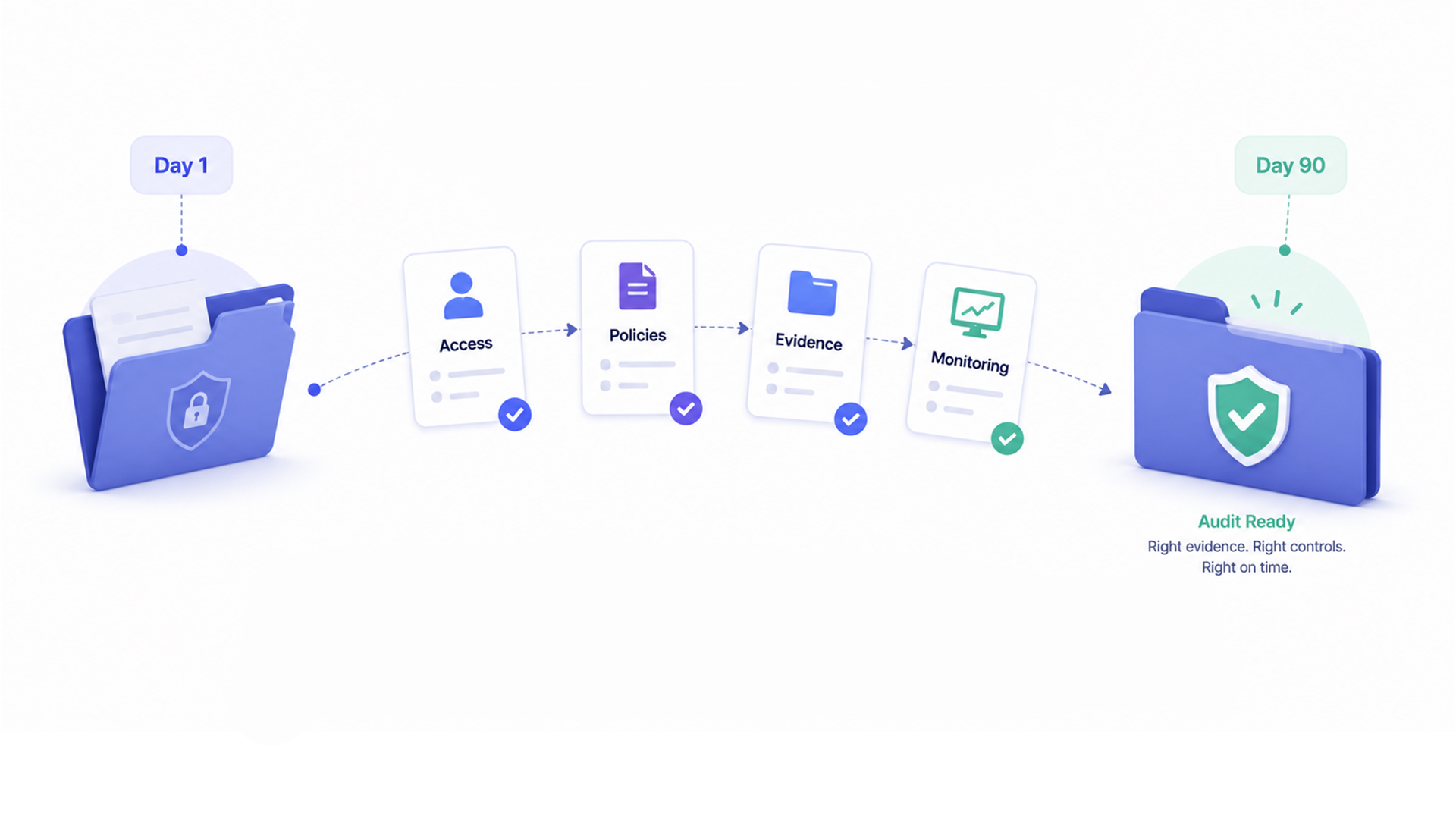
The ninety-day sequence below is designed to produce audit-ready controls for a Security-scoped SOC 2 Type I for a SaaS company with an existing engineering team and a modern cloud infrastructure. Extending scope to Availability or Confidentiality adds work within each phase but does not change the sequencing logic.
This final phase consolidates the evidence generated in the first two phases into the format an auditor can review efficiently, and closes any remaining gaps a SOC 2 readiness assessment surfaced earlier in the process.
The cost of maintaining SOC 2 compliance over time is primarily driven by the cost of continuous evidence collection: access reviews, logging verification, vendor assessments, and policy acknowledgments that must be performed and documented on a regular basis. Compliance automation platforms reduce this cost by automating the collection of evidence from connected systems.
Understanding where audit findings are most likely to occur allows teams to prioritize those controls during the readiness period rather than discovering gaps during fieldwork, which is exactly the value a SOC 2 readiness assessment is supposed to deliver.
WebOsmotic’s compliance-focused development practice for clients in fintech and healthcare builds the logging infrastructure, access control architecture, and audit evidence trail into software from the start of development, visible across our case studies. Teams that build these controls in from day one avoid the most expensive part of any SOC 2 readiness assessment: retrofitting compliant infrastructure onto an existing system that was not designed for it.
Ready to start your SOC 2 readiness program with the right technical foundation?
WebOsmotic builds SOC 2-ready software for SaaS and fintech teams. Whether you are starting a new product that needs to reach SOC 2 Type II within 18 months or preparing an existing product for audit, we can help you design the architecture and implement the controls that pass.
→ Get your compliance architecture review
A SOC 2 readiness assessment is a pre-audit exercise that maps an organization’s current controls against the AICPA Trust Services Criteria and produces a prioritized gap list. It functions as a practice run before the actual audit.
Organizations that skip the readiness assessment and proceed directly to a Type II audit frequently encounter gaps during auditor fieldwork that generate qualified findings, delay the report, or require remediation before the audit can conclude. The cost of a readiness engagement, typically $15,000 to $50,000 for a mid-sized SaaS company, is substantially lower than the cost of remediating gaps discovered during an active audit.
A SOC 2 Type I audit assesses whether controls are suitably designed at a single point in time. With a completed readiness assessment and organized evidence, Type I fieldwork typically takes two to four weeks, and the report is issued a few weeks after that.
SOC 2 Type II requires a minimum observation period during which evidence of control effectiveness must accumulate continuously. Microsoft’s SOC 2 compliance documentation confirms that reports are issued a few weeks after the end of the observation period. A full SOC 2 Type II program, from starting readiness to holding a 12-month observation period report, typically takes 14 to 18 months.
The most common audit finding categories are: access reviews without a documented and repeatable cadence; logging infrastructure that does not capture the privileged activity and data access events auditors need to sample.
Also common: incident response plans that exist but have never been exercised; and sub-processor vendor management documentation that lacks formal security assessments for third-party services processing customer data. Policy documentation gaps are less frequently the cause of audit failures than these technical and operational control gaps.
Compliance automation platforms including Vanta, Drata, and Secureframe integrate with cloud infrastructure, identity providers, code repositories, and HR systems to continuously collect evidence against SOC 2 controls. This replaces manual evidence collection processes that require team members to export logs, conduct access reviews, and document vendor assessments on a scheduled basis.
Automation reduces the labor cost of annual Type II renewals substantially, generates alerts when controls drift out of compliance, and organizes evidence in a format that auditors can review efficiently.
SOC 2 Type I readiness, the state in which controls are suitably designed and evidence is organized for a point-in-time audit, can be achieved in 90 days for a SaaS company with modern cloud infrastructure and an engineering team that can implement the required access controls and logging.
SOC 2 Type II readiness requires the 90-day control implementation phase plus a minimum observation period during which continuous evidence accumulates. The 90-day goal is realistic for Type I and for establishing the foundation that makes the Type II observation period productive.
WebOsmotic approaches SOC 2 compliance as an architecture decision rather than a retroactive audit exercise. For new products, we embed the access controls, logging infrastructure, and audit evidence trail into the software design from the first sprint.
For existing products preparing for audit, we conduct a technical gap analysis, design the remediation architecture, and implement the controls that most commonly generate audit findings. We work with SaaS, fintech, and healthcare technology clients and treat every SOC 2 readiness assessment engagement as a first-class deliverable.