AI Agent Development Cost: What Blows the Budget in 2026
197 Views
Summarize Article



Summarize Article
AI agent development cost gets misjudged before a single line of code gets written, because most teams start by asking how much the LLM API will cost. That is the wrong starting question, and it is the question behind most bad estimates of the cost to build an AI agent.
Token pricing for the underlying model is typically one of the smaller pieces of AI agent development cost in a production system, and it is also the piece most likely to shrink over time. Gartner predicts LLM inference costs will fall over 90% by 2030.
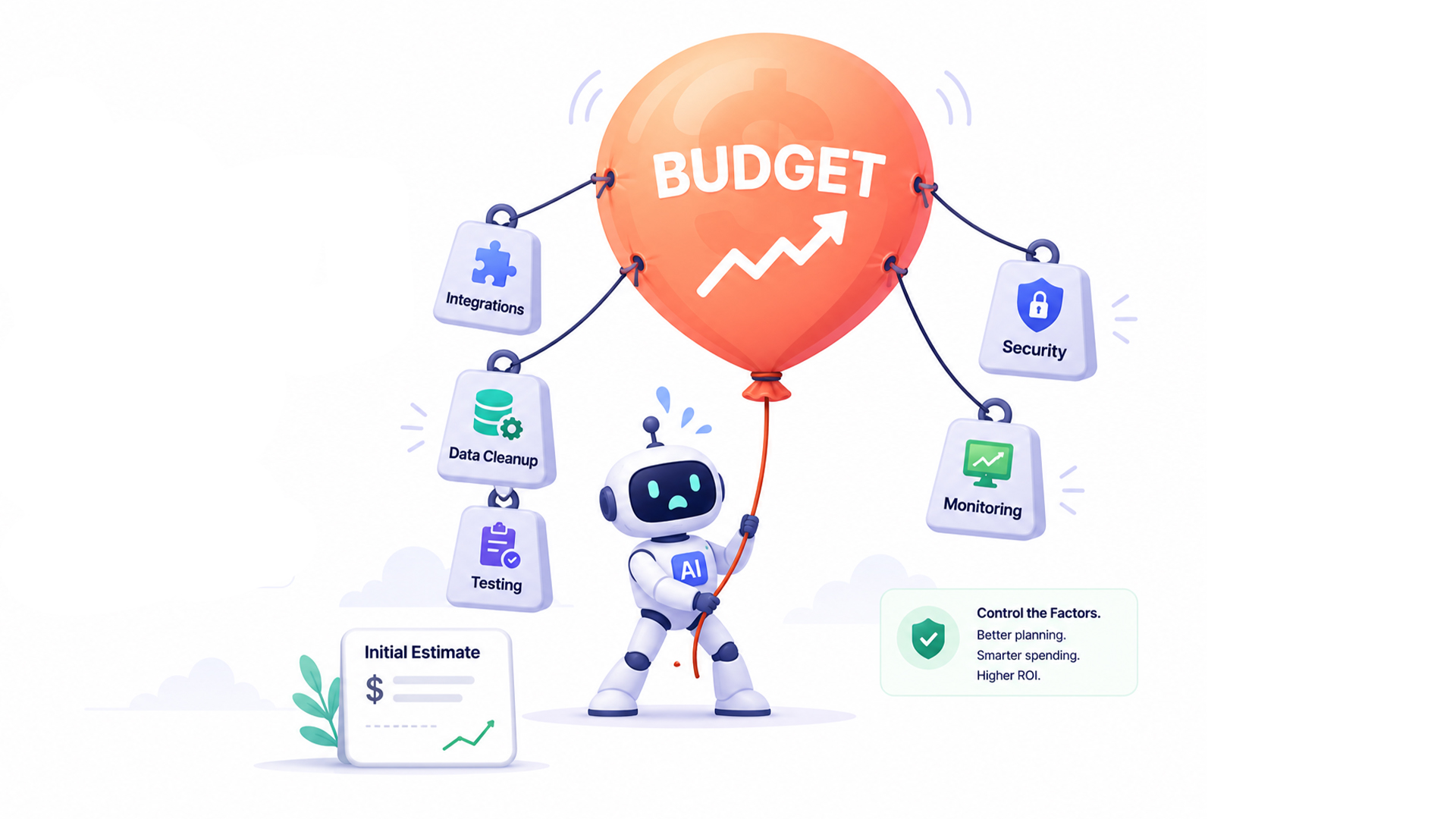
The pieces that actually drive AI agent development cost are integration complexity, evaluation infrastructure, the gap between demo and production, compliance architecture in regulated industries, and the ongoing operational cost of keeping an agent working as the model, the connected systems, and the business requirements all change.
Gartner’s research on LLM-based AI agent costs is direct: organizations anchoring on token prices systematically underestimate the composite AI agent development cost. This guide maps where AI agent budgets actually go, what drives each cost component, and how to scope realistically before any commitment is made.
| Scoping an AI agent development project and need a realistic cost breakdown? WebOsmotic provides component-level cost estimates for AI agent development before any development commitment. We evaluate model costs, integration scope, evaluation infrastructure, compliance requirements, and ongoing operational costs for fintech, healthcare, eCommerce, and logistics clients. |
The table below breaks down each cost component of AI agent development cost and what pushes it toward the top of its range.
A production AI agent has six cost categories that need scoping before the project begins. Understanding each category, and what pushes it to the upper or lower end of its range, prevents the budget surprise that hits teams who scope only the LLM API cost and discover the real AI agent development cost six weeks into the build. This is also where most AI agent pricing quotes from vendors fall apart under scrutiny.
| Cost component | What it includes | What drives it to the upper end |
|---|---|---|
| LLM API inference | Token cost per query (input and output tokens). Scales with query volume, prompt length, and model tier selection | Long system prompts, large RAG contexts, multi-step agentic chains that make multiple LLM calls per request, and using a frontier model for every task instead of routing simple tasks to cheaper models |
| Integration engineering | Connecting the agent to data sources, APIs, internal tools, and external services it needs to take actions | Number of integrations; age and accessibility of the systems being integrated; authentication and authorization complexity; legacy system protocol translation |
| RAG and vector infrastructure | Embedding pipeline, vector database hosting, document processing, chunking strategy, and retrieval evaluation | Size and update frequency of the knowledge base; number of document types; accuracy requirements for retrieval; compliance constraints on where vector embeddings can be stored |
| Evaluation and testing | LLM-as-a-judge evaluation framework, test dataset construction, red-team exercises, regression testing after model updates | Regulated industry requirements for documented evaluation; high-stakes decision workflows requiring accuracy guarantees; agentic chains where evaluation must test multi-step behavior |
| Compliance architecture | BAA agreements, audit logging, encryption, access controls, minimum necessary data handling, and regulatory documentation | Healthcare (HIPAA), financial services, or other regulated industries where compliance is a hard requirement rather than a best practice |
| Ongoing operations | Model monitoring, prompt drift detection, retraining or re-evaluation cycles, integration maintenance as upstream APIs change, and user feedback processing | Number of connected integrations; pace of change in upstream systems; regulatory requirement for periodic re-evaluation; production query volume driving monitoring infrastructure cost |
The most consistent source of AI agent development cost overruns is the gap between a working demo and a production-grade system. This is the single biggest variable in any custom AI agent budget. A demo runs on clean, representative inputs with a single user and no concurrent load.
Production handles edge cases, ambiguous inputs, system failures, concurrent sessions, and users who interact with the agent in ways the development team did not anticipate. Each of those adds to the real AI agent development cost that a demo never surfaces.
Gartner’s guidance on the implication is direct: routine, high-frequency tasks must route to more efficient small and domain-specific models, which perform better than generic solutions at a fraction of the cost when matched to specialized workflows.
Expensive frontier model inference must be gated and reserved for high-margin, complex reasoning tasks. Teams that use frontier models for every agent task, regardless of complexity, leave cost optimization on the table and mask architectural inefficiencies with cheap tokens. Those inefficiencies raise total AI agent development cost sharply once token prices stop falling.
The ranges below reflect real-world production AI agent development cost across WebOsmotic engagements and the broader market for custom AI development. Vendors quote LLM agent cost in wildly different ways, so treat any AI development pricing sheet that skips these ranges with caution. These are build costs; ongoing operational costs are additional.
Ongoing costs, including LLM API fees, vector database hosting, monitoring infrastructure, and the engineering time for periodic re-evaluation and maintenance, typically add 20-40% of the initial AI agent development cost annually. This ongoing share of AI agent development cost is easy to leave out of an initial quote. McKinsey’s infrastructure research projects a two- to threefold increase in IT infrastructure costs by 2030 driven by agentic AI workloads, confirming that the operational side of AI agent development cost grows with deployment scale.
WebOsmotic scopes AI agent development cost at the architecture stage for every engagement, producing a component-level breakdown that covers LLM API costs, integration engineering, evaluation infrastructure, compliance architecture, and ongoing operational estimates. For clients in fintech, healthcare, eCommerce, and logistics, the compliance architecture cost is scoped and documented before any development begins.
| Ready to scope your AI agent development project with a realistic budget breakdown? WebOsmotic delivers component-level cost estimates for AI agent development before any commitment. We scope model costs, integration scope, evaluation infrastructure, compliance requirements, and operational costs for enterprise clients in fintech, healthcare, eCommerce, and logistics. |
AI agent development cost varies by scope, and a simple, single-purpose AI agent with one or two integrations and no compliance requirements typically runs $25,000 to $80,000. A multi-integration production agent with evaluation infrastructure runs $80,000 to $250,000. Regulated industry agents in healthcare or financial services with HIPAA or financial compliance architecture run $150,000 to $500,000. Enterprise multi-agent systems can exceed $1,000,000. These are initial build costs; ongoing operational costs, including LLM API fees, monitoring, and maintenance, typically add 20-40% of the build cost annually. Gartner’s research notes that organizations anchoring on token prices systematically underestimate composite AI agent development cost, since integration, evaluation, and operational costs are typically larger than the LLM API cost at production scale.
Integration engineering and evaluation infrastructure are typically the largest share of AI agent development cost in a production build, not the LLM API. Integration engineering connects the agent to the data sources and systems it needs to take actions, and is driven by the number of integrations, the age and accessibility of connected systems, and authentication complexity. Evaluation infrastructure includes the test dataset, LLM-as-a-judge evaluation framework, and red-team exercises that confirm the agent produces reliable output before production deployment. Compliance architecture in regulated industries adds the most cost for healthcare and financial services clients, where HIPAA or financial regulations require audit logging, access controls, and documented evaluation frameworks as first-class deliverables.
Gartner identifies the demo-to-production gap as the primary source of AI agent development cost overruns. A working demo does not capture the cost of production-grade error handling, load testing at peak concurrent volume, comprehensive prompt engineering for edge cases, and the observability infrastructure needed to debug agent behavior in production. IBM adds that governance, workflow design, and data strategy, not technology, are the primary constraints that keep AI initiatives from delivering expected ROI. Data quality and accessibility issues discovered after the project starts frequently add unplanned scope. Compliance requirements that were not fully scoped at the architecture stage are another common source of cost escalation in regulated industry deployments.
Gartner predicts LLM inference costs will fall over 90% by 2030. Token costs are falling and will keep falling. Gartner’s guidance is to route routine, high-frequency tasks to smaller, domain-specific models and reserve expensive frontier model inference for complex reasoning tasks. Teams that use frontier models for every agent task regardless of complexity overpay on this slice of AI agent development cost and build architectural inefficiencies that get expensive at scale. Model routing strategies can cut LLM API costs 40-70% on high-volume workloads without lowering output quality. Context window management, batch inference for non-real-time tasks, and smaller specialist models for routing and safety checks are the main token cost levers.
Yes, in two ways. LLM API costs scale with query volume, prompt length, and the number of LLM calls per agent request in multi-step agentic chains. As volume grows, these per-token costs compound. Infrastructure costs also scale: vector database hosting, logging infrastructure, and monitoring systems all grow with query volume, adding to total AI agent development cost. McKinsey projects a two- to threefold increase in IT infrastructure costs by 2030 driven by agentic AI workloads. Gartner predicts the GenAI cost per customer service resolution will exceed $3.00 by 2030 for many workloads, higher than offshore human agents, as model costs, data center costs, and use case complexity increase.
WebOsmotic produces a component-level cost breakdown at the architecture stage, covering LLM API inference costs at projected volume, integration engineering by system and complexity, RAG and vector infrastructure, evaluation and testing scope, compliance architecture for regulated industries, and ongoing operational cost estimates. This breakdown is produced before any development commitment is made, so the client can make an informed investment decision with a full picture of total AI agent development cost, beyond the initial build alone. We work with fintech, healthcare, eCommerce, and logistics clients, and the compliance architecture cost is scoped and documented in the architecture phase.
| AI agent development cost stops being a surprise when the component breakdown, integration scope, and compliance requirements are scoped before development starts. Getting AI agent development cost right at the architecture stage is what keeps a project on budget. WebOsmotic builds that breakdown for fintech, healthcare, eCommerce, and logistics teams. |