How to hire remote developers without getting burned
142 Views
Summarize Article



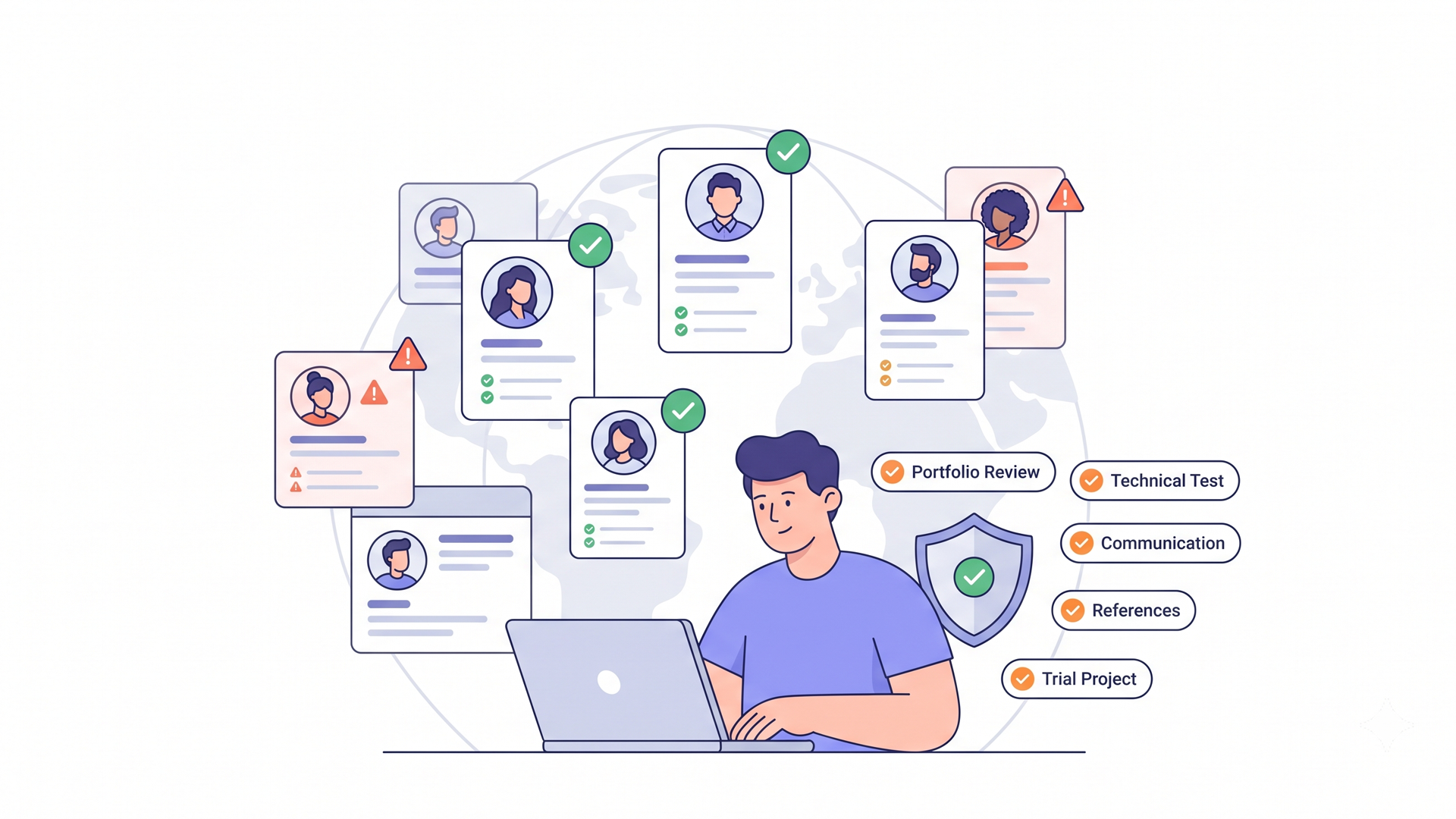
Hire React developers the wrong way, and the mistake shows up three months in, not on day one. Remote developer hiring has become the primary mechanism for accessing technology talent outside a local market. The talent pool available to a team willing to hire React developers remotely is orders of magnitude larger than the local market. But the evaluation process, the contract structure, and the management model all require more intentionality than equivalent in-office hiring, because the feedback loops that reveal poor fit are slower and the consequences of a bad hire persist longer. This guide exists to help you hire React developers without hitting those failure modes.
These principles for how to hire React developers are backed by Gartner and Microsoft research, not general hiring advice. Read them before you hire React developers for your next sprint or project.
Gartner reports that talent shortages remain one of the most significant barriers IT leaders face in technology adoption. Hiring remotely is the correct response to that constraint. The problem is not whether to hire React developers remotely. It is how to do it without accepting the most common failure modes: misrepresented credentials, inadequate technical screening, IP exposure, and onboarding processes that leave remote developers disoriented and unproductive for the first quarter.
This guide maps the evaluation criteria, contract terms, technical screening approaches, and onboarding processes that distinguish remote developer hires that work from those that do not, so you can hire React developers with confidence.
Want to hire React developers who are pre-vetted, along with full-stack engineers or AI specialists?
WebOsmotic provides individually screened React, Node.js, Python, AI, and DevOps engineers for staff augmentation and dedicated team engagements, so you can hire React developers with confidence. All engineers are technically assessed before client interviews.
Remote developer hiring is not one thing. When you hire React developers, the three primary models have different risk profiles, cost structures, and appropriate use cases. Choosing the wrong model for a given engagement type is as consequential as choosing the wrong developer, which is why the model decision should come before you hire React developers, not after.
Compare the three models below before you hire React developers on any of them:
| Model | Description | When to Use | Risk Profile |
| Direct remote hire (employee or contractor) | Individual developer hired directly, working exclusively for the client, managed by the client | When the client wants full control over day-to-day management, has management capacity for remote individuals, and needs long-term embedding in the team | Lower ongoing cost after hire. Higher screening cost. Full IP control. Client bears employment or contractor compliance responsibility |
| Staff augmentation via a partner | Individual developers sourced and employed by a development firm, placed with the client on a monthly engagement | When the client wants development capacity without handling international employment, compliance, or the screening infrastructure to evaluate global candidates | Mid-range cost. Screening responsibility shared with a partner. IP clauses in the partner agreement are critical. Faster to scale up and down |
| Dedicated development team | A full team (developers, QA, PM) employed by and managed by a development partner, delivering defined outcomes for the client | When the client needs a self-managing team for a specific product or workstream without managing individual developers or offshore operations | Higher monthly cost than individual staff aug. Lowest management burden on clients. IP and data handling terms in the partner agreement are the critical control variable |
Whichever model you choose, the screening and contract standards below apply whenever you hire React developers.
The most common failure when teams hire React developers, or any remote engineers, is selecting candidates based on credentials, GitHub stars, and verbal facility with technical terminology rather than demonstrated competence on problems that resemble the actual work. The solution is structured technical evaluation that tests judgment, not knowledge, the same standard WebOsmotic applies whenever it helps a client hire React developers.
Test these four things whenever you hire React developers, regardless of seniority level.
Remote developer contracts are frequently treated as a formality. They are not. The contract terms for remote developers, whether direct contractors or staff augmentation, determine whether the code the developer writes belongs to the client, whether the developer can take work to a competitor, and who bears liability if the developer’s work contains third-party IP. This applies whether you hire React developers directly or through a partner.
Whatever hiring model you used to hire React developers, onboarding quality determines how fast they contribute.
Microsoft’s research on hybrid and remote work and Gartner’s findings on flexible remote models document that intentional design of remote work produces better outcomes than one-size-fits-all approaches. For remote developers, intentional onboarding design is the variable that most directly determines time to productive contribution, whether you hire React developers or engineers in any other stack.
WebOsmotic’s staff augmentation and dedicated team services provide pre-vetted React, Node.js, Python, AI, and DevOps engineers to clients in fintech, healthcare, eCommerce, and logistics. All engineers are technically assessed through structured evaluation before client interviews. Engagement structures include contracts that assign IP to the client from day one, so when you hire React developers through WebOsmotic, ownership is never ambiguous.
Ready to hire React developers who are pre-vetted, or full-stack engineers?
WebOsmotic provides individually screened React, Node.js, Python, AI, and DevOps developers for staff augmentation and dedicated team engagements, whether you hire React developers as individuals or as a dedicated team. All engineers pass technical assessment before client interviews. Serving US and global clients from India, visible across our case studies.
More questions on how to hire React developers, answered directly. Bookmark this before you hire React developers again:
The teams that hire React developers successfully test judgment and architectural thinking, not syntax recall. The most predictive evaluation sequence is: component hierarchy design from a UI specification (before any code is written), state management decision rationale (when to use local state vs. context vs. a library), performance problem diagnosis from a described symptom without immediately reaching for memoization hooks, and a code review of a provided sample with architectural problems. Gartner’s guidance on external staffing emphasizes that proper strategy and governance in the evaluation process are prerequisites for receiving value from external development resources, the evaluation stage is where this governance begins.
Staff augmentation adds individual developers to an existing client-managed team, typically employed by a staffing or development partner, placed with the client on a monthly engagement basis. The client manages the developer’s daily work. Outsourcing transfers responsibility for a defined scope of work to an external team, which manages its own delivery. The practical difference is accountability: in staff augmentation, the client is accountable for direction and quality control; in outsourcing, the external partner is accountable for delivery.
Gartner’s research identifies that without proper strategy, governance, and control, organizations can spend significant dollars and receive limited value from either model, but the governance requirements are different: staff augmentation requires client-side management capability; outsourcing requires client-side specification and quality gate capability. This distinction matters whether you hire React developers individually or bring on a full outsourced team.
The four critical contract terms for remote developer engagements are: IP assignment (all work product created during the engagement is assigned to the client, explicitly covering code, documentation, schemas, and API designs); NDA covering proprietary data, codebase, and business strategy for a defined post-engagement period; non-solicitation (not non-compete, which is unenforceable for contractors in most jurisdictions) covering the client’s employees and customers; and data handling obligations specifying how the developer handles client data, what systems can be accessed, and what happens to data at engagement end.
The data handling terms are particularly critical for regulated industries, and apply whether you hire React developers, backend engineers, or any other remote technical role. Review every clause before you hire React developers on a new contract.
Microsoft’s research on remote work documents that intentional design of remote working arrangements produces better outcomes than default policies. For remote developers, the most effective onboarding structure includes: complete development environment documentation and system architecture documentation available before day one; a defined week-one goal (typically a small first contribution by day three); structured pair programming sessions in weeks one and two for codebase familiarity regardless of seniority; and a defined daily synchronous overlap that reflects the actual collaboration requirements of the role. Remote developers who spend their first week navigating undocumented setup processes and asynchronous orientation questions are not productive in weeks three through six, regardless of whether you hire React developers or backend engineers.
A dedicated development team, a fixed, named team of developers, QA, and a project manager operating under partner-side management, is appropriate when the client needs significant development capacity for a defined product or workstream but does not want to manage individual developer performance, offshore HR, or daily team operations. It is most appropriate when the scope of work justifies a full team (typically a team of 4-8 people for 6+ months) and when the client’s engineering management capacity is limited.
Staff augmentation is appropriate when the client has strong engineering management, a defined backlog, and specific skill gaps to fill within an existing team structure, such as when you need to hire React developers to cover a single sprint’s worth of frontend work. Gartner’s guidance on external staffing emphasizes that the governance model must match the engagement type.
WebOsmotic screens developers through a multi-stage technical evaluation: an initial skills assessment for the relevant technology stack, a domain-specific coding challenge (not a LeetCode problem but a problem resembling the type of work the client’s project requires), a code review session where the candidate reviews a provided sample, and a system design discussion for senior roles. Only candidates who pass all stages proceed to client interviews. The client then conducts their own technical interview, which WebOsmotic supports with briefing materials on each candidate’s assessed strengths and areas to probe. This structure means that when clients hire React developers or any other engineers through WebOsmotic, they interview qualified candidates rather than conducting initial screening themselves.
This guide reflects current practice for teams that hire React developers remotely in 2026.
Whether you hire React developers directly, through staff augmentation, or as a dedicated team, the same screening and contract standards apply.
Teams that skip these standards to hire React developers faster almost always pay for it later.
Slow down at the start, and you hire React developers who stay productive for years, not months.