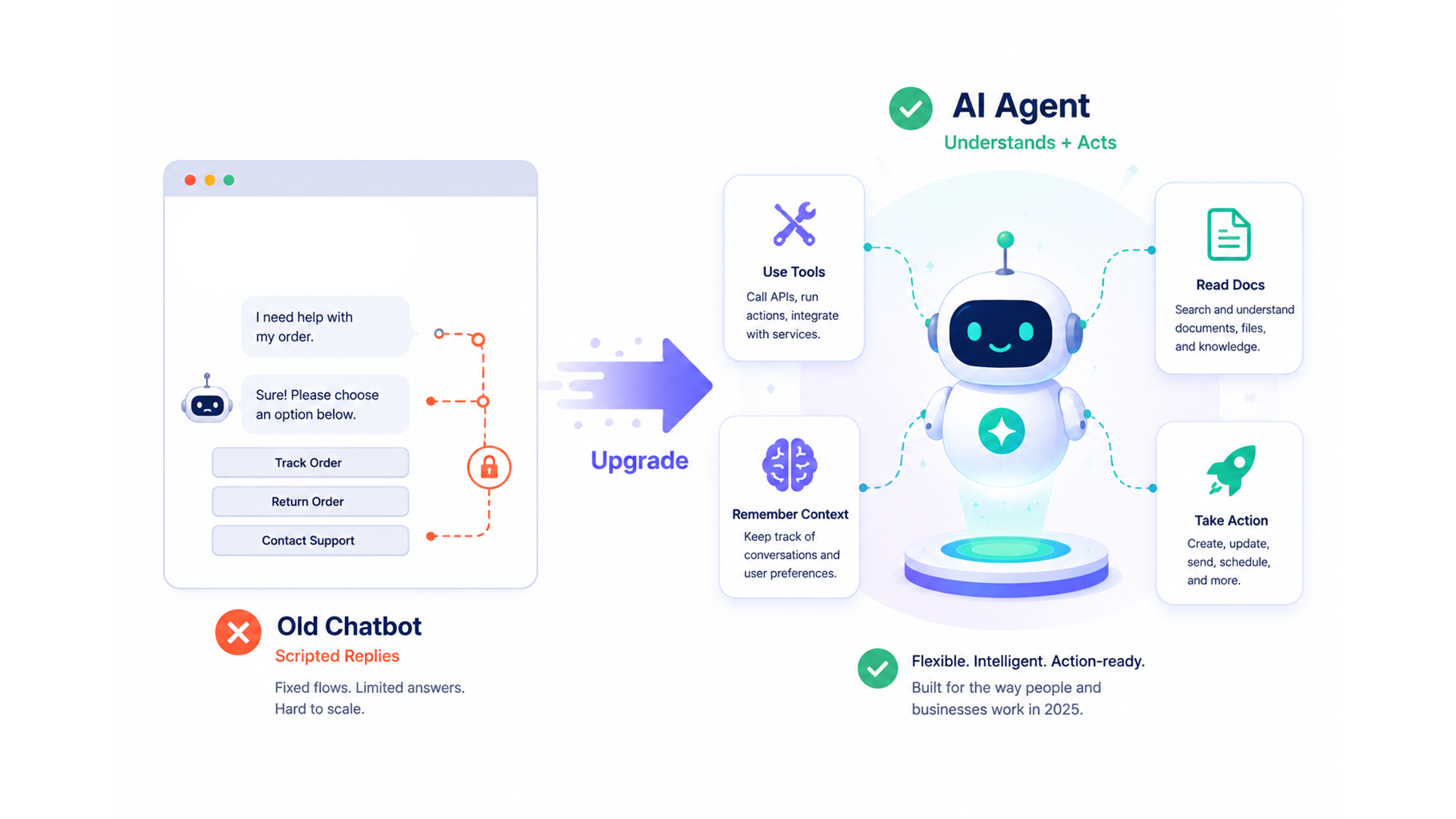
AI in Customer Service: Deploy Agents That Cut Tickets
209 Views
Summarize Article



Summarize Article
Key Takeaway: AI customer service agents resolve 40 to 80% of inbound tickets without human involvement, but most deployments miss this range. The gap is architectural, not technological. Teams that hit 50%+ deflection rates build narrow, intent-specific agents first, then scale. (Freshworks, 2025)
Deploying AI and watching ticket volume stay flat is not a tooling problem. It is a sequencing problem. AI customer service agents can cut first response time from six hours to under four minutes, yet only 25% of contact centers using AI have fully integrated it into daily operations. The majority are running chatbots on edge cases and calling it automation.
The difference between a deployment that resolves 20% of tickets and one that resolves 80% comes down to intent targeting, knowledge base structure, and rollout discipline. Businesses that get this right see $3.50 back for every $1 invested, with top performers reaching 8x ROI. This guide breaks down exactly what separates functional deployments from expensive ones.
Most AI customer service rollouts target broad automation coverage instead of deep resolution accuracy on specific, high-frequency intents. The result is an agent that touches everything and resolves almost nothing.
AI support ticket deflection starts with 20% of issues driving 80% of your volume. WISMO queries, password resets, and policy lookups consistently represent the highest-volume, lowest-complexity ticket categories in most support queues.
Teams that automate order tracking before validating accuracy on account-related queries routinely see CSAT drop in the first 30 days. Breadth feels like progress. Resolution rate is what actually moves the metrics.
AI customer service agents replicate the behaviors and resolution patterns they are trained on. If human agents escalate 40% of conversations unnecessarily, the AI will too.
The underlying workflow determines the AI performance ceiling. No model upgrade changes a bad resolution flow.
AI support ticket deflection performs reliably in a specific, well-defined category of interactions. Understanding where AI customer service agents deliver and where they introduce risk prevents expensive rollbacks and protects CSAT during the critical first 90 days.
Order status, refund eligibility, account verification, and FAQ resolution are the highest-deflection targets across industries. AI agents in contact centers have halved the cost per call while improving customer satisfaction scores.
The cost math is straightforward. Human agents run $6 to $8 per interaction. AI costs $0.50 to $0.70, a 12x cost advantage that compounds as volume scales.
An AI that fails and traps the user in a dead-end loop does more damage than no automation at all. Escalation path design is not optional.
Deployment sequence matters more than tool selection. The businesses consistently hitting 50%+ deflection rates follow a phased, metric-driven rollout, not a platform-first one. Use the table below as a glance reference for each phase, then expand into the details that follow.
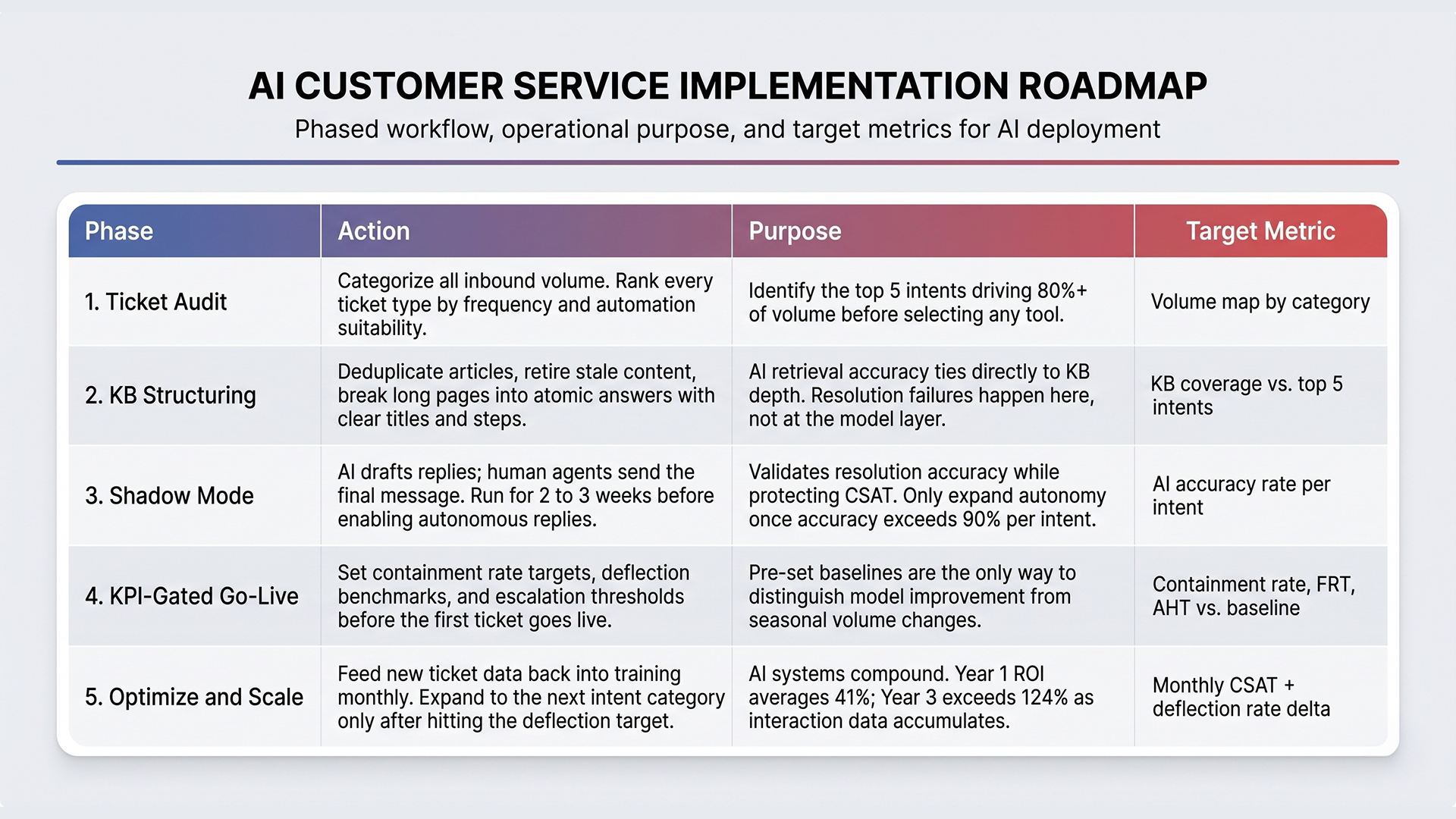
Customer service automation starts with your knowledge base, not the model. Deduplicate articles, retire outdated content, and break long pages into atomic answers with clear titles, steps, and prerequisites.
An AI agent is only as accurate as the content it retrieves from. Most resolution failures happen at the retrieval layer, not the reasoning layer.
Shadow mode means the AI drafts replies while agents send the final message. Run it for two to three weeks, then measure accuracy and edit rate before switching to autonomous replies.
AI customer service at scale requires more than a platform license. WebOsmotic builds AI support ticket deflection systems scoped by ticket category volume, not wishful automation coverage.
With 1,000+ AI systems delivered across healthcare, fintech, logistics, and eCommerce, the team brings a domain-specific deployment context that generic vendors cannot match.
Our delivery process covers the full deployment cycle:
AI customer service agents cut ticket volume when they are deployed against the right intents, trained on validated workflows, and given clean knowledge to retrieve from. The businesses hitting 50 to 80% deflection rates did not get there by automating everything at once. They started narrow, proved resolution accuracy, and scaled methodically.
By 2029, 80% of common customer queries will be resolved autonomously by agentic AI, cutting operational costs by 30%. If your deployment is not performing at that level yet, the architecture is where to start.
Talk to WebOsmotic to scope a rollout grounded in actual ticket data.
Well-deployed AI customer service agents resolve between 40 and 80% of inbound tickets without human involvement. The range depends on knowledge base quality, use-case targeting, and how accurately high-volume intents are prioritized at deployment.
AI support ticket deflection happens when a customer resolves their issue without reaching a live agent. AI achieves this through intent-matched self-service, proactive chatbot responses, and automated workflows that handle common queries end-to-end.
Most organizations reach positive ROI within three to six months. Year 1 ROI averages 41%, Year 2 reaches 87%, and Year 3 exceeds 124% as AI customer service agents improve from accumulated interaction data.
Track containment rate, first response time, average handle time, first-contact resolution rate, and CSAT scores before and after deployment. Chatbot usage volume alone does not indicate business impact.
Automating edge cases and complex queries before validating performance on high-volume, simple intents. The second biggest mistake is deploying AI customer service agents without first auditing and structuring the knowledge base they will retrieve from.