AI in Retail 2026: Forecasting, Pricing & Personalisation
245 Views
Summarize Article



Summarize Article

Key Takeaway: AI in retail is no longer a pilot program. In 2026, retailers are deploying it across forecasting, pricing, and personalisation as core operating infrastructure. The gap between early adopters and late movers shows up directly in margin, inventory efficiency, and conversion rates.
Retail’s biggest operational bottleneck has never been execution. It has always been timing. Knowing what to stock, at what price, for which customer, and precisely when has historically taken weeks of manual analysis. AI in retail has compressed that cycle to minutes, sometimes seconds.
AI in retail now sits directly between the shopper and the shelf, shaping what a customer sees before they even reach a product page, making it a front-of-house function as much as a back-office one.
Nine in ten retailers plan to increase their AI in retail budgets in 2026, with retail demand forecasting, dynamic pricing in retail, and personalisation at scale as the three priority areas. The retailers gaining ground are not experimenting with AI in retail, they are building operational infrastructure around it.
This guide breaks down what is working, where retailers are still leaving margin on the table, and how to build an AI stack that compounds results over time.
AI in retail has made retail demand forecasting accurate at a granularity that was previously impossible. By processing live sales data, weather patterns, local demographics, and competitor signals simultaneously, it reaches forecasting accuracy that traditional models cannot match at the store level, cutting inventory carrying costs significantly.
Traditional forecasting ran on historical averages and seasonal patterns. That model breaks down the moment demand becomes hyper-local. A product that sells out in one zip code can sit unsold two miles away.
Predictive analytics retail tools now process hundreds of variables in parallel and update continuously as demand signals shift. That speed changes how operations teams function. Category managers no longer pull Monday morning reports. AI in retail has already scoped the decisions waiting for them.
Machine learning retail models give operations teams retail demand forecasting visibility at the store and customer segment level rather than the regional aggregate. Walmart’s AI in retail inventory system integrates historical sales, weather data, macroeconomic trends, and local demographics to forecast demand at zip-code precision, reducing stockouts while cutting transportation inefficiency. Human analysts cannot replicate this level of granularity at scale.
Agentic commerce is reshaping where human decisions stop and AI in retail decisions begin. Trade promotion planning, inventory reordering, and commercial forecasting are shifting toward AI-generated recommendations that teams approve rather than build from scratch. The model flips from humans generating plans to humans validating the outputs, cutting planning cycles from days to hours.
Supply chain AI is moving toward autonomous action on retail demand forecasting predictions, not just surfacing them. Retailers building agentic workflows today are compressing the gap between insight and inventory movement that used to take a full planning cycle.
That operational speed advantage feeds directly into how AI in retail pricing decisions get made.
Dynamic pricing in retail has moved well past airlines and hotel rooms. Fashion brands, FMCG companies, and speciality retailers now run price elasticity modelling engines that reprice products based on live demand signals, competitor positioning, and individual customer behaviour, without manual input in between. AI in retail makes this level of pricing responsiveness possible at scale.
The shift from weekly repricing cycles to continuous dynamic pricing in retail is not just operational. It changes the margin math entirely. A retailer that replicates in real time captures margin during demand spikes rather than discovering a missed opportunity in a monthly review.
Quick Glance: Traditional Pricing vs AI-Driven Dynamic Pricing in Retail
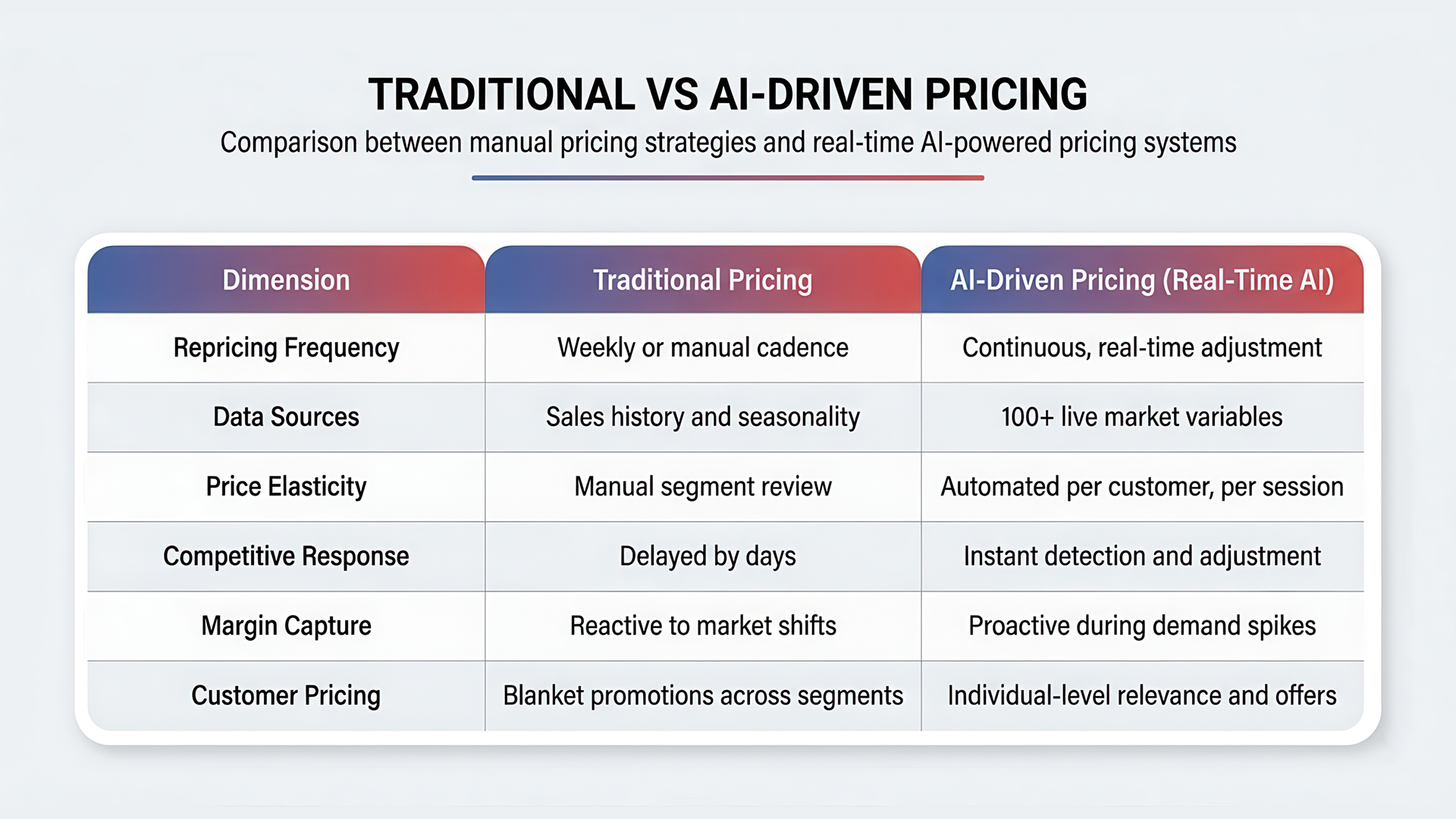
Customer behaviour analytics systems now feed willingness-to-pay data directly into pricing engines. Purchase velocity, cart abandonment rates, and segment-level conversion data all flow into a model that prices accordingly at scale. What used to require a team of category managers now runs continuously inside AI in retail infrastructure.
The result is a dynamic pricing in retail strategy that responds to each shopper’s behaviour rather than applying a blanket discount or promotion across a category.
AI in retail scans competitor catalogues, promotions, and stock availability in real time, flagging positioning gaps before a weekly merchandising meeting ever happens. This removes one of the most time-consuming bottlenecks in retail operations: competitive pricing monitoring done manually by hand.
“AI will play a vital role in facilitating a necessary flight to profitability. Retailers will use algorithms to predict demand with greater accuracy to cut inventory carrying costs and redefine return policies,” said Sudip Mazumder, SVP Retail Industry Lead, Publicis Sapient.
That intelligence layer powers the next leap: personalisation that actually converts.
AI in retail personalisation in 2026 is not about recommending similar products. It means real-time journey adjustment across every touchpoint a customer encounters, from the first search query to the post-purchase email. A personalisation engine that only works on-site misses most of the customer’s decision window.
Fifty-eight per cent of consumers now begin product discovery on AI tools rather than branded websites or search engines. That means the AI shopping assistant is often the first impression a retailer makes, and it belongs to a platform the retailer does not control. The only lever available is content quality and data structure.
The gap between a personalisation engine that works and one that sits idle is whether AI in retail acts on data or just stores it. AI agents now adjust messaging, surface products, and modify pricing offers based on individual context in real time. A returning customer browsing outerwear in winter sees a different product set and price point than a first-time visitor in the same category.
Generative AI retail applications are raising this as the baseline expectation. Retailers still running static recommendation widgets are building for a customer behaviour model that no longer exists.
One sportswear brand deployed AI-powered messaging through AI in retail tools across email, web push, and SMS, achieving a 49x ROI and a 700% increase in customer acquisition. The enabling factor was not the sophistication of the model. It was clean, unified first-party data feeding into it consistently. Without data hygiene, no personalisation engine operates at this level.
Inventory optimisation and personalisation are converging. An AI in a retail system that knows what a customer is likely to buy next also knows which regional stock to prioritise, closing the loop between demand signal and fulfilment decision.
Knowing where personalisation works starts with understanding where retail AI fails.
No AI in a retail system performs better than the data it trains on. Retailers running AI in retail on siloed, inconsistent data get outputs that are confidently wrong, which is worse than no output at all. When store sales data does not sync with e-commerce data or third-party feeds, retail demand forecasting accuracy collapses regardless of model sophistication.
Before deploying any AI in the retail layer, the underlying data infrastructure has to be unified and validated. This is a prerequisite, not a parallel workstream.
Retailers that attempt to deploy AI in retail across all functions simultaneously dilute ROI and stall adoption. The faster path is concentrating on two or three high-impact use cases. Inventory optimisation and personalised marketing deliver measurable results fastest. Early wins create internal buy-in and surface the data gaps that would have derailed a broader rollout anyway.
Ninety-three per cent of consumers still prefer human interaction for complex queries, meaning customer journeys built on AI alone without a human fallback carry real retention risk. Hybrid models consistently outperform fully automated approaches in customer satisfaction scores.
WebOsmotic builds production-ready AI in retail systems for e-commerce teams that need retail demand forecasting, dynamic pricing in retail logic, and personalisation infrastructure to function together, not in isolation.
Every engagement starts with use-case identification and ROI scoping before any code is written. If your AI in retail infrastructure needs a clear roadmap first, let’s talk.
AI in retail in 2026 is operational, not experimental. Retailers using retail demand forecasting AI run leaner inventory. Those running dynamic pricing in retail capture margin in real time instead of reviewing missed opportunities after the fact.
Those investing in personalisation engines compound conversion gains across every channel. The retailers falling behind share one pattern: they treat AI in retail as a feature bolt-on rather than a core operating layer.
Start with one high-impact use case, clean the data underneath it, and build from there. Ready to map out your AI in retail strategy? Let’s explore what that looks like for your business.
AI in retail uses machine learning, predictive analytics, retail tools, and natural language processing to automate pricing, personalise customer experiences, and improve inventory decisions. These systems learn from historical and real-time data to surface actionable insights across operations, marketing, and supply chain functions continuously.
Traditional forecasting relies on seasonal averages and manual inputs. AI-powered retail demand forecasting processes hundreds of variables simultaneously, including weather, competitor activity, local demographics, and live sales velocity, producing store-level accuracy that reduces stockouts and overstock carrying costs significantly.
Dynamic pricing in retail is the practice of adjusting product prices in real time based on demand signals, competitor data, and inventory levels. AI in retail makes this possible at scale without manual intervention, improving margin capture during demand spikes and delivering customer-specific pricing relevance.
Fashion, beauty, and FMCG are leading the AI in retail personalisation adoption in 2026. These segments benefit from high purchase frequency and rich behavioural data, allowing these models to refine product and pricing recommendations across email, app, and in-store touchpoints.
The two most common failure points are poor data quality and over-broad deployment. Models trained on fragmented data produce inaccurate outputs. Retailers that target high-ROI use cases first, typically inventory optimisation and personalised marketing, achieve faster results with lower implementation risk.
AI in retail is automating repetitive and data-intensive tasks, but human oversight remains critical for complex customer interactions and strategic decisions. Most retailers in 2026 run hybrid models where AI in retail handles volume decisions while humans manage judgment-heavy situations.