Beyond Staff Augmentation: Finding a True Product Engineering Partner in Bangalore
1 Views
Summarize Article



Summarize Article

Bangalore did not become the city global banks, hyperscalers, and Fortune 500 engineering teams call home by accident. Karnataka’s official Global Capability Center Policy, launched in November 2024, documents the state hosting roughly 30 to 35% of India’s entire GCC base and workforce, with a target of 1,000 operating centers by 2029, per the Karnataka Department of Electronics, IT, BT and S&T. Companies with the resources to build engineering capability anywhere on earth keep choosing Bangalore, and they are not staffing it with contractors filling seats. They are building product engineering teams that own architecture, roadmap, and outcomes.
Most startups and mid-market companies evaluating it outsourcing services Bangalore providers never get access to that same model. What they get instead is staff augmentation dressed up in product language: developers who show up, complete assigned tickets, and rotate off the account the moment the invoice clears. This article explains the real difference between staff augmentation and a genuine product engineering partner, why Bangalore’s talent ecosystem makes that distinction possible, and what to look for before signing an engagement.
Key takeaways
|
Staff augmentation adds individual developers to an existing team, working under the client’s own management, process, and tools. It is a legitimate model with a real use case: a company with strong in-house engineering leadership and a defined backlog that needs specific skill gaps filled fast. The model breaks down the moment a company expects the augmented developers to also own architecture decisions, product judgment, or delivery outcomes, because nobody was ever contracted to provide that. Many companies that search for it outsourcing services Bangalore providers are actually looking for the second thing while shopping in a market built to sell the first.
The most common complaint about outsourced engineering is not skill quality. It is a lack of accountability when something goes wrong: a missed deadline nobody owns, an architecture decision nobody defends, a production incident nobody is contractually responsible for resolving. This pattern shows up specifically when a company hires it outsourcing services Bangalore providers expecting a product partner and receives a staffing pool instead. The developers may be individually excellent. The engagement structure simply never assigned anyone ownership of the outcome.
A true product engineering partner participates in architecture decisions against a multi-year roadmap, not just the current sprint’s ticket queue. That means pushing back on requirements that create technical debt, flagging scalability risk before it becomes a production incident, and taking a position on trade-offs instead of building exactly what was specified without comment.
Product engineering bangalore work depends on institutional memory. A team that rotates developers in and out of a shared resource pool cannot build the context that makes engineers productive on a complex, evolving codebase. A genuine partner assigns a named, stable team from day one and treats developer continuity as a delivery requirement, not a nice-to-have.
Documented security certifications, structured QA processes, and defined delivery retrospectives are not add-ons a mature partner offers when asked. They are standing practice built into every engagement, the same way an in-house engineering team would operate them, regardless of whether the client requested them explicitly.
| Tired of staff augmentation that never quite becomes a real product partnership? WebOsmotic operates as a dedicated product engineering team from Bengaluru, with 80+ engineers and a 4.9 rating on Upwork built on delivery, not resourcing. If you have been shopping it outsourcing services Bangalore vendors and getting the same resourcing pitch, this is the alternative. |
Bangalore’s product-engineering depth is a byproduct of thirty years of global capability center presence. Engineers who spend several years inside a GCC or a product company’s core engineering team absorb architecture ownership, incident response discipline, and roadmap thinking as day-to-day habits, not theory. When those engineers move into a custom software company Bangalore team, they bring that ownership culture with them. This is the structural reason Bangalore produces a different caliber of “product engineering bangalore” talent than a market with a thinner GCC and product-company history.
Enterprises accessing Bangalore’s talent typically build their own captive global capability center: their own legal entity, their own recruiting pipeline, their own multi-year real estate commitment. That approach makes sense for a company deploying thousands of employees. It does not make sense for a startup or mid-market company that needs ten to forty engineers shipping product now. A genuine it outsourcing services Bangalore partner gives smaller companies access to the same talent pool and the same ownership culture, scoped to a team size and contract structure that fits their actual stage.
NASSCOM’s Annual Strategic Review 2026 breaks India’s $315 billion technology industry into segments, and engineering R&D alone accounts for $63 billion of that figure, a category distinct from generic IT services precisely because it covers product ownership work rather than support tickets. McKinsey’s research on India’s global capability centers documents the same shift: centers that once ran transactional support functions increasingly own end-to-end product development and platform modernization for their parent companies. Both data points point the same direction. The market for it outsourcing services Bangalore providers is bifurcating between vendors still selling hours and partners selling outcomes, and the growth is concentrated in the second category.
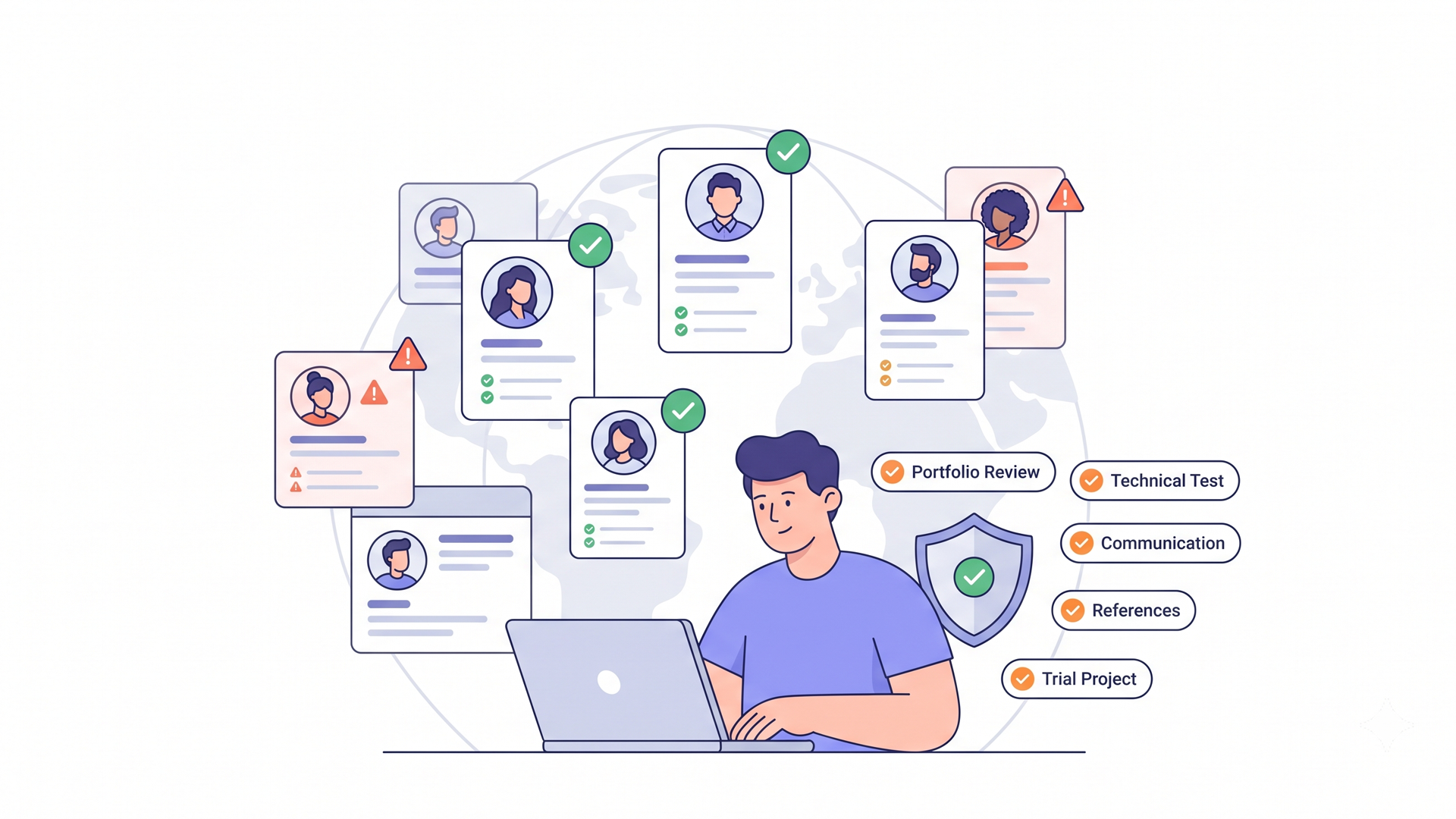
A structured evaluation separates a genuine partner from a resourcing vendor before a contract is signed:
Companies that hire dedicated developers Bangalore successfully treat this evaluation with the same rigor they would apply to a senior in-house engineering hire, not a vendor procurement checklist.
The table below makes the it outsourcing services Bangalore decision concrete rather than conceptual.
| Factor | Staffing vendor | Custom software company Bangalore (product partner) |
|---|---|---|
| Team assignment | Rotating pool, availability-driven | Named, dedicated team from day one |
| Architecture involvement | Executes assigned tickets only | Participates in roadmap and architecture decisions |
| Accountability for outcomes | Limited to hours billed | Contractual ownership of delivery quality |
| Security and QA practice | Ad hoc, client-driven | Standing practice built into every engagement |
| Communication | Status updates on request | Structured cadence with defined US time zone overlap |
| Best fit | Short-term skill gap in a well-managed in-house team | Long-term product development, new builds, scaling teams |
| Ready to evaluate a genuine product engineering partner instead of a resourcing pool? WebOsmotic delivers dedicated teams for fintech, healthcare, eCommerce, and logistics clients, with named engineers, documented security practice, and delivery accountability from day one. |
Bangalore’s talent pool did not get this deep by accident, and neither did the ownership culture that separates a real product engineering partner from a staffing vendor wearing the same job titles. The city’s GCC scale proves the talent exists. The harder question for any company evaluating it outsourcing services Bangalore providers is whether the specific team in front of them was built to own outcomes, or just to fill hours.
What is the real difference between staff augmentation and a product engineering partner in Bangalore?
Staff augmentation adds individual developers to a client-managed team, executing assigned work under the client’s own process and architecture decisions. A product engineering partner takes ownership of architecture, roadmap trade-offs, and delivery outcomes as part of the engagement, not just the hours billed. The distinction shows up clearest when something goes wrong: a staffing model has no one contractually accountable for the outcome, while a genuine partner does.
Why does Bangalore specifically produce strong it outsourcing services Bangalore providers?
Karnataka’s official GCC Policy documents the state hosting roughly 30 to 35% of India’s GCC workforce, with decades of global capability center presence that trained a generation of engineers in real product ownership, not just technical execution. NASSCOM’s data shows engineering R&D contributing $63 billion to India’s FY26 tech revenue, the segment that best reflects genuine product engineering rather than support staffing. This concentration of ownership-trained talent is what separates Bangalore’s ecosystem from markets with a thinner GCC history.
How do I hire dedicated developers Bangalore without ending up with disguised staff augmentation?
Evaluate the engagement structure before signing, not after. Ask for real project retrospectives, request a code review of comparable work, and confirm the team assigned is named and stable rather than pulled from a shared bench. Teams that hire dedicated developers Bangalore successfully also ask directly how the vendor handles disagreement over a requirement that creates technical debt. A genuine partner has an opinion and defends it.
What should I look for in a custom software company Bangalore before signing a contract?
Look for documented security certifications such as ISO/IEC 27001 or SOC 2 alignment, a named team assigned from day one, a structured communication cadence with defined US time zone overlap, and contractual terms that specify code ownership and delivery accountability. A custom software company Bangalore worth hiring will have all of this as standing practice, not something assembled after a client asks for it. This is the same bar worth applying to any it outsourcing services Bangalore provider, regardless of what the sales deck calls itself.
Is product engineering Bangalore work only available to large enterprises building their own GCC?
No. Enterprises typically build a captive global capability center because they are deploying thousands of employees and multi-year capital, which is the wrong tool for a startup or mid-market company. A genuine product engineering Bangalore partner gives smaller companies access to the same talent pool and ownership culture through a dedicated team scoped to their actual size, without the years of legal entity setup a captive center requires.