Custom AI Development: Build vs Buy
192 Views
Summarize Article



Key takeaways
|
The decision to build custom AI versus buy a packaged solution is one of the most consequential early decisions in an AI investment cycle, and one of the most frequently made incorrectly. Teams buy off-the-shelf AI tools when they need competitive differentiation that only custom models on their own data can provide. Teams choose custom AI development when packaged solutions would have served the use case adequately at a fraction of the engineering cost.
Gartner’s framework describes the landscape clearly: the most effective AI strategy for today’s organizations combines existing applications with embedded AI features, net-new AI-packaged software, and enterprise-crafted AI. The role of IT and AI leaders is to create a system to safely evolve, coordinate, and run all three types simultaneously. The mistake is treating the question as binary when it is almost always a portfolio decision.
Simultaneously, McKinsey documents that vertical use cases frequently require custom development because mature packaged solutions do not exist for domain-specific problems. Fewer than 30% of companies have their CEO directly sponsoring the AI agenda, which leads to fragmented micro-initiatives and dispersed investments. The combination of immature packaged solutions for vertical use cases and fragmented sponsorship is why so many AI investments fail to produce competitive advantage.
| Evaluating whether to build custom AI, buy a packaged platform, or blend both? WebOsmotic scopes the build-buy-blend decision for fintech, healthcare, eCommerce, and logistics teams before any development budget is committed. We evaluate the competitive differentiation requirement, the data moat, the integration complexity, and the total cost of ownership for each option. |
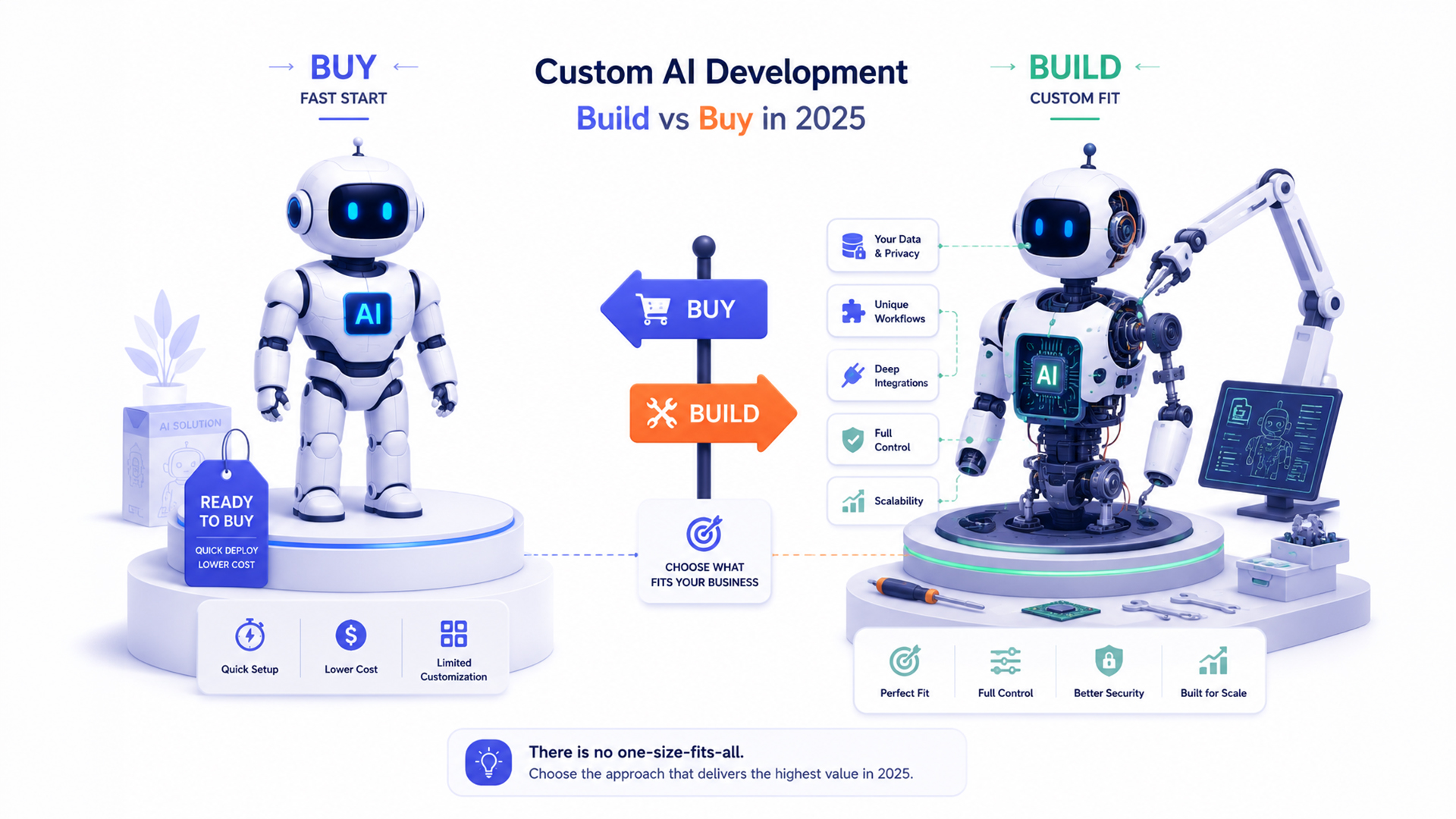
Gartner’s deployment framework distinguishes three sources of AI capability, each with different cost, control, and customization tradeoffs. Understanding which category addresses which problem prevents the most expensive category of build-vs.-buy mistake: building when buying was the right answer, or buying when building was.
| Decision factor | Buy (embedded or packaged) | Build or blend (custom) |
| Competitive differentiation | Low: the same tool is available to every competitor in your market | High: proprietary data, workflows, or model tuning that competitors cannot replicate |
| Data requirement | General: the packaged tool’s training data adequately covers your domain | Specific: your proprietary data must ground the AI output for it to be accurate and trustworthy |
| Integration complexity | Low-to-medium: the packaged tool connects to your existing systems via standard connectors | High: deep integration with legacy systems, internal APIs, or proprietary data formats that no standard connector supports |
| Compliance requirement | Standard: the vendor’s BAA, SOC 2, and data handling terms satisfy your regulatory context | Regulated or restricted: data cannot be sent to a third-party vendor, or the processing environment must meet specific requirements that managed services cannot guarantee |
| Total cost of ownership | Lower short-term: no build cost. Higher long-term if usage scales rapidly and per-seat or per-transaction pricing compounds | Higher short-term: engineering cost. Lower long-term at scale if the custom system eliminates per-transaction pricing |
| Time to deployment | Faster: weeks to months depending on configuration complexity | Slower: months to over a year depending on system complexity and integration scope |
| Maintenance responsibility | Vendor: model updates, infrastructure, and security patches are the vendor’s responsibility | Internal: the organization owns the model, the infrastructure, and the ongoing maintenance and improvement cycle |
Custom AI development cost is primarily determined by four factors: the complexity of the AI system being built, the number and depth of integrations required, the compliance architecture needed for the deployment environment, and whether the team is building on top of foundation model APIs or training or fine-tuning their own models.
Gartner identifies open GenAI models as reshaping the enterprise AI landscape by offering greater flexibility, lower costs, and freedom from vendor lock-in, enabling organizations to customize, fine-tune, and deploy AI solutions on-premises or in their own cloud environment. The practical implication for the build-vs.-buy decision is that the cost of building a competitive custom AI system on open-weight models has fallen substantially since 2023.
WebOsmotic’s custom AI development practice builds on both managed APIs and open-weight models depending on the client’s compliance requirements, scale economics, and data sovereignty constraints. The model selection decision is made at the architecture stage for every engagement in fintech, healthcare, eCommerce, and logistics, not after the application is already being built.
| Ready to scope your custom AI development project? WebOsmotic designs and builds custom LLM applications, RAG systems, AI agents, and AI-powered product features for enterprise teams. We evaluate the build-buy-blend decision, recommend the right architecture, and deliver production software with evaluation infrastructure included. |
When should an enterprise build custom AI instead of buying a packaged solution?
The primary conditions that justify custom AI development are: the use case requires the organization’s proprietary data to be the primary grounding source for accurate output; the AI capability is a competitive differentiator that competitors could replicate by subscribing to the same packaged platform; the compliance environment requires complete data control that managed services cannot guarantee; or no packaged solution provides the integrations, workflow support, or domain specificity the use case requires. Gartner’s framework notes that vertical use cases frequently require custom development specifically because mature packaged solutions do not exist for domain-specific problems, in contrast to horizontal use cases such as email drafting or document summarization where packaged tools are generally adequate.
What is ‘blended’ AI and why is it the most common enterprise approach?
Gartner describes blended AI as combining APIs from foundation models with custom front-ends, integrations, and whatever customization is needed to make the models functional for the organization. It is neither training a model from scratch nor buying a pre-configured packaged tool. Most enterprise custom AI development in 2025 is blended: teams call the OpenAI, Anthropic, or Gemini API through their own application layer, add the organization’s proprietary data via RAG, build the UX and business logic, and manage the integration with existing enterprise systems. This approach captures most of the capability advantage of custom development without the cost and complexity of training models from scratch.
How much does custom AI development cost?
Cost depends primarily on system complexity and integration scope. A single-purpose custom LLM application with one to three integrations typically ranges from $30,000 to $150,000 for initial development. A multi-integration enterprise AI system connecting multiple data sources, handling multiple user roles, and integrating with ERP or domain-specific systems ranges from $100,000 to $500,000. Custom AI development cost does not end at deployment: monitoring, evaluation, prompt refinement, and ongoing maintenance typically add 20-40% of the initial build cost annually.
What role do open-source models play in the build-vs.-buy decision?
Gartner identifies open GenAI models as reshaping the enterprise AI landscape by offering greater flexibility, lower costs, and freedom from vendor lock-in compared to proprietary model APIs. Open-weight models such as Meta Llama, Mistral, and Google Gemma can be deployed on the organization’s own infrastructure, fine-tuned on proprietary data, and served without per-token pricing. This makes self-hosted open-weight model deployments economically justified for organizations with data sovereignty requirements, high query volumes, or use cases that benefit from fine-tuning.
What does WebOsmotic deliver in a custom AI development engagement?
WebOsmotic delivers working, production-deployed software, not strategy documents. A custom AI development engagement includes: architecture design specifying the model, RAG pipeline, infrastructure, evaluation framework, and integration points; development of the application layer, integrations, and data pipelines; evaluation infrastructure that measures output quality before and after model changes; deployment and monitoring setup; and documentation sufficient for the client’s engineering team to maintain and extend the system. Engagements for clients in fintech and healthcare include compliance architecture, audit logging, and data handling documentation as first-class deliverables.
How long does custom AI development take?
A single-purpose custom LLM application with well-defined requirements and one to three integrations can reach production in 8 to 16 weeks. A multi-integration enterprise AI system with complex data pipelines and compliance requirements typically takes 16 to 36 weeks. The timeline is primarily driven by integration complexity, data quality and preparation requirements, and the compliance architecture. McKinsey’s venture-building research shows that AI-native ventures built in 2023-2024 are achieving higher output with faster timelines than earlier builds, reflecting both the maturity of the tooling and the accumulation of engineering patterns that can be reused across similar use cases.