Deepgram vs. Whisper API: which STT is right for real-time AI apps
688 Views
Summarize Article



Summarize Article
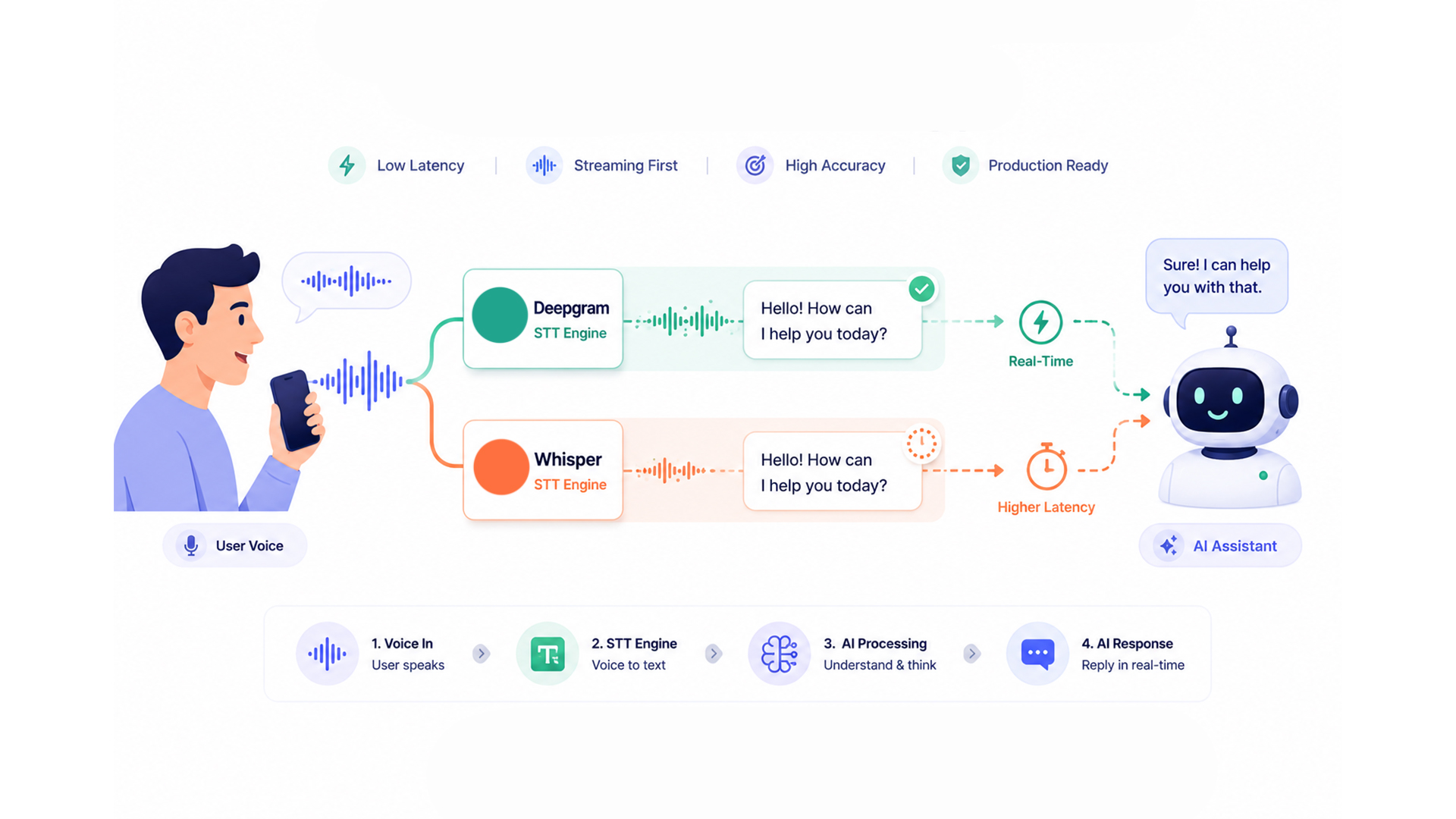
✓ Deepgram Nova-3 delivers sub-300ms streaming latency and is 36% more accurate and up to 5x faster than OpenAI Whisper, per Deepgram’s published benchmarks. Nova-3 is priced at $0.0077/minute for streaming ($0.462/hour) and $0.0043/minute for batch processing, per Deepgram’s published pricing as of 2025.
✓ Whisper lacks native streaming capabilities. Teams building real-time voice agents with Whisper must create chunked processing pipelines that add seconds of latency, incompatible with the sub-500ms conversational threshold documented in Microsoft’s AI agent performance research.
✓ OpenAI released GPT-4o-transcribe and GPT-4o-mini-transcribe in March 2025, with lower word error rates than the older Whisper Large V2 model. Both are priced at $6.00 per 1,000 minutes, significantly higher than Deepgram Nova-3 at $4.30 per 1,000 minutes, per Deepgram’s cost analysis citing Artificial Analysis benchmarks.
✓ Deepgram’s Flux model adds model-integrated end-of-turn detection for conversational AI, eliminating the need for a separate voice activity detection system and reducing integration complexity for voice agent pipelines.
✓ Whisper Large V3 Turbo (released October 2024) delivers 5.4x speed improvement over earlier Whisper versions through architectural optimization. Self-hosting Whisper on cloud GPUs still carries infrastructure costs that can reach $0.56 to over $1.25 per hour of audio processed at production scale, per Deepgram’s AWS EC2 P4 benchmark estimates.
✓ WebOsmotic builds real-time voice AI systems for contact centers, logistics dispatch, healthcare triage, and fintech automation, evaluating STT platform selection against latency, accuracy, compliance, and scale requirements before any architecture is committed.
Deepgram vs Whisper API is the first decision every voice AI team gets wrong before they even open the SDK docs. Choosing between them determines whether a voice agent can hold a natural conversation, because the Deepgram vs Whisper API gap in streaming latency shows up before the LLM has processed a single token.
Quick answer: in the Deepgram vs Whisper API matchup, Deepgram Nova-3 wins on latency, price, and streaming support, while Whisper wins on open-source control and batch-only budgets. The rest of this Deepgram vs Whisper API breakdown covers exactly why.
A voice agent pipeline has four latency stages: speech-to-text, endpointing, LLM inference, and text-to-speech. Each stage adds to the total before the caller hears a response. Microsoft’s AI agent performance research establishes 500ms as the psychological threshold for natural conversation and 1,000ms as the abandonment threshold.
An STT layer that adds 300ms leaves 200ms for the remaining three stages at the conversational threshold. An STT layer that adds two seconds makes the target unreachable regardless of how fast the LLM runs. This is the core of the Deepgram vs Whisper API debate.
This Deepgram vs Whisper API post compares Deepgram Nova-3 and OpenAI’s Whisper family, including the newer GPT-4o-transcribe models, across the four production dimensions that matter in any Deepgram vs Whisper API evaluation: latency, accuracy, pricing, and deployment model.
Building a voice agent that needs sub-500ms end-to-end response?
WebOsmotic engineers real-time voice AI systems with STT, LLM, and TTS integrated for sub-second production performance. We evaluate Deepgram, Whisper, and GPT-4o-transcribe against your call volume, compliance requirements, and latency budget before any platform is committed.
On the Deepgram side of the Deepgram vs Whisper API comparison, Nova-3 is Deepgram’s current-generation speech-to-text model, available through their managed API. It is purpose-built for production voice workloads, with streaming transcription that delivers partial results as audio is received rather than waiting for sentence completion.
In the Deepgram vs Whisper API comparison, Deepgram’s published benchmarks position Nova-3 as 36% more accurate and up to 5x faster than OpenAI Whisper. Nova-3 streams transcription results in under 300ms, described by Deepgram as nearly imperceptible latency for real-time applications.
Pricing is where the Deepgram vs Whisper API gap widens further. Nova-3 costs $0.0077 per minute for streaming ($0.462 per hour) and $0.0043 per minute for batch processing on the Pay As You Go tier. Deepgram’s cost comparison analysis found Nova-3 to be the cheapest option in the market at $4.30 per 1,000 minutes, compared to OpenAI at $6.00 and Google Chirp 2 at $16.00 per 1,000 minutes, per benchmarks by Artificial Analysis.
Whisper is OpenAI’s open-source speech recognition model, available both as a self-hosted open-source model and as a managed API. Understanding which version is being evaluated matters, because in the Deepgram vs Whisper API comparison the options carry very different performance and cost profiles. This is where most Deepgram vs Whisper API research goes wrong, by treating “Whisper” as a single product.
The table below lays out the full Deepgram vs Whisper API comparison across nine production dimensions, from streaming support to pricing to compliance posture.
| Dimension | Deepgram Nova-3 | Whisper (self-hosted or API) |
|---|---|---|
| Streaming support | Native: sub-300ms partial results during audio capture | No native streaming. Requires a chunked pipeline that adds seconds of latency |
| Latency for real-time | Under 300ms, compatible with sub-500ms voice agent targets | Self-hosted: often 1–4+ seconds depending on GPU provisioning. API: faster but still no streaming |
| Word error rate | Deepgram claims 36% higher accuracy than Whisper on production audio | Accuracy varies; can hallucinate. Degrades on noisy audio and specialized vocabulary |
| Pricing (managed) | $4.30 per 1,000 minutes, the cheapest in the 2025 Artificial Analysis benchmark | $6.00 per 1,000 minutes for the Whisper API and GPT-4o-transcribe |
| Infrastructure burden | Zero: fully managed, no GPUs, no DevOps | Self-hosted: GPU procurement, DevOps, scaling. API: zero infrastructure |
| Model updates | Deepgram manages updates; teams stay current automatically | Self-hosted: manual updates. API: automatic, but no streaming for older Whisper versions |
| Domain-specific models | Nova-3 Medical, Nova-3 Finance, and others | General-purpose only; no domain fine-tuned variants via the API |
| Self-hosted option | Yes: on-premises and VPC deployment for compliance-sensitive workloads | Yes: open-source self-hosting is Whisper’s primary use case |
| Best use case | Real-time voice agents, contact centers, sub-500ms STT pipelines | Batch transcription of recorded audio; self-hosted deployments needing open-source control |
Deepgram’s performance advantage in real-time streaming is genuine and well documented. Whisper’s continued relevance in the Deepgram vs Whisper API decision comes from two specific scenarios where its characteristics are advantages rather than disadvantages.
OpenAI’s release of GPT-4o-transcribe in March 2025 changed the Deepgram vs Whisper API comparison because it replaced the older Whisper Large V2 as OpenAI’s primary transcription offering. GPT-4o-transcribe has lower word error rates than Whisper Large V2, but it inherits several of the same limitations that affect Whisper’s suitability for real-time voice AI.
WebOsmotic builds the voice AI pipeline for clients in logistics, healthcare, and fintech, including STT selection, LLM routing, and TTS integration. These are the same criteria that should drive any team’s Deepgram vs Whisper API decision.
Evaluating STT platforms for a voice AI or contact center application?
WebOsmotic selects and integrates STT, LLM, and TTS components for real-time voice AI systems. We test against your audio conditions, compliance requirements, and latency budget before committing any platform in the architecture.
→ Get your voice AI architecture review
A quick Deepgram vs Whisper API answer up front: yes, Deepgram wins for real-time. In the Deepgram vs Whisper API comparison, Deepgram Nova-3 is substantially better for real-time voice agents because it provides native streaming with sub-300ms latency. Whisper does not support native streaming, requiring chunked processing pipelines that add seconds of latency.
Microsoft’s AI agent performance research establishes 500ms as the psychological threshold for natural conversation and 1,000ms as the abandonment threshold. Whisper’s chunked pipeline latency typically exceeds these thresholds, making it structurally incompatible with production voice agent requirements unless a custom streaming workaround is implemented. For batch transcription where latency isn’t a constraint, Whisper’s open-source model is a viable, cost-effective option.
Deepgram Nova-3 is Deepgram’s current-generation managed STT model, designed for production voice workloads with native streaming, sub-300ms latency, and domain-specific variants including Nova-3 Medical. In the Deepgram vs Whisper API comparison, Deepgram’s published benchmarks claim Nova-3 is 36% more accurate and up to 5x faster than Whisper.
At $4.30 per 1,000 minutes, it’s priced below OpenAI’s Whisper API and GPT-4o-transcribe at $6.00 per 1,000 minutes, per Artificial Analysis benchmark data. Whisper’s advantages are its open-source availability under the MIT license, zero licensing cost for self-hosted deployments, and compatibility with teams already standardized on the OpenAI ecosystem.
On raw numbers, the Deepgram vs Whisper API cost comparison isn’t close: Deepgram Nova-3 is priced at $0.0077 per minute for streaming ($4.62 per 10 hours) and $0.0043 per minute for batch on the Pay As You Go tier. OpenAI’s Whisper API and GPT-4o-transcribe are priced at $6.00 per 1,000 minutes ($0.006/minute).
Self-hosting Whisper Large eliminates API costs but introduces GPU infrastructure expense: Deepgram estimates self-hosted Whisper Large at $0.56 to over $1.25 per hour of audio processed on AWS EC2 P4 instances, which can exceed Deepgram’s own managed cost of $0.462/hour.
In the Deepgram vs Whisper API conversation, GPT-4o-transcribe is OpenAI’s March 2025 transcription model with lower word error rates than the older Whisper Large V2. It’s the current recommended OpenAI option for accuracy-sensitive batch workloads.
However, it inherits Whisper’s lack of native streaming, is 40% more expensive than Deepgram Nova-3, and processes audio at roughly 25% of Deepgram’s throughput speed. For teams already on the OpenAI stack, GPT-4o-transcribe offers operational simplicity. For teams prioritizing latency and cost in the Deepgram vs Whisper API decision, Deepgram Nova-3 wins on both dimensions.
In the broader Deepgram vs Whisper API decision, self-hosted Whisper makes sense in two scenarios: high-volume batch workloads where GPU infrastructure already exists and per-transcript cost is the priority, and compliance environments where audio data can’t leave the organization’s own infrastructure and no commercial self-hosted agreement is acceptable.
For real-time voice agents where latency is the constraint, self-hosted Whisper typically needs custom streaming infrastructure that adds significant engineering complexity. Deepgram’s self-hosted option offers similar data sovereignty with a commercial agreement and better latency than DIY Whisper streaming.
WebOsmotic evaluates the Deepgram vs Whisper API decision, and every Deepgram vs Whisper API project, on three variables: latency requirements relative to the overall pipeline budget; audio conditions including noise, accents, and domain vocabulary; and compliance requirements for audio data handling.
For real-time voice agents targeting sub-500ms end-to-end response, Deepgram Nova-3 or Deepgram Flux is the default recommendation. For batch workloads where cost is the priority and no real-time requirement exists, self-hosted Whisper V3 Turbo may be appropriate. The selection is made before architecture is committed, which is the whole point of running the Deepgram vs Whisper API comparison properly the first time.