How to Track Brand Mentions in AI Search to Boost SEO
52 Views
Summarize Article



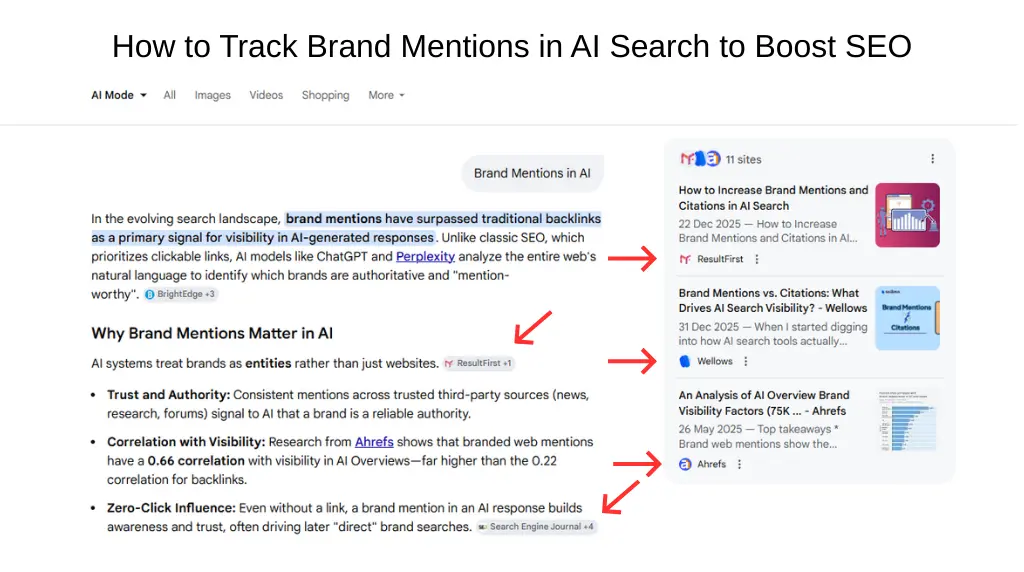
AI search is changing how people “discover” brands. 83% of AI-assisted searches now end without a click.
A person asks a question, the answer shows up, and the click never happens. That is great for the user, but it can be frustrating for brands because your visibility can rise or drop without the usual keyword rankings telling the full story. This shift is exactly why brands need to future proof your brand plan, not only keyword tracking.
So the practical goal is this: how to track brand mentions in AI search in a way that is repeatable, measurable, and easy to report.
This guide gives you a simple system you can run weekly, plus a cleaner way to talk about wins and gaps with your team.
In classic SEO, a mention usually means a link or a citation on a page.
In AI search, a brand mention can look like:
When you track mentions, track the exact wording too. “Acme”, “Acme Inc”, and “Acme CRM” do not behave the same in AI answers.
Cited brands earn 35% more organic clicks. This is not just a vanity metric. Mentions affect real outcomes:
If you can show that your brand appears in answers for buyer questions, you are closer to revenue than a generic ranking report.
Most teams track random prompts. That creates random data.
Instead, build a “query set” that stays stable for at least 4 weeks. Keep it tight and realistic.
That gives you 30 to 40 prompts, which is enough to see patterns without turning this into a full time job.
This is the core step behind how to track brand mentions in AI search results, because AI answers change based on question wording.
You do not need to track everything. Pick the places your audience actually uses.
For a US audience, a practical shortlist is:
Keep the list consistent. If you change channels every week, your report will feel messy.
You can start in a spreadsheet and still get solid insights.
Use these columns:
This helps you run how to track brand mentions in AI search engines in a way that is auditable. If a stakeholder asks, “Where did this come from?”, you can show it. If your team cares about logs and retention, pair this with AI data governance so reporting stays consistent.
AI answers can change based on location, account history, and wording.
To reduce noise:
It sounds basic, but consistency is the difference between “trend” and “random screenshot”.
A simple scoring model makes your report useful.
Try this scoring:
Add one more tag: “Top position in answer” if your mention appears early. Early mentions get remembered.
This method makes how to track brand mentions in AI searches easier to explain to non-SEO teammates, because you can show a single number trend.
If you only track your name, you miss the real story.
In the same sheet, log:
This is the easiest way to discover what content AI systems trust in your niche.
Example: If a competitor keeps getting mentioned for “pricing transparency,” you just found a content gap to fix on your own site.
Tracking is pointless if it does not change what you publish.
Here are common patterns and what to do next:
What to do:
What to do:
What to do:
If you are doing this for one brand, a sheet can be enough.
If you manage multiple brands or many prompts, consider automation:
One caution: do not violate any platform terms by aggressive scraping. If you automate, do it politely and document the method.
Keep it simple:
That is enough to make this real for leadership and useful for content teams.