n8n vs Make vs Zapier: Which Handles AI Agents
253 Views
Summarize Article



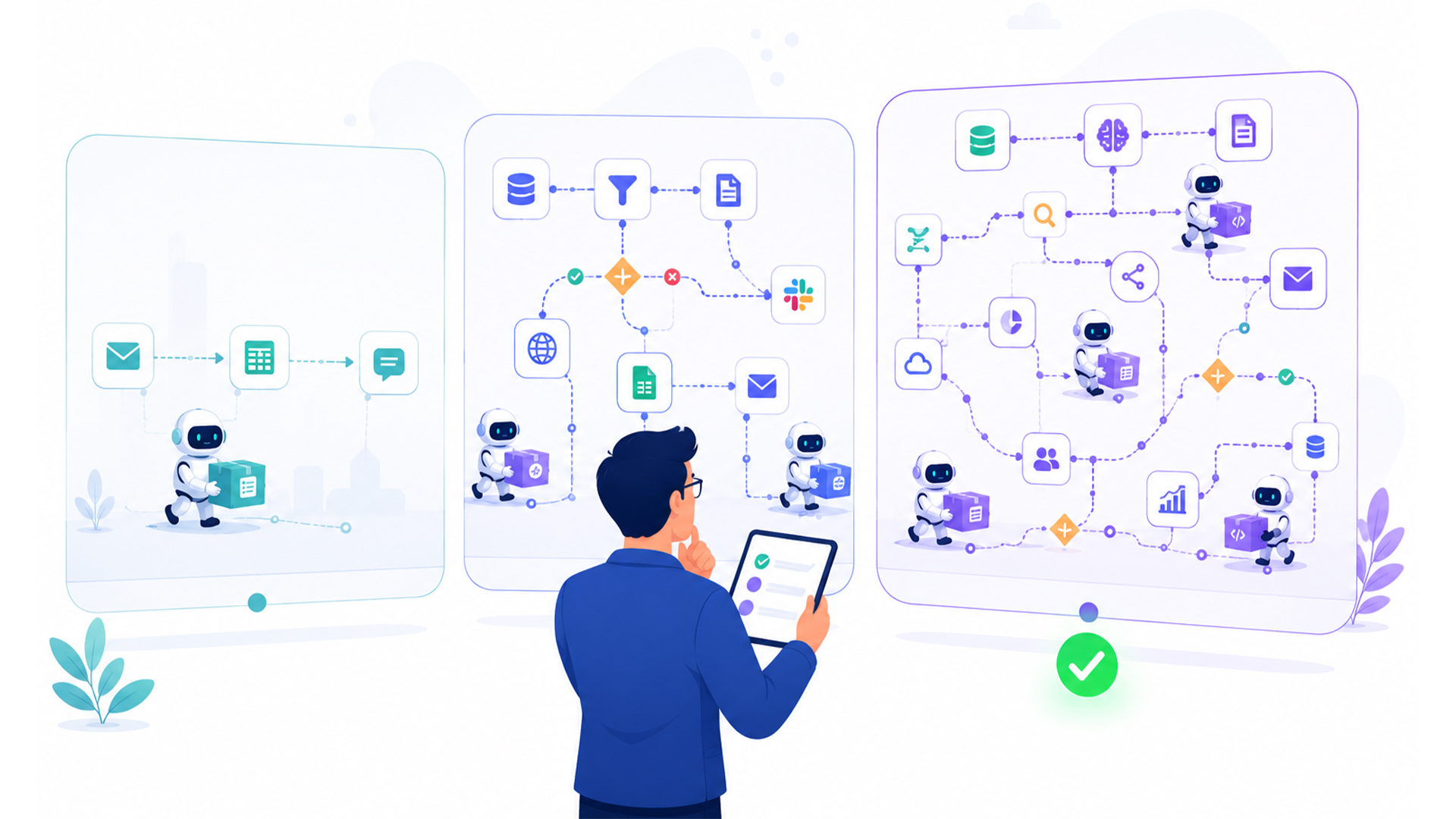
n8n vs Make vs Zapier AI agents: the marketing for all three platforms sounds similar in 2025, connect your tools, build agents, automate workflows with AI. The underlying architectures are not similar, and the difference matters once the workflow moves beyond a simple trigger-action chain into something that requires multi-step reasoning, RAG retrieval, conditional logic, or self-hosted data sovereignty.
The global AI automation market was valued at USD 129.92 billion in 2025, per Grand View Research, growing at 31.4% CAGR through 2033.
The Enterprise Agentic AI segment is accelerating even faster, from USD 6.76 billion in 2025 to USD 46.04 billion by 2030 at a 47% CAGR, per MarketsandMarkets. Workflow automation platforms are the primary on-ramp for that investment in many teams, particularly in the operational functions of eCommerce, logistics, healthcare, and fintech where non-developer staff need to work within the same AI pipeline as engineers.
This guide compares n8n vs Make vs Zapier AI agents on the dimensions that matter for production AI workflows: agent architecture, LLM flexibility, MCP support, self-hosting, compliance, and where each platform reaches its limits.
Building AI agent workflows and not sure which automation platform fits your stack?
WebOsmotic builds custom AI workflows on n8n, Zapier, and Make, selecting the right platform based on your team’s technical profile, compliance requirements, and workflow complexity. We work with fintech, eCommerce, healthcare, and logistics teams.
Before 2024, choosing between Zapier, Make, and n8n was primarily an operational decision: which platform had the integrations you needed, at a price your team could justify, with a user interface that matched your team’s technical ability. The AI capabilities of each were limited to calling a GPT-3.5 endpoint and passing the response to the next step.
That has changed. All three platforms have shipped substantial AI agent capabilities, and the choices made in each product reflect fundamentally different philosophies about where AI fits in a workflow.
Zapier built AI agents that sit on top of its 9,000-plus integration library as a governance-first enterprise feature. Make built AI agents as transparent, inspectable decision steps within its visual scenario builder. n8n redesigned its core architecture around LangChain integration, native MCP support, and multi-agent orchestration as first-class primitives, the pattern that defines the n8n vs Make vs Zapier AI agents debate today.
Zapier is the oldest and most widely adopted of the three platforms, with 81 billion automated tasks and nearly 15 years of operation. Its primary value proposition in 2025 is not the width of its AI model support or the depth of its agent reasoning.
It is the combination of the largest integration library in the market with enterprise-grade governance controls that pass security reviews in regulated industries, per Zapier’s own guidance.
Make (formerly Integromat) positions itself as a visual automation platform where the entire workflow logic, including AI agent decision steps, is visible and inspectable in a diagram. Its February 2026 AI Agents launch introduced reusable agents that work across multiple workflows, with a transparency-first design philosophy that makes agent decision logic explicit rather than hiding it inside a black-box AI step.
n8n describes itself not as a chat interface with a brain, but as an automation engine first, where agents trigger, act, and complete tasks across hundreds of LLMs, services, data sources, MCP servers, and other agents out of the box.
This positioning reflects a fundamentally different design philosophy from Zapier and Make. n8n was not a workflow tool that added AI. It is an automation engine that was redesigned to treat AI agents as a core use case alongside traditional automation.
| Dimension | n8n | Make | Zapier |
| AI agent architecture | LangChain-native, MCP client and server, multi-agent orchestration, RAG with vector databases | Visual scenario-based agents with MCP client and server, transparency-first design | Agents on top of 9,000+ integrations, human-in-the-loop, guardrails, model flexibility |
| LLM model flexibility | Any LLM via API or local deployment (Ollama). Swap models per workflow step | OpenAI, Anthropic, Gemini, Azure OpenAI, Mistral, Hugging Face, OpenAI-compatible models | Anthropic, OpenAI, Gemini, and other frontier models |
| MCP support | Native MCP client and MCP server. Call n8n workflows from other AI systems | MCP client and MCP server. Stateless Streamable HTTP. Introduced November 2025 | Zapier MCP: external AI systems can call Zapier’s 9,000+ integrations |
| Self-hosted deployment | Yes. On-premises, private cloud, or n8n cloud | No. Cloud-only | No. Cloud-only |
| Integration library | Hundreds of pre-built nodes. HTTP Request node for custom integrations | 3,000+ apps | 9,000+ apps, the widest library in the market |
| Enterprise compliance | Self-hosted provides full data control. n8n Cloud offers SOC 2 | Cloud-hosted. Evaluate data processing terms for compliance requirements | SOC 2 Type II. SSO, admin controls on Enterprise. 13+ years of credential management |
| Technical skill required | High. JavaScript/Python comfortable | Medium. Visual builder accessible to operational teams | Low-to-medium. Designed for non-technical users |
| Pricing model | Free open-source self-hosted. n8n Cloud from $20/month | Free tier. Core from €9/month. Pro from €16/month | Free tier. Paid from $33.33/month (billed annually) |
The n8n vs Make vs Zapier AI agents choice is primarily determined by four variables: the technical profile of the team building and maintaining the workflows, the compliance and data sovereignty requirements of the deployment environment, the complexity of the AI agent workflows, and the integration coverage required.
WebOsmotic’s answer to the n8n vs Make vs Zapier AI agents question depends on the client: we use n8n as the primary orchestration layer for clients in fintech, healthcare, and logistics where data sovereignty, LangChain integration, or RAG pipelines are required, visible across our case studies.
For clients with existing Zapier or Make footprints, we build the AI agent layer in n8n or custom code and connect it to the existing integration infrastructure rather than replacing it.
Ready to build AI agent workflows that match your team’s technical profile and compliance requirements?
WebOsmotic architects and builds custom AI workflows on n8n, Zapier, and Make. We evaluate your integration requirements, agent complexity, and data governance needs before recommending a platform. We work with fintech, eCommerce, healthcare, and logistics teams across India and the US.
→ Get your free workflow consultation
The fundamental difference is architectural. Zapier and Make are workflow automation platforms that added AI agent capabilities to their existing trigger-action infrastructure. n8n is an automation engine that was redesigned from the ground up to support AI agents as a core use case, with LangChain integration, MCP client and server support, multi-agent orchestration, and RAG with vector databases as first-class features.
Zapier has the widest integration library at 9,000-plus apps with the strongest enterprise compliance posture. Make provides visual transparency of agent decision logic. n8n provides the deepest technical control over agent behaviour and is the only one of the three that supports self-hosted deployment for data sovereignty requirements, the deciding factor in most n8n vs Make vs Zapier AI agents evaluations.
Yes to both. n8n AI agents are built on the LangChain library, with LangChain nodes for agent configuration, memory types, interchangeable LLMs, and structured output parsing available in the visual builder. On self-hosted n8n, the LangChain Code node enables fully custom agent logic.
n8n also supports MCP as both a client, connecting to external MCP servers via the MCP Client Tool node, and as a server, allowing other AI systems including Claude and ChatGPT to call n8n workflows as tools. This bidirectional MCP support makes n8n a connective layer in the broader AI agent ecosystem.
Yes. Zapier Agents allow non-technical teams to build AI teammates that access 9,000-plus app integrations, support models from Anthropic, OpenAI, and Gemini, include built-in human-in-the-loop approvals, and have AI guardrails for prompt injection and PII scanning. Zapier MCP also allows external AI systems to use Zapier’s integration library.
The primary limitations for complex AI agent workflows are that Zapier’s architecture is optimized for linear trigger-action chains rather than cyclical stateful agent reasoning, and it is cloud-only with no self-hosting option.
Make’s AI Agents, launched in February 2026, are well-suited for operational teams that need visual transparency of AI decision logic within complex workflows. Make supports MCP client and server, integrates with 3,000-plus applications, and supports a wide range of LLM providers including OpenAI, Anthropic, Gemini, and Azure OpenAI.
Its visual scenario builder makes agent execution traceable and understandable for non-developer operators. The limitations are cloud-only deployment, a smaller integration library than Zapier, and less technical depth than n8n for teams that need LangChain-level agent control or custom RAG pipelines.
n8n is the only one of the three that supports self-hosted deployment. It can run entirely on-premises, in a private cloud, or on n8n’s managed cloud service. Gartner Peer Insights reviewers cite the self-hosted model as providing stronger data governance and infrastructure management freedom.
For teams in regulated industries with data sovereignty requirements that prohibit sending data to third-party cloud services, self-hosted n8n with local LLM support provides a fully internal workflow automation and AI agent capability.
WebOsmotic evaluates automation platform choices based on your team’s technical profile, compliance requirements, integration coverage needs, and AI agent complexity. For clients requiring self-hosted deployment, LangChain-level agent control, or RAG pipelines, we recommend and implement n8n.
For clients with large existing Zapier or Make footprints, we typically build the AI agent layer in n8n or custom code and connect it to the existing integration infrastructure. This is the same evaluation process behind every n8n vs Make vs Zapier AI agents recommendation we make.