OpenAI API vs Gemini API: Token Cost Is Not the Point
190 Views
Summarize Article



Key takeaways
|
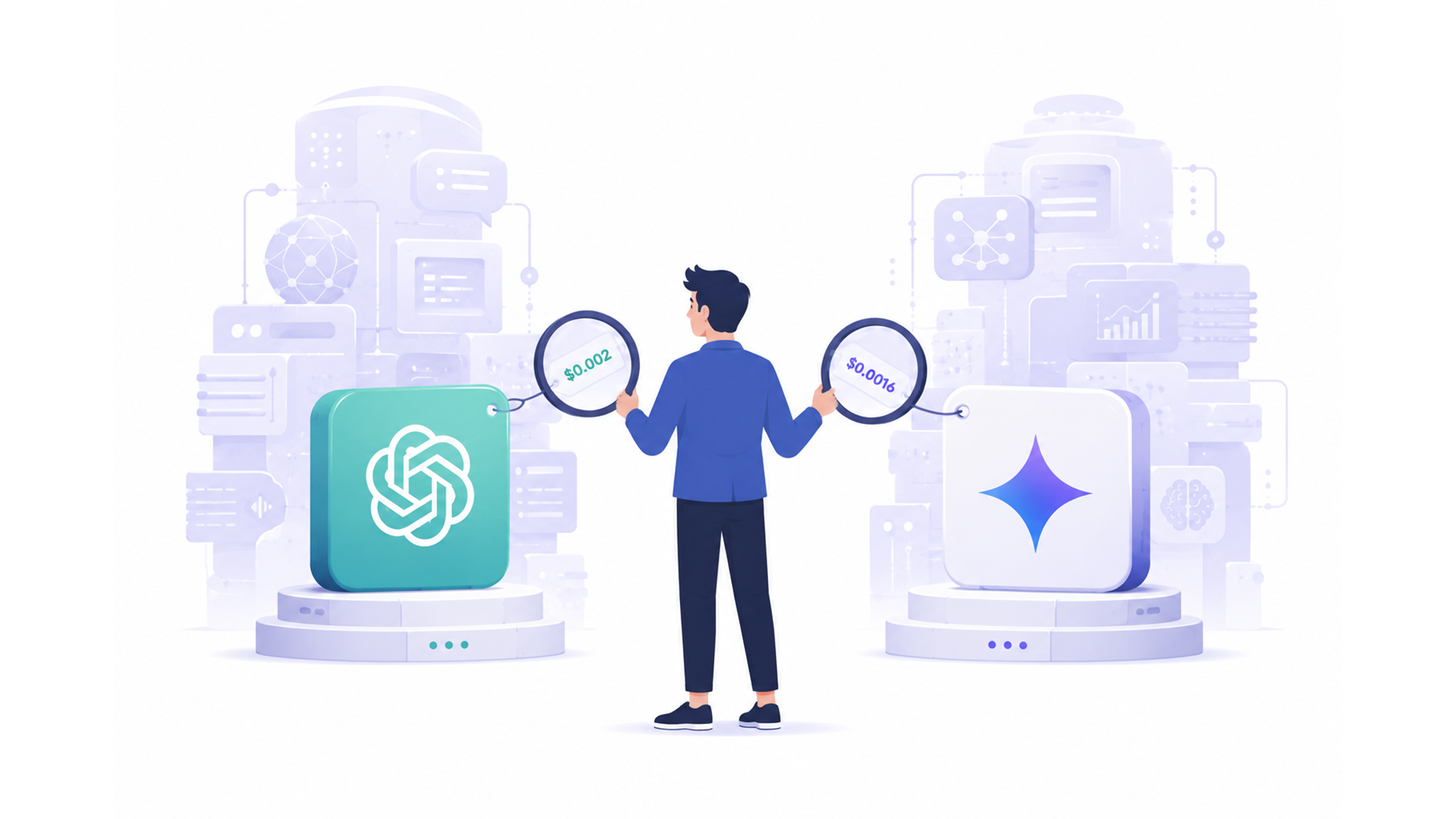
Every team evaluating LLM APIs spends the first thirty minutes on the pricing page. Token costs are visible, comparable, and easy to model. They are also, for most enterprise decisions, not the most important variable.
The decision that determines whether an LLM API will still be appropriate for your product in 18 months is the combination of context window size, multimodal capabilities, ecosystem integration, compliance posture, and how the API performs on your specific tasks, not on someone else’s benchmark. OpenAI and Google Gemini both offer competitive token pricing. The difference between them shows up in the dimensions that are harder to quantify at the evaluation stage.
OpenAI’s developer ecosystem is the most mature of any model provider. Gartner Peer Insights reviewers note that the OpenAI platform dashboard is intuitive with clear permissions management and predictable cost controls, while the developer community is one of the most active of any AI platform. Google’s Gemini 2.5 series, generally available on Vertex AI, brings a one-million-token context window, native multimodal understanding across text, image, audio, and video, and deep integration with Google Cloud’s data infrastructure.
| Building an AI product and evaluating which LLM API to standardise on? WebOsmotic’s engineering team evaluates OpenAI, Gemini, Anthropic, and open-source models against your specific capability, cost, and compliance requirements. We build production AI products for fintech, healthcare, eCommerce, and logistics. |
OpenAI’s model lineup as of 2025 spans GPT-5, GPT-5.4, and their respective variants. The key capabilities for enterprise evaluation are:
Google’s Gemini 2.5 series represents the current generation, with Pro, Flash, and Flash-Lite variants optimized for different latency and cost points. All models are available through the Gemini API directly and through Vertex AI on Google Cloud.
| Dimension | OpenAI API | Gemini API (Vertex AI) |
| Context window | GPT-5/5.4: 1.05M tokens (272K standard rate; above that 2x priced) | Gemini 2.5 Pro/Flash: 1M tokens standard; historical support up to 2M |
| Multimodal input | Image, document, audio via GPT-4o and GPT-5 family | Text, image, audio, video natively in a single model call. No modality routing required |
| Real-time data access | Web search tool available as an API option | Grounding with Google Search built into Vertex AI Gemini models |
| Reasoning models | GPT-5 and o-series with extended reasoning. Configurable reasoning effort | Gemini 2.5 series with controllable thinking budgets. Flash-Lite for efficiency |
| Batch pricing | 50% of standard rate for non-urgent workloads via Batch API | Vertex AI batch prediction available; pricing varies by model and region |
| Data privacy | Zero Data Retention option. Prompts not used for training | On Vertex AI: your data is not used to train Gemini models. Customer data isolation |
| Data residency | Regional processing at 10% uplift on GPT-5.4 | Vertex AI supports data residency with DRZ compliance requirements |
| Enterprise compliance | SOC 2; HIPAA available under BAA. Suitable for regulated workloads | Vertex AI: HIPAA, SOC 2, ISO 27001, GDPR. VPC Service Controls, CMEK |
| Developer ecosystem | Largest developer community. Extensive tooling, documentation, integration support | Strong Google Cloud ecosystem. Deep BigQuery, Cloud Storage, Dataflow integration |
| Model selection | GPT-5, GPT-5.4, GPT-4o, GPT-4o mini, o-series reasoning models | Gemini 2.5 Pro, Flash, Flash-Lite, plus open-source Gemma models |
The practical impact of a one-million-token context window is not that teams will fill it on every call. It is that it changes which architectural patterns are viable. With a 128K context window, every long-document use case required a RAG pipeline to fit relevant chunks into the available context. With a million-token window, many of those same use cases can pre-load entire documents, contracts, or codebases into context at query time.
Accessing Gemini via the Gemini API directly is appropriate for prototyping and small-scale production. For enterprise deployment, the relevant access path is through Vertex AI on Google Cloud, which adds a layer of infrastructure and compliance controls that changes the comparison significantly.
For teams building on AWS or Azure, WebOsmotic’s AI development services frequently use OpenAI’s API or Anthropic’s models via those clouds’ managed services, where the compliance and integration story aligns better with the existing infrastructure. For teams on Google Cloud, Gemini on Vertex AI is usually the cleaner architecture.
The right evaluation framework for OpenAI vs Gemini is not running the same public benchmark on both models. It is evaluating both on a representative sample of the actual tasks, inputs, and edge cases your product will face in production.
WebOsmotic’s AI product engagements always include a structured model evaluation phase before the API is committed to in the architecture. For clients in fintech and healthcare, the compliance verification step is completed before any prototype is built, not after it is already in production.
| Evaluating OpenAI vs Gemini for a specific product or use case? WebOsmotic builds AI products using OpenAI, Gemini, Anthropic, and open-source models. We evaluate and often combine APIs based on capability, cost, and compliance. Our work spans fintech, healthcare, eCommerce, and logistics clients across India and the US. |
Is GPT-5 or Gemini 2.5 the better model in 2025?
Both are frontier models with strong benchmark performance. GPT-5, per OpenAI’s official benchmarks, achieves 94.6% on AIME 2025 math, 74.9% on SWE-bench Verified, and 84.2% on MMMU multimodal reasoning. Gemini 2.5 Pro, per Google Cloud’s documentation, excels at complex reasoning over dense documents, entire codebases, and multimodal inputs across text, image, audio, and video with a 1-million-token context. The ‘better’ model depends on your specific task. Performance on your domain and your data matters more than headline benchmark scores on someone else’s test set.
What is the context window difference between OpenAI and Gemini?
GPT-5.4 supports 1.05 million tokens, with prompts above 272K tokens priced at 2x the standard rate for the full session. Gemini 2.5 Pro and Flash both support 1-million-token context windows at standard pricing. Google Cloud’s long-context documentation notes that Gemini 1.5 Pro previously supported up to 2 million tokens. The practical implication is that large-context workloads, including full-document analysis, full codebase understanding, and long conversation history, are viable without RAG on both platforms, but the cost model differs at the upper end of the context range.
Is Gemini API enterprise-ready for regulated industries?
Yes, when accessed through Vertex AI on Google Cloud. Vertex AI Agent Engine supports HIPAA workloads, meets Data Residency Zone requirements, supports VPC Service Controls for data exfiltration prevention, and provides Customer-Managed Encryption Keys. Google explicitly states that customer data is not used to train Gemini models on Vertex AI. Teams in healthcare, fintech, or other regulated industries should use the Vertex AI path rather than the direct Gemini API, as the compliance controls are part of the Vertex AI infrastructure layer, not the model API itself.
What are OpenAI API’s enterprise compliance capabilities?
OpenAI offers Zero Data Retention (ZDR) for sensitive workloads, ensuring that input, prompts, and outputs are not stored beyond the immediate processing window. HIPAA compliance is available under a Business Associate Agreement. SOC 2 Type II certification is in place. GPT-5.4 adds regional processing endpoints with a 10% pricing uplift for data residency requirements. Gartner Peer Insights reviewers specifically cite ZDR as a purchase decision factor for enterprise clients managing sensitive campaigns and client data.
Should I use the Gemini API or Vertex AI for production?
For prototyping and small-scale production, the Gemini API accessed directly is faster to set up. For enterprise production, particularly in regulated industries or in organizations already on Google Cloud, Vertex AI is the correct path. It adds HIPAA compliance, VPC Service Controls, CMEK, data residency, IAM integration, and deep connectivity to Google Cloud’s data services. The model capabilities are the same: the Vertex AI path adds the compliance and infrastructure layer that enterprise deployment requires.
How does WebOsmotic select between OpenAI and Gemini for client projects?
WebOsmotic evaluates four variables: the specific task the model needs to perform and which model family performs best on it, the compliance requirements of the deployment environment, the existing cloud infrastructure (AWS, Azure, or GCP), and the total cost at projected volume. Many production systems use more than one model provider, routing different task types to the model best suited to handle them. We build on OpenAI, Gemini, Anthropic, and open-source models depending on the requirements, and the selection is made at the architecture stage, not based on familiarity.