Sovereign AI Explained: Why Countries Want Control Over Their AI Stack
76 Views
Summarize Article



Summarize Article
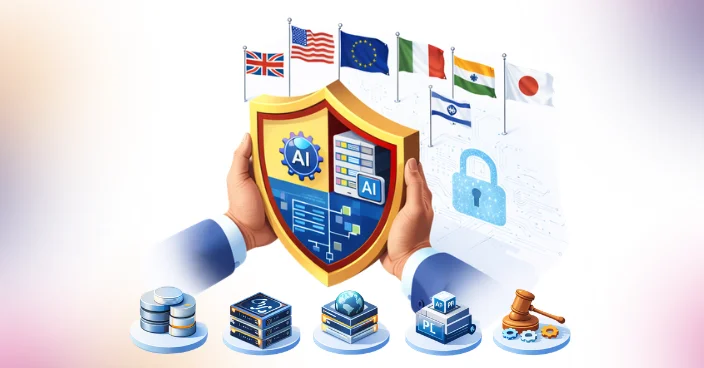
A lot of leaders like the idea of using powerful AI, but they also hate one feeling: “We do not control this.” When core models sit inside someone else’s cloud, trained on unclear data, and governed by rules that can change overnight, it starts to look less like “innovation” and more like “dependency.”
That is why Sovereign AI is getting serious attention. It is not a trend name. It is a reaction to existent pressure in areas of national security, critical infrastructure, government information and local regulation.
The current international survey of AI implementation and capability development also illustrates the accelerating pace of the increasing stakes. This is why the governments are attempting to consider getting the control in place before the divide grows wider.
Let us answer the search question directly: what is Sovereign AI?
Sovereign AI means a country can run and govern key AI systems under its own rules. That usually includes control over data location, model access, security policies, and the ability to audit how the system behaves.
A quick way to think about model choice here is generative AI vs predictive AI, since Sovereign stacks often mix both for different risks.
A simple Sovereign AI definition is this: AI that is operated under the legal and operational authority of a nation, not only under a vendor’s terms.
The Sovereign AI meaning is not “build everything alone.” It is “own the decision rights,” even if partners help with parts of the build.
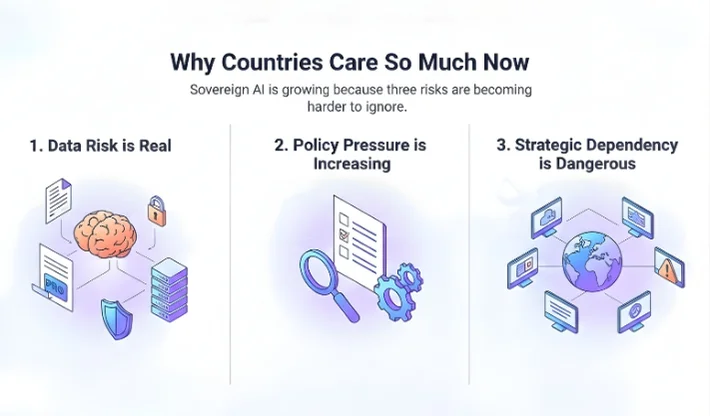
Sovereign AI is growing because three risks are becoming harder to ignore.
Public sector data can include health records, tax details, court documents, and security signals. If that data is processed in a place that cannot be inspected, a government has a real exposure, even if nothing “bad” happens today.
Regulated sectors already deal with strict oversight, so this piece on AI in healthcare shows what governance looks like in real workflows.
AI rules are getting tighter in many regions. Governments need systems that can prove compliance, show logs, and follow local constraints. Once rules apply, “trust us” is not enough.
When a nation relies on foreign computers and models to educate, protect, treat, and identify individuals, it may be compressed by the price changes, access measures, export regulations or geopolitics. Even such a tiny break can cause detention throughout the services that people use every day.
When people say “control over the AI stack,” they mean control over the layers that make AI usable in real life.
Here is a clean way to think about it:
A Sovereign approach can cover all layers, or it can focus on the most sensitive layers and keep lower-risk layers more flexible. If you want fast, low-cost inference inside controlled systems, SLMs are often the practical starting point.
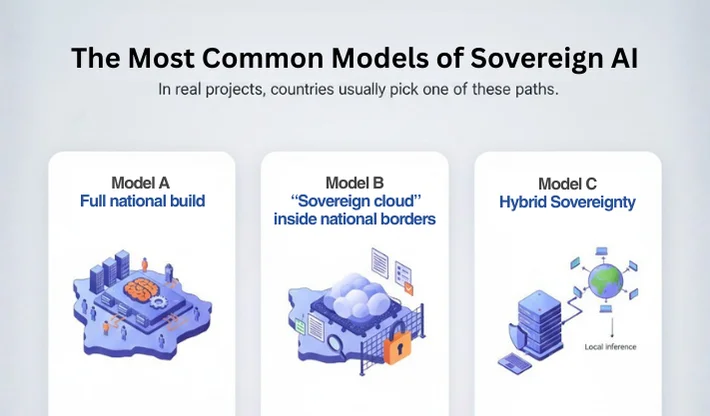
In real projects, countries usually pick one of these paths.
The country invests in local compute, local teams, and long-term capability building. This is expensive and slow, but it gives maximum control.
Best fit: defence use cases, national identity, and highly sensitive citizen data.
Compute and storage run in-country, controlled by local entities, with strict controls. Vendors may supply tech, but the country sets the rules on data residency, access, and auditing.
Best fit: public services, regulated industries, and national health systems.
Sensitive workloads run in-country, while lower-risk workloads use global services. The goal is practical control without blocking progress. Hybrid setups often use local inference too, so it helps to understand embedded AI and how devices make quick decisions without a round trip.
Best fit: countries that need speed now and deeper build-out later.
A typical enterprise AI project can succeed with strong product thinking and decent security. A Sovereign AI program needs extra discipline.
You need written rules on:
This sounds basic, but many programs fail here because “useful data” keeps expanding unless someone stops it.
Sovereign AI is not only about running models. It is about proving control. That means audit logs, model cards, evaluation reports, and repeatable testing.
A practical anchor many US teams use is the NIST AI Risk Management Framework, since it gives a structured way to map risks and controls.
If a vendor can change model access, pricing, or usage policy without negotiation, you do not have Sovereignty. Contracts need clauses for:
Even with strong partners, you need local people who can evaluate models, run red teams, and respond to incidents. A country that cannot operate the system will always be dependent.
Sovereign AI can be the right move, but it is not “free.”
Compute is expensive. Skilled talent is expensive. Security and compliance add ongoing work. If leadership expects “quick wins at SaaS cost,” the program will disappoint.
Global platforms ship updates quickly. Sovereign environments move slower because changes require review, audits, and approvals. That friction is sometimes the whole point, but it must be accepted.
Some cutting-edge tools appear first in open ecosystems. Sovereign setups might lag unless the country invests in developer programs, research partnerships, and open standards.
Many governments are not chasing Sovereignty only for “control vibes.” They are preparing for enforcement realities.
To illustrate, the EU AI Act places responsibilities on teams that compel them to be more documented, have more control and accountability on high-risk systems.
However, large vendors and global supply chains tend to embrace similar controls even in the case of a country without the EU. So the operationalization of compliance, not only legal, is also possible with the help of Sovereign AI.
Sovereign AI is a practical strategy: keep decision rights close to home while building AI capabilities that a country can trust in crises, not only in demos. The best programs start small with high-value, high-sensitivity workloads, then grow capacity step by step as governance and local talent mature.
WebOsmotic can help teams design a Sovereign AI roadmap that keeps data residency, auditability, and decision rights clear on day one.
If you want to move fast without losing control, WebOsmotic can help you pick the right stack and governance model for your country’s risk level.
No. Banks, hospitals, and critical infrastructure providers also adopt Sovereign-style controls when they handle sensitive data and must prove compliance.
Not always. Some countries use existing models but run them in controlled environments with strict access, auditing, and clear update rules.
Unclear data boundaries. If teams cannot clearly say what data is allowed and what is banned, trust breaks and the program stalls.
Yes, in some cases, using in-country Sovereign cloud setups or tightly controlled hybrid deployments. Full independence is harder without local compute.
They show evidence: data residency controls, audit logs, evaluation results, update governance, vendor portability plans, and named accountability owners.