Conversational AI in Ecommerce: Next-Level Customer Interaction
281 Views
Summarize Article



Summarize Article
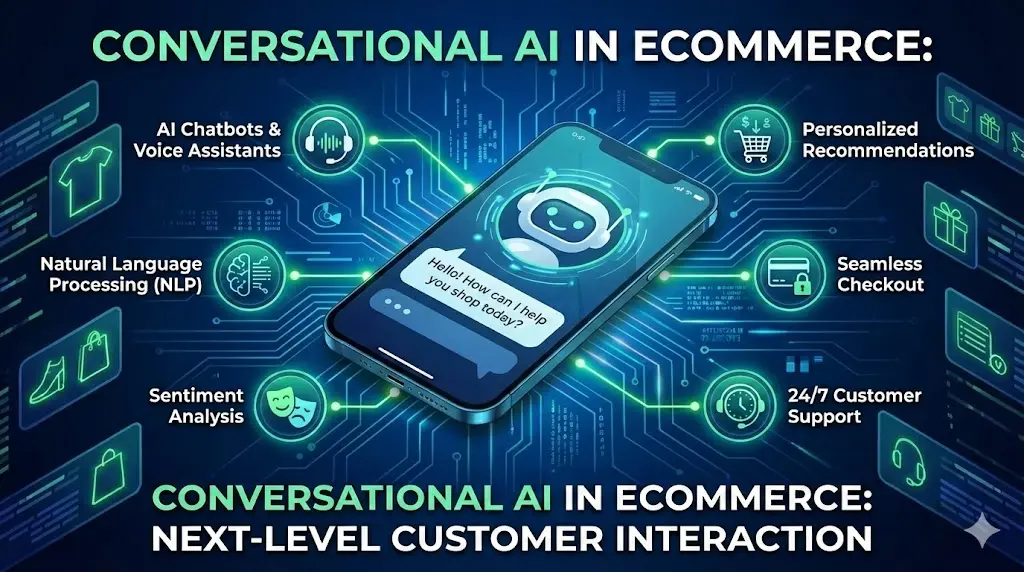
Online shopping is fast, but questions still slow people down. “Is this in stock?” “Will it arrive before Friday?” “How do I return it?” If the buyer cannot get an answer in ten seconds, many just leave. That is where conversational AI ecommerce becomes practical.
This need for speed is measurable. A HubSpot study found 90% of customers rate an “immediate” response as important, and 60% say “immediate” means 10 minutes or less.
It puts helpful replies and guided choices right inside the shopping journey, without forcing the customer to open a ticket and wait.
This article breaks down how conversational tools work in real ecommerce teams, what to use them for, and how to roll them out without making your store feel robotic.
Conversational AI is software that can talk with shoppers in natural language through chat and voice. In ecommerce, it usually lives on product pages, the cart, checkout, and post purchase support. It can answer common questions, guide product discovery, and hand off to a human agent when things get tricky.
The goal is simple. Reduce friction and keep the customer moving with confidence. If you want the bigger picture of how AI fits into an online store, see what is AI-powered ecommerce.
When people say conversational AI in ecommerce, they usually mean two things:
Not every use case is worth building on day one. Start where intent is high and the questions are predictable.
A shopper might type, “I need a black dress for a winter wedding.” A good assistant asks one or two follow ups, then shows a short set of options. This feels closer to an in store helper than a search bar.
This is one of the best places for a conversational AI chatbot for ecommerce, because it turns vague intent into a product list the customer can act on. For practical examples of product suggestions and tailored journeys, read AI ecommerce personalization.
Sizing charts exist, but many shoppers still hesitate. A conversational layer can ask for height and fit preference, then suggest the right size based on your brand’s returns data. On electronics, it can help confirm compatibility, like cable types and device models.
Checkout is where anxiety spikes. Baymard’s cart research found 18% of US online shoppers abandon because checkout feels too long or complicated. That is exactly where a checkout chatbot can reduce confusion around coupons, delivery, and payment errors.
Shipping cost surprises, coupon confusion, and payment failures all happen here. A chatbot can:
Even small reductions in checkout confusion can show up as real revenue.
Order tracking is often the top support driver. Conversational AI can pull order status, show the carrier link, and explain next steps if the package is delayed. It can also reduce “Where is my order” tickets without sacrificing trust.
Most teams picture “a bot that chats.” Under the hood, the quality depends on three building blocks:
A strong conversational AI chatbot solution for ecommerce is not only about wording. It is about connecting the right data and setting safe boundaries. If you are shortlisting tools that plug into catalog and order data, check AI tools for ecommerce businesses.
You do not need a fancy stack to start, but you do need the basics done well.
If a customer says “agent” or “talk to support,” the option should be obvious. Also, the agent should receive context, like order ID and chat history, so the customer does not repeat everything.
Make it good at what it knows. Make it humble when it does not. That usually means:
To keep answers accurate and privacy-safe as you scale, use a simple AI data governance setup.
Personalisation can help, but it should not feel creepy. Simple wins include:
This is where ecommerce conversational AI can improve experience without crossing privacy lines.
Many buyers start on the mobile web, then move to email or SMS. If your assistant can keep context across channels, the experience feels smoother. If not, keep it tight on your highest traffic channel first, then expand.
A clean rollout is usually more important than a big launch.
Start with order tracking and returns, or product discovery and checkout support. Avoid trying to cover the whole store at once.
For each journey, define what a correct answer looks like. Keep them short and plain. Include policy details like timelines and fees, so the assistant stays consistent.
For tracking, you need an order lookup. For product discovery, you need catalogue search and stock status. Keep the first version simple, then add more signals later.
Your first version will miss edge cases. That is normal. Set a weekly review to:
If you see fewer support tickets and better conversion on assisted sessions, then expand into new flows.
If your team wants a guided build with UX and data alignment, WebOsmotic can help map the first two journeys and ship a version that feels like part of the store, not a random widget.
Avoid vanity metrics like total chats. This is not a niche add-on anymore. Gartner reported 54% of customer service teams in its survey already use chatbots or conversational assistants, so measuring quality and resolution matters more than chat volume. Track outcomes that matter.
Good metrics include:
Conversational AI for ecommerce can improve the industry in a very grounded way. It reduces waiting, it lowers confusion, and it helps shoppers finish what they came to do. The best results come when you start with two journeys, connect the right data, and keep improving based on real chats.
If you want to move fast without shipping a messy experience, WebOsmotic can design the flows, connect the store systems, and tune the assistant so it supports customers and your support team at the same time.
It is a chat or voice assistant used on an online store to answer questions, guide product selection, and help with tasks like tracking and returns, using natural language.
No. Support is a strong first use case, but it also helps product discovery and checkout by clearing doubts that cause cart abandonment.
Use approved policy text, connect it to live order and product data, and set rules so it escalates to a human when confidence is low.
In most stores, it handles repetitive questions and routes complex cases to agents. That usually improves agent focus and response quality.
A basic version for tracking and returns can launch in a few weeks if data access is ready and the policy content is clear.