AWS Bedrock vs Vertex AI: Enterprise LLM Infra Showdown
258 Views
Summarize Article



Summarize Article
Key takeaways
|
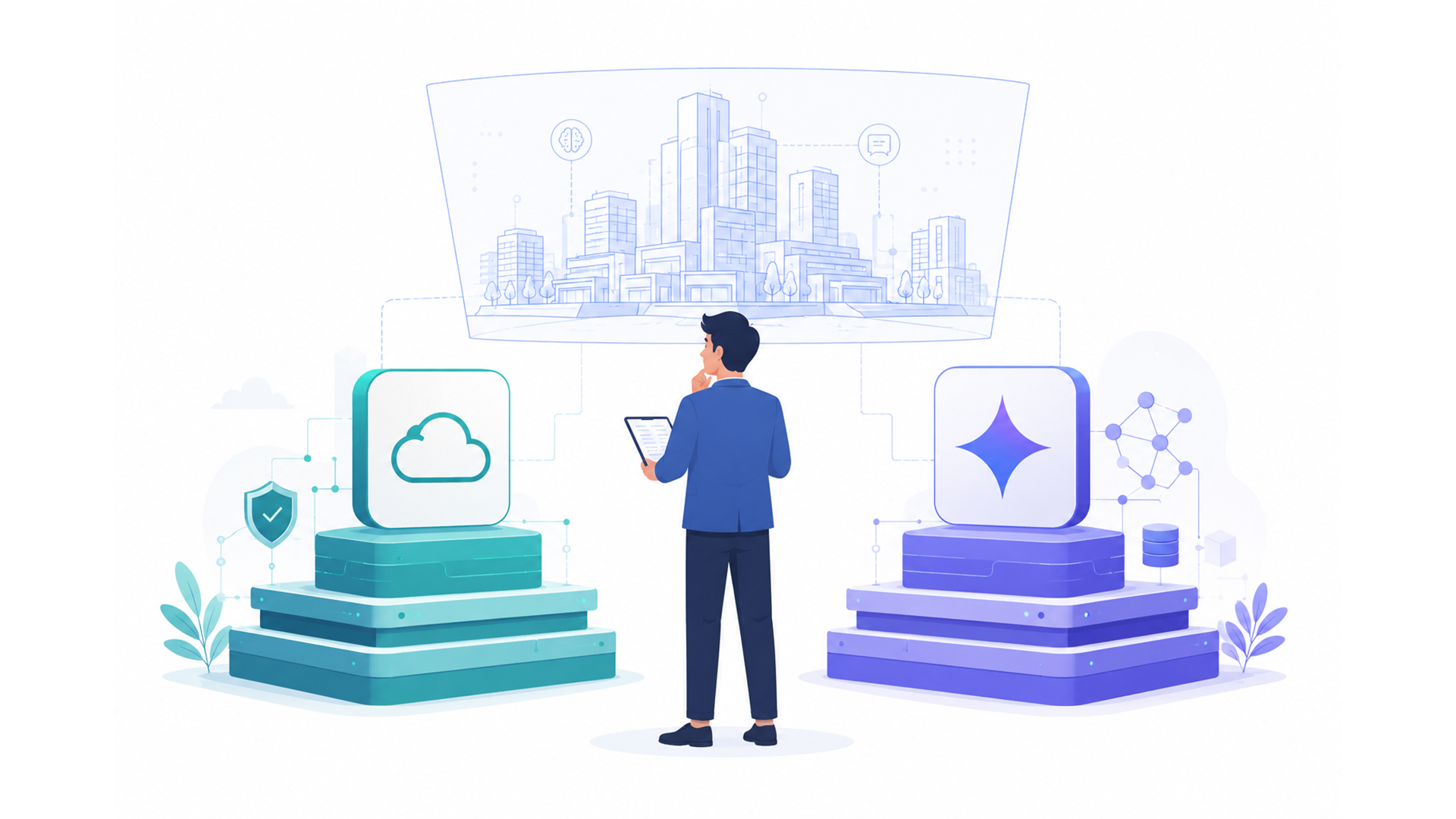
AWS Bedrock and Vertex AI represent the same category: fully managed, cloud-native infrastructure for running large language models in enterprise production environments. Both abstract the infrastructure management of running foundation models. Both provide compliance certifications. Both offer multi-model access. Both handle the security controls that enterprise buyers require.
The difference between them is not primarily a technology difference. It is a cloud infrastructure alignment decision. Teams standardised on AWS will build on Bedrock. Teams standardised on Google Cloud will build on Vertex AI. The meaningful engineering decisions come after that alignment: which models, which compliance controls, and how to architect the agent and RAG layer on top of the managed model access.
The AWS Generative AI Adoption Index, surveying 3,739 senior IT decision-makers across nine countries, found 45% selected generative AI tools as their top budget priority in 2025. Both Bedrock and Vertex AI are positioned as the enterprise on-ramp for that investment within their respective cloud ecosystems.
| Deploying LLMs on AWS or Google Cloud and need to scope the infrastructure architecture? WebOsmotic builds enterprise AI systems on AWS Bedrock, Vertex AI, and Azure OpenAI, evaluating cloud alignment, model selection, and compliance requirements at the architecture stage. We work with fintech, healthcare, logistics, and eCommerce clients. |
Amazon Bedrock is a fully managed service that provides access to foundation models from leading AI providers through a single API, without requiring teams to manage infrastructure, model hosting, or scaling. AWS describes Bedrock as providing industry-leading security, privacy, and compliance for generative AI applications, with customer data never stored or used to train foundation models.
Vertex AI, currently transitioning to Gemini Enterprise Agent Platform, is Google Cloud’s unified AI development and deployment platform. It provides access to Google’s Gemini model family, open-source Gemma models, and third-party models through the Google Cloud infrastructure with enterprise security controls built in.
| Dimension | AWS Bedrock | Vertex AI (Google Cloud) |
| Primary model provider | Anthropic Claude (preferred), Amazon Nova, Meta Llama, Mistral | Google Gemini 2.5 Pro/Flash, open-source Gemma, third-party models via Model Garden |
| Context window | Depends on model: Claude 4.5 Sonnet supports 200K tokens. Amazon Nova varies by variant | Gemini 2.5 Pro and Flash: 1 million tokens standard |
| Compliance (HIPAA) | HIPAA eligible. BAA available. Confirmed in AWS compliance documentation | HIPAA compliant on Vertex AI Agent Engine. BAA via Google Cloud |
| Data not used for training | Confirmed: customer data never stored or used to train base models | Confirmed: customer data not used to train Gemini models on Vertex AI |
| Data residency | AWS Outposts and Local Zones for on-premises/edge data residency. Regional endpoint control | VPC Service Controls, DRZ compliance, Private Service Connect for in-VPC deployment |
| Encryption | In transit (TLS) and at rest (AWS KMS). Customer-managed keys optional | In transit and at rest. CMEK via Google Cloud KMS |
| Agent framework support | AgentCore: LangGraph, LangChain, CrewAI, LlamaIndex, Strands Agents | Agent Engine: A2A protocol, LangGraph, memory bank, code execution sandbox |
| Model selection breadth | Widest third-party model catalogue. Claude, Llama, Mistral, Stability AI, and expanding to include cross-cloud models | Gemini family plus Gemma open models plus expanding third-party Model Garden access |
| Cloud ecosystem fit | AWS IAM, S3, CloudWatch, Lambda, VPC. Best for AWS-native architectures | BigQuery, Cloud Storage, Dataflow, Google Workspace. Best for Google Cloud architectures |
| Multi-model routing | Model Evaluation for comparison. Application-level routing supported | Model Optimizer for automatic routing between Gemini variants |
One of the most significant features of AWS Bedrock from an enterprise architecture perspective is that it provides access to Anthropic’s Claude family within the AWS compliance and security envelope. For teams already on AWS who want Claude’s performance characteristics, Bedrock eliminates the need to call out to Anthropic’s API directly, keeping all inference within the AWS security perimeter.
The most common pattern in enterprise LLM deployment is straightforward: teams choose the managed platform that aligns with their existing cloud infrastructure. An organization with 90% of its data and applications on AWS will choose Bedrock. An organization deeply invested in Google Cloud’s data and analytics stack will choose Vertex AI. The integration density between the LLM platform and the surrounding data infrastructure is more valuable than any model-level capability difference.
WebOsmotic works with clients on both platforms, and the selection is almost always determined by the existing cloud infrastructure first. For clients building on AWS, we use Bedrock with Claude and Nova. For clients on Google Cloud, we use Vertex AI with Gemini. For clients with mixed infrastructure or no strong cloud preference, we evaluate based on model requirements, compliance needs, and total cost at volume.
| Ready to deploy LLMs on your cloud infrastructure? WebOsmotic builds and deploys enterprise AI systems on AWS Bedrock, Vertex AI, and Azure OpenAI. Whether you are starting from scratch or migrating an existing prototype to production infrastructure, we can scope and deliver the right architecture. |
What is the main difference between AWS Bedrock and Vertex AI?
Both are fully managed cloud platforms for deploying LLMs in enterprise production environments. The primary difference is cloud ecosystem alignment: Bedrock is the AWS path, integrating natively with IAM, S3, CloudWatch, and AWS VPC. Vertex AI is the Google Cloud path, integrating natively with BigQuery, Cloud Storage, Google Workspace, and Google’s data services. Model access differs: Bedrock provides Anthropic Claude, Amazon Nova, Meta Llama, and others. Vertex AI provides Google Gemini 2.5, open-source Gemma models, and a growing third-party Model Garden.
Is AWS Bedrock HIPAA compliant?
Yes. AWS documentation confirms that Amazon Bedrock is HIPAA eligible, with a Business Associate Agreement available for organizations processing protected health information. Data is encrypted in transit using TLS and at rest using AWS KMS. Customer data is never stored or used to train foundation models. HIPAA compliance on Bedrock operates under the AWS Shared Responsibility Model, where AWS secures the infrastructure and the customer is responsible for application-level security controls and proper IAM configuration.
Is Vertex AI HIPAA compliant?
Yes. Vertex AI Agent Engine supports HIPAA workloads, per Google Cloud’s Agent Builder documentation. Google provides a Business Associate Agreement for HIPAA-covered workloads. Additional controls include VPC Service Controls for data exfiltration prevention, Customer-Managed Encryption Keys, and Private Service Connect for in-VPC deployment. Not all Vertex AI features meet data-at-rest commitments: teams should verify the specific services in scope for their workload against Google’s current security controls documentation.
Can I use Claude on AWS Bedrock?
Yes. Anthropic’s Claude family, including Claude 4.5 Sonnet and Claude 4.5 Haiku, is available through Amazon Bedrock. This is one of Bedrock’s most widely used model options for enterprise deployments. Using Claude through Bedrock keeps all inference within the AWS security perimeter, with Bedrock’s IAM, CloudWatch, and Guardrails controls applied. Customer data is not stored or used to train models. AWS documentation uses Claude 4.5 Sonnet and Haiku as primary reference examples in Bedrock’s evaluation and benchmarking documentation.
What is Bedrock Guardrails and why does it matter?
Bedrock Guardrails is AWS’s built-in safety and content moderation layer for foundation models. AWS documents it as blocking up to 88% of harmful content and identifying correct model responses with up to 99% accuracy via Automated Reasoning checks. It allows organizations to configure content filters, topic denials, and hallucination detection without building these controls at the application layer. For enterprise deployments in regulated industries where content safety and response accuracy are compliance requirements, Guardrails provides an auditable control layer between the model and the application.
Should teams use Bedrock or Vertex AI for multi-cloud deployments?
For multi-cloud deployments, teams typically choose a primary platform based on where the majority of their data and applications live, then use the secondary platform selectively. Both platforms are moving toward cross-cloud model hosting: AWS is building a runtime that allows models from Microsoft, OpenAI, and Google to run through Bedrock’s API, while Vertex AI’s Model Garden now includes OpenAI models. For most teams, the practical recommendation is to align the primary LLM platform with the primary cloud and route specific model needs to the secondary platform only where a compelling model-level reason exists.