Chatbot Development Frameworks: Skip Rasa, Build This Instead
218 Views
Summarize Article



Summarize Article
Key takeaways
|
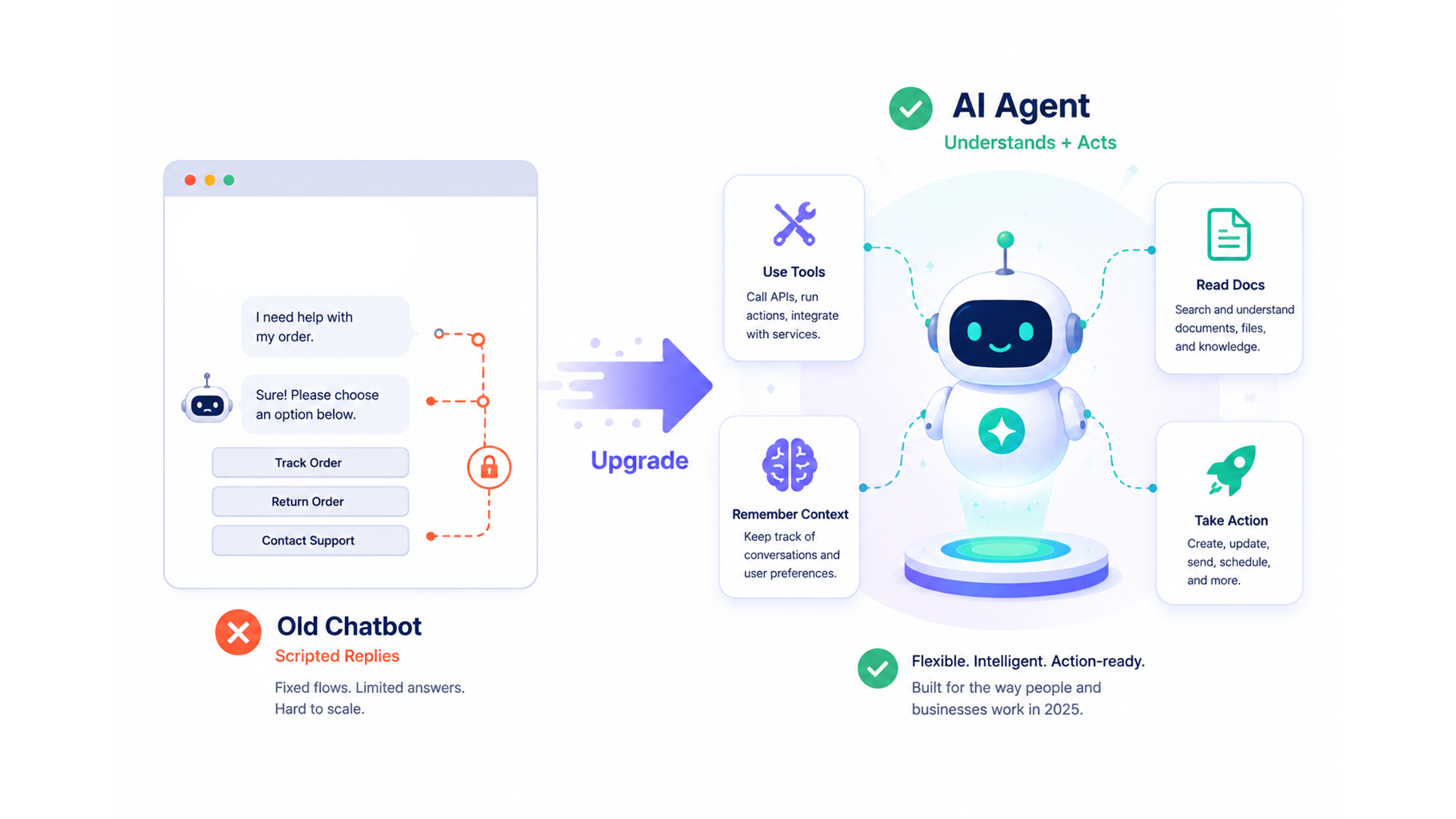
The fastest way to identify whether a chatbot framework belongs to the previous era is to ask how it handles a request it was not explicitly trained for. An intent-based chatbot returns a fallback or confusion response and asks the user to rephrase. An LLM-powered chatbot reasons about the request, retrieves relevant context, and produces a response. The engineering implications of this distinction are substantial enough that the choice of framework, made before the first line of code, determines whether the resulting chatbot can be extended into a production-grade conversational agent or will require a complete rebuild in eighteen months.
The institutional signal that the framework landscape has changed is not subtle. Microsoft announced the archival of its Bot Framework SDK in 2025, documenting that support will no longer be provided as of December 31, 2025, and directing teams to migrate to the Microsoft 365 Agents SDK. The market for intent-based, rule-governed chatbot frameworks has not grown. It has been superseded by LLM-first architectures.
This post maps the four main approaches to chatbot development in 2025, explains where each belongs, and makes the case for which architecture you should build on before your next engagement.
| Building a chatbot or conversational agent and need to choose the right architecture? WebOsmotic builds production LLM chatbots and conversational agents for fintech, healthcare, eCommerce, and logistics. We scope the architecture, select the framework, and deliver the system with evaluation infrastructure included. |
It helps to be precise about what changed. Chatbot frameworks before 2023 were built around the assumption that intent classification and entity extraction were the hard problems. NLU pipelines like Rasa’s original open-source stack were genuinely useful because they solved these problems reliably and cheaply without requiring a large language model. The assumption that intent classification is the hard problem no longer holds. LLMs classify intent as a side effect of generating responses. The hard problems in 2025 are orchestration, state management, tool integration, hallucination control, and compliance.
| Approach | Representative tools | Strengths | When to use |
| Intent-based NLU | Rasa (pre-CALM), legacy rule-based bots | Deterministic, auditable, no LLM cost, works offline | Simple FAQ bots, static IVR replacement, highly scripted workflows with no deviation |
| LLM-native (API-based) | Direct OpenAI/Gemini API, minimal orchestration | Fastest to prototype, maximum model capability, no framework overhead | Proof of concepts, internal tools, simple single-turn Q&A over a bounded knowledge base |
| LLM orchestration framework | LangChain, LangGraph, LlamaIndex | Full control over agent loop, RAG integration, memory, multi-step reasoning, tool use | Production chatbots requiring RAG, multi-step workflows, tool calling, or multi-agent coordination |
| Hybrid (LLM + deterministic flows) | Rasa CALM, Botpress | LLM handles understanding, deterministic flows handle business logic. Best of both | Regulated industry chatbots, high-volume contact centres, workflows where auditability and flow control matter as much as natural language quality |
The headline on this blog is deliberately provocative. The more accurate statement is: if you are evaluating Rasa for a use case where the original intent-and-entity architecture was the right fit, and you have not reviewed what Rasa is now, you may be solving a problem that the current Rasa no longer has.
Rasa has made a decisive shift. CALM, the Conversational AI with Language Models framework, is now the core of Rasa’s architecture. CALM uses LLMs for natural language understanding and response generation while using deterministic flows for business logic execution. Rasa’s chatbot framework comparison blog explicitly positions the framework as model-agnostic: teams can integrate the LLM provider that fits today and switch later without rewriting core orchestration logic.
IBM describes LangChain as an open-source orchestration framework for building LLM-powered applications including chatbots, available in both Python and JavaScript libraries. IBM characterises LangChain as useful for developing simple AI agents with straightforward workflows, providing support for vector databases and utilities for memory that retain history and context.
For chatbot development specifically, LangChain provides:
When a chatbot needs more than a straightforward conversation loop, LangGraph is the architecture to reach for. LangChain’s documentation defines LangGraph as the low-level orchestration framework and runtime that LangChain is built on top of, suitable for complex workflows combining deterministic and agentic steps.
For chatbots, the use cases that push from LangChain to LangGraph are:
Botpress occupies a middle position: more structured than a raw LangChain implementation, less opinionated than Rasa’s CALM, and designed for teams that want a visual development experience for LLM chatbot workflows without giving up the ability to write custom code when needed.
The choice of chatbot development framework in 2025 follows the same pattern as most AI architecture decisions: match the framework to the primary complexity in the system. The primary complexity for most production chatbots is one of four things.
WebOsmotic’s chatbot development practice builds production LLM chatbots for clients in fintech, healthcare, and eCommerce. The framework recommendation comes after the architecture is defined, not before.
| Ready to build a production LLM chatbot on the right architecture? WebOsmotic builds LLM chatbots and conversational agents using LangChain, LangGraph, Rasa, and direct API architectures. We define the architecture before the framework is chosen, and include evaluation infrastructure and monitoring in every production engagement. |
Should I use Rasa or LangChain for chatbot development in 2025?
It depends on whether conversational flow control or LLM orchestration is the primary complexity. Rasa’s CALM architecture is well-suited to regulated industry deployments where chatbot behaviour must be deterministic and auditable, on-premise deployment is required, and the team needs enterprise conversation management features. IBM recommends LangChain for building LLM-powered chatbots with straightforward agent workflows, RAG integration, and tool use. LangGraph, within the LangChain ecosystem, handles complex multi-step workflows and human-in-the-loop patterns that Rasa’s CALM targets with a different architecture.
Is Rasa still relevant in 2025?
Yes, but it is a different product than the Rasa of 2021. Rasa’s CALM framework combines LLM-powered natural language understanding with deterministic flow management, directly addressing the hallucination and auditability problems that pure LLM agents face in regulated production deployments. Rasa was evaluated in the Forrester Wave for Conversational AI Platforms for Customer Service Q2 2026 among 14 leading enterprise platforms. It supports full on-premises deployment, which remains a hard requirement in financial services, government, and healthcare contexts where cloud-based chatbot infrastructure is non-negotiable.
What happened to the Microsoft Bot Framework?
Microsoft archived the Bot Framework SDK in 2025. Per Microsoft’s official documentation, the Bot Framework SDK is no longer updated or maintained, and support tickets will no longer be serviced as of December 31, 2025. Microsoft explicitly recommends migrating existing bots to the Microsoft 365 Agents SDK, which supports C#, JavaScript, and Python. This is the clearest institutional signal that the intent-based, rule-governed chatbot framework generation has been superseded by LLM-first agent architectures.
What is the difference between LangChain and LangGraph for chatbot development?
LangChain provides the higher-level orchestration abstractions for building chatbots: conversation memory, RAG retrieval chains, tool definitions, and model interfaces. IBM describes it as useful for simple AI agents with straightforward workflows. LangGraph is the lower-level runtime that LangChain is built on, providing durable state, checkpoint-based execution, and fine-grained control over the conversation graph. LangGraph is the right choice when the chatbot needs multi-step task completion that must survive interruptions, human-in-the-loop approval steps, or multi-agent routing. LangChain handles most standard chatbot use cases without needing to interact with LangGraph directly.
What is Botpress and when should I use it?
Botpress is a visual LLM chatbot development platform that combines a drag-and-drop flow builder with LLM integration, multi-model support, and built-in knowledge base management. It supports cloud and on-premise deployment. Botpress is the right choice when a team wants a visual development experience with LLM capabilities and built-in knowledge base management without assembling LangChain components from scratch. The tradeoff is a lower customization ceiling than LangChain: teams needing complex multi-agent coordination, custom memory architectures, or deep tool integration will outgrow Botpress’s abstractions.
What LLM chatbot architecture does WebOsmotic recommend for enterprise use cases?
WebOsmotic’s recommendation depends on the primary complexity in the specific use case. For production chatbots that need RAG, tool use, and straightforward conversation management, LangChain is the standard foundation. For chatbots with multi-step task workflows, human-in-the-loop requirements, or multi-agent routing, LangGraph provides the stateful execution primitives that LangChain alone cannot reliably deliver. For regulated industry deployments requiring on-premise hosting and hybrid LLM-plus-deterministic-flow architecture, Rasa CALM is worth evaluating alongside LangGraph. The framework is always chosen after the architecture is defined, not before.