AI in Manufacturing: From Demo to Shop Floor Reality
143 Views
Summarize Article



Key takeaways
|
AI in manufacturing has been running as pilots longer than most industrial technology categories. The first wave of proof-of-concept projects launched in 2019 and 2020 proved that AI could identify equipment failure precursors, detect visual defects faster than human inspectors, and optimize production schedules in ways that manual planning could not. Many of those pilots never made it to the shop floor.
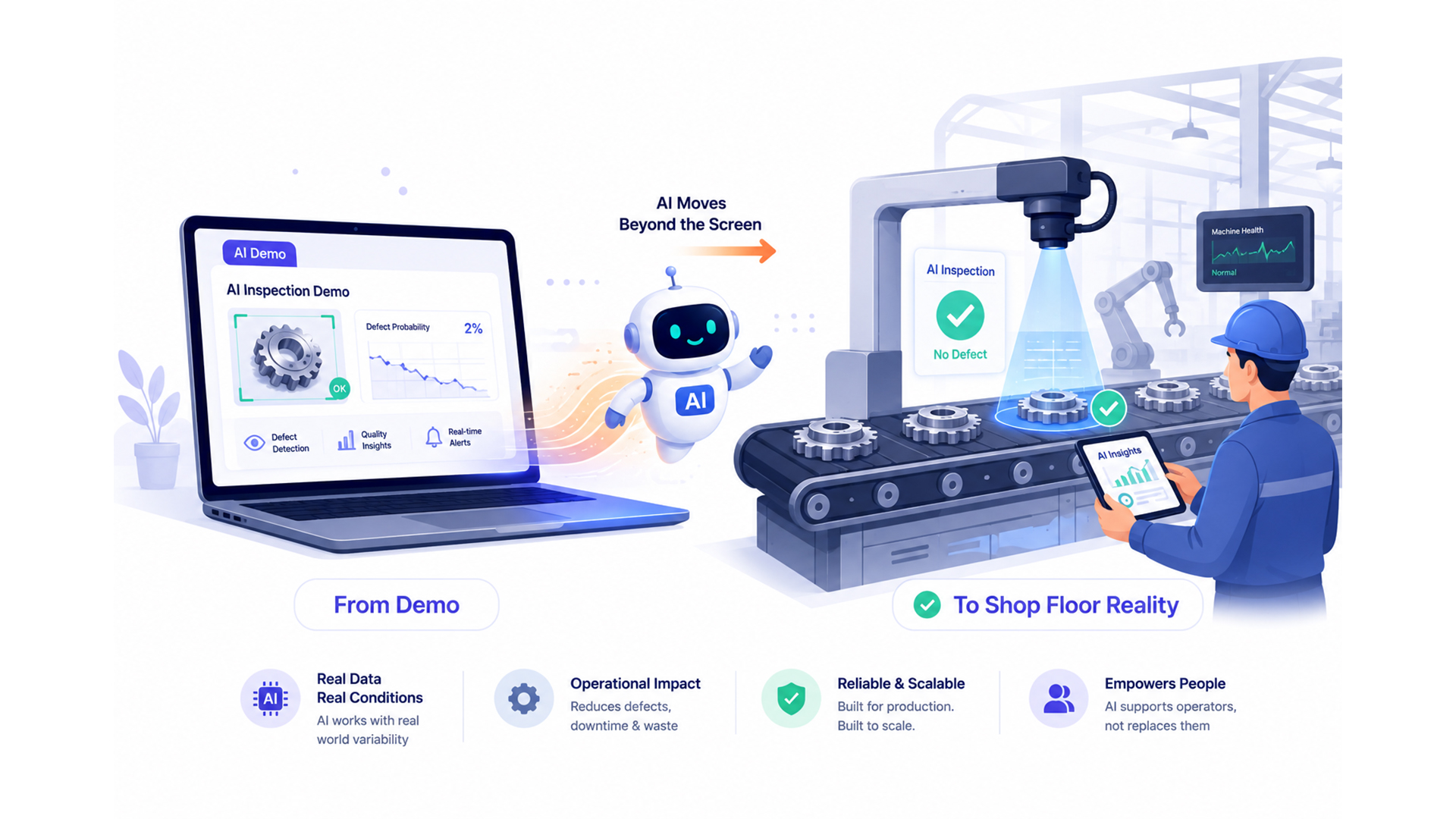
The gap between a successful demo of AI in manufacturing and a production deployment is specific and consistent. The demo runs on clean, labeled data pulled from one machine. Production requires integrating with legacy OT systems, PLC controllers, and SCADA infrastructure that was not designed to send data to a machine learning pipeline. The demo runs in a controlled environment. Production runs in conditions where sensor drift, dust, vibration, and network interruptions are the norm, not exceptions.
The companies crossing that gap at scale are doing so now. MarketsandMarkets projects the US AI in manufacturing market at USD 52.31 billion by 2030, growing at 32.3% CAGR from USD 12.20 billion in 2025, with predictive maintenance and quality control driving the largest share of that growth. This post maps the use cases that are producing shop floor results, the technical architecture they run on, and the deployment barriers that still stop most pilots from reaching production.
| Building an AI system for a manufacturing client and need to scope the architecture? WebOsmotic designs and deploys AI systems for manufacturing teams: predictive maintenance pipelines, computer vision quality inspection, IIoT integration, and production optimization. We scope the data architecture and edge-cloud deployment model at the start of every engagement. |
IBM documents that AI-based predictive maintenance solutions can deliver a 47% reduction in unplanned downtime events, citing IDC’s 2025-2026 Worldwide AI-Enabled Asset Management Assessment. In an industry where unplanned downtime costs between $50,000 and $500,000 per hour depending on the production line, a 47% reduction is a commercial outcome that justifies significant technology investment.
The evolution from scheduled maintenance to predictive maintenance is an architectural shift. Scheduled maintenance replaces components on a calendar. Predictive maintenance deploys IoT sensors that continuously monitor vibration, temperature, current draw, acoustic signatures, and oil chemistry, and uses machine learning models to identify the deviation patterns that precede failure. IBM introduced Maximo Condition Insight in December 2025 specifically to add AI-powered asset health monitoring and predictive insights to its enterprise asset management suite.
IBM documents that AI powers advanced quality control through computer vision systems that scan products in real time to identify defects. The accuracy advantage over manual inspection is well-documented: AI computer vision systems detect defects with accuracy exceeding 90%, compared to 70-80% for manual inspectors, and operate continuously without fatigue effects on detection rates.
The generative AI layer is adding a new capability on top of detection. Traditional computer vision models require thousands of labeled defect images for each defect type. Generative AI can create synthetic defect images that expand the training dataset for rare defect categories, addressing one of the core limitations of computer vision quality inspection: the difficulty of collecting sufficient examples of infrequent failure modes.
Edge AI refers to running AI models on hardware located at or near the production equipment rather than sending data to a centralized cloud for inference. In manufacturing, edge AI is not an architectural preference. It is often a technical requirement.
| Scenario | Why edge AI is required | Why cloud inference fails |
| Real-time quality inspection at line speed | Defect detection must complete in milliseconds to halt the line or divert a defective unit before it reaches the next stage | Network latency adds 50-300ms per inference call. At line speeds of hundreds of units per minute, this is operationally incompatible |
| Predictive maintenance on legacy OT networks | Older manufacturing networks were not designed for high-bandwidth data transmission. Sending raw sensor streams to the cloud may exceed available bandwidth | Industrial control networks often run on air-gapped or bandwidth-limited infrastructure that cannot support continuous cloud data egress |
| Compliance and data sovereignty | Proprietary process parameters and product specifications embedded in sensor data may be subject to trade secret protection or export controls | Sending manufacturing process data to a third-party cloud raises IP and compliance concerns for some defense, pharmaceutical, and semiconductor manufacturers |
| Resilience requirements | Production cannot stop because of a cloud connectivity outage | If the inference endpoint is a cloud API, a network disruption suspends quality inspection and predictive monitoring until connectivity is restored |
A digital twin is a virtual replica of a physical asset or process, updated in real time from sensor data, that enables simulation and optimization without stopping production. McKinsey documents that using digital twins can reduce maintenance costs by up to 40% while boosting asset uptime 5-10%.
McKinsey’s State of AI 2025 survey notes that 88% of organizations use AI in at least one business function, but only about one-third have scaled AI across the enterprise, with smaller organizations often remaining in pilot mode. Manufacturing’s specific barriers are different from those in other industries.
WebOsmotic’s manufacturing AI practice builds production AI systems for clients in manufacturing and logistics. The data architecture and edge-cloud deployment model are scoped before any model development begins, specifically because the integration and data quality work determines whether the AI reaches production, not the model performance on a clean pilot dataset.
| Ready to move a manufacturing AI use case from pilot to production? WebOsmotic builds predictive maintenance pipelines, computer vision quality inspection systems, and IIoT data architectures for manufacturing clients. We scope the OT/IT integration, edge deployment model, and data quality requirements at the start of every engagement. |
What is predictive maintenance AI and what results does it produce in manufacturing?
Predictive maintenance AI uses IoT sensors to continuously monitor equipment health indicators, including vibration, temperature, current draw, and acoustic signatures, and applies machine learning models to identify patterns that precede equipment failure. IBM’s documentation, citing IDC’s 2025-2026 assessment, indicates that AI-based predictive maintenance solutions can deliver a 47% reduction in unplanned downtime events. The commercial value is significant because unplanned downtime in manufacturing typically costs between $50,000 and $500,000 per hour depending on the production line. IBM introduced Maximo Condition Insight in December 2025 to bring AI-powered predictive insights to its enterprise asset management platform.
How does AI computer vision quality control compare to manual inspection?
AI computer vision quality control systems detect defects with accuracy exceeding 90%, compared to 70-80% accuracy for manual inspectors, and operate continuously without the fatigue effects that reduce human inspection accuracy over a shift. IBM documents this as one of the most impactful manufacturing AI applications. The additional capability that generative AI adds is synthetic defect image generation, which expands training datasets for rare defect categories that are difficult to collect in sufficient volume from real production. Production deployment requires calibrated lighting, real-time edge inference at line speed, and defect classification that identifies root cause rather than just flagging defects.
What is edge AI in manufacturing and when is it required?
Edge AI runs AI models on hardware located at or near production equipment rather than sending data to the cloud for inference. It is required when inference latency would exceed the time available for a real-time production decision, when manufacturing networks cannot support the bandwidth of continuous raw data transmission to the cloud, when OT systems are air-gapped or run on bandwidth-limited industrial control networks, or when trade secret and data sovereignty constraints prohibit sending process data to a third-party cloud. For quality inspection at production line speeds and real-time predictive monitoring on industrial equipment, edge inference is typically a technical requirement rather than an architectural preference.
What is a digital twin and what ROI does it deliver in manufacturing?
A digital twin is a virtual replica of a physical asset or production process, updated in real time from sensor data, that enables simulation and optimization without interrupting production. McKinsey documents that digital twins can reduce maintenance costs by up to 40% while boosting asset uptime 5-10%. Siemens’ acquisition of Altair for $10 billion in 2024 reflects the commercial importance of digital twin capability in industrial AI. Manufacturing teams use digital twins for virtual commissioning of new equipment configurations, process parameter optimization, and root cause analysis of recurring failure patterns.
Why do manufacturing AI projects get stuck in pilot mode?
The most consistent barriers are legacy OT/IT integration, data quality, change management, and model drift. The OT systems that run the shop floor, PLCs, SCADA, and industrial control networks, were not designed for AI integration. Building the data pipeline from legacy systems is typically more expensive and time-consuming than training the AI model. Data quality and labeling requirements are higher than most teams anticipate before they start. And models trained on clean pilot data do not automatically maintain their performance as production conditions change. McKinsey’s State of AI 2025 survey confirms that only about one-third of organizations have scaled AI across the enterprise, with smaller manufacturers particularly likely to remain in pilot mode.
How does WebOsmotic approach AI deployment in manufacturing?
WebOsmotic scopes OT/IT integration requirements, data quality and labeling needs, edge versus cloud deployment architecture, and change management considerations before any model development begins. The data architecture work determines whether the AI system reaches production, not the model’s performance on clean pilot data. We build predictive maintenance pipelines, computer vision quality inspection systems, and IIoT data architectures for manufacturing clients, and we include model monitoring and retraining cadences in every production deployment because manufacturing conditions change in ways that degrade model performance over time.