AI in Fintech: What’s Past the ChatGPT Chatbot Stage
193 Views
Summarize Article



Key takeaways
|
The customer service chatbot was the first AI in fintech investment most teams made, and it is now table stakes. Every neo-bank, lending platform, and payment processor has one. The teams that are building durable competitive advantages with AI are not doing it in the chat interface.
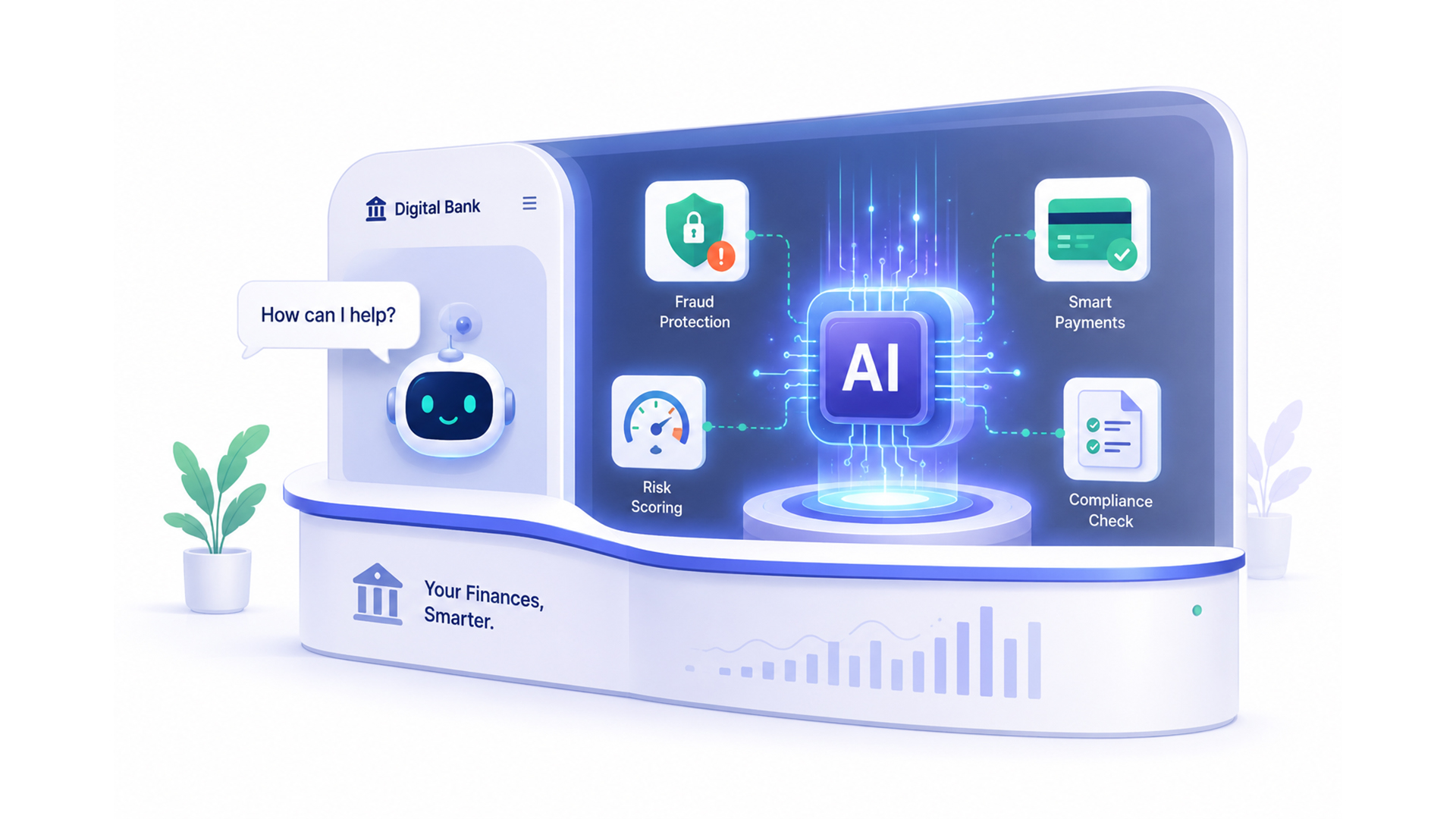
They are doing it in credit models that include data sources traditional scoring ignores, fraud systems that detect synthetic identities and deepfake attacks that did not exist three years ago, compliance engines that process regulatory documentation at scale without proportional headcount, and autonomous agents that can manage multi-step financial workflows end-to-end.
The scale of the opportunity is institutional. DBS Singapore has deployed over 800 AI models across 350 use cases and estimated an economic impact exceeding SGD 1 billion in 2025. One regulator cited in the same BIS report processed files from 155,000 in 2022 to 230,000 in 2025 with 20% fewer staff, using AI-assisted processing. These are not proof-of-concept outcomes. They are production results from institutions that moved past the chatbot stage years ago.
This post maps the AI investments in financial services that are past the chatbot stage, the specific technical architecture behind each, and what fintech engineering teams building them need to account for in the design.
| Building production AI for a fintech company and need to scope the architecture? WebOsmotic builds AI systems for fintech teams covering fraud detection, credit scoring, compliance automation, and LLM-powered financial agents. We evaluate regulatory requirements, data architecture, and model explainability at the architecture stage. |
IBM’s AI in finance explainer documents AI in financial services as operating across credit scoring, fraud detection, algorithmic trading, portfolio management, regulatory compliance, and customer service. IBM identifies LLMs as useful for customer service and document analysis, and notes that large reasoning models (LRMs) may take this further with complex analytical reasoning for financial scenario simulation, portfolio optimization, and credit risk assessment with more precision.
The BIS Financial Stability Institute’s 2025 report on regulating AI in financial services identifies three areas receiving the most attention across regulators and financial institutions: customer support chatbots, fraud detection including AML and CFT, and credit and insurance underwriting. The BIS notes that AI for chatbots and fraud detection is not new but has significantly improved, and that financial institutions are investing heavily in AI adoption while remaining cautious about generative AI specifically for regulated decision-making.
IBM’s fraud detection explainer documents how AI is transforming fraud prevention in financial services, and simultaneously warns that generative AI is lowering the barrier for fraudsters. A malicious actor can use an LLM to rapidly iterate on phishing campaigns, social engineering scripts, and synthetic identity techniques, accelerating the emergence of new fraud patterns. Modern fraud detection systems must defend against AI-generated attacks, not just historical pattern violations.
Traditional credit scoring models use a narrow set of inputs: payment history, credit utilization, credit age, credit mix, and new credit applications. This works well for consumers with established credit histories and poorly for thin-file consumers, first-time borrowers, and markets where the formal credit infrastructure is less developed, which describes much of the addressable market for fintech lending in India and Southeast Asia.
The BIS documents that financial institutions are increasingly using AI for credit scoring, valuation of collateral, and assessing unstructured information from multiple sources to more accurately predict insurance risks. AI credit models can incorporate alternative data: transaction cash flow analysis, utility payment history, rent payment history, mobile usage patterns, and social signals, to build a more complete creditworthiness picture for borrowers who would be rejected or underpriced by a traditional score.
Regulatory compliance is the largest operational cost category for most regulated financial institutions, and it is growing as regulatory complexity increases. The RegTech market is projected to reach USD 112.10 billion by 2033, with risk and compliance management the largest segment at 21.3% CAGR. MarketsandMarkets identifies compliance automation platforms as the fastest-growing product category in AI in finance.
IBM notes that AI agents capable of managing entire workflows autonomously are expected to become more sophisticated, and could handle complex processes such as expense management, compliance monitoring, and cash flow forecasting without requiring constant human oversight. The BIS working paper on AI in financial systems documents LLM applications for robo-advising, fraud detection, back-end processing, and internal software development and harmonization.
WebOsmotic’s fintech AI development practice builds production systems for clients in lending, payments, and financial infrastructure. Every engagement begins with a regulatory architecture review to identify which AI decisions require explainability, which data sources are permissible in the relevant jurisdiction, and what audit logging and model governance the system needs to satisfy regulators.
| Ready to build AI that creates a durable advantage in your fintech product? WebOsmotic designs and delivers AI systems for fintech teams: fraud detection models, AI credit scoring with explainability, compliance automation pipelines, and LLM financial agents. We scope regulatory requirements and model governance at the architecture stage. |
What are the most impactful AI use cases in fintech beyond customer service chatbots?
The BIS identifies three priority areas: fraud detection including AML/CFT, credit and insurance underwriting, and customer support. Beyond the chatbot layer, IBM documents AI as powering credit scoring, algorithmic trading, portfolio management, and regulatory compliance. The highest commercial impact in production deployments is coming from fraud detection systems that defend against AI-generated synthetic identities and deepfakes, credit models that incorporate alternative data to serve thin-file borrowers, and compliance automation that reduces the labour cost of regulatory document processing. DBS Singapore has estimated over SGD 1 billion in economic impact from AI deployment across 350 use cases.
How does AI fraud detection work in banking?
IBM documents AI fraud detection as operating across multiple layers: anomaly detection using graph neural networks to identify network-level fraud patterns in transaction data; real-time transaction scoring that incorporates purchase frequency, geographic location, device fingerprint, and behavioural velocity simultaneously; synthetic identity detection that cross-references identity attributes for statistical anomalies; and AML pattern detection that flags movement of identical currency amounts between accounts. The emerging challenge IBM identifies is that generative AI is accelerating fraud innovation, with fraudsters using LLMs to iterate on phishing and social engineering scripts, requiring modern fraud detection to defend against AI-generated attacks and not just historical patterns.
Can AI replace traditional credit scoring like FICO?
Not entirely, but it can substantially extend the reach of credit assessment. Traditional FICO scoring works well for consumers with established credit histories but performs poorly for thin-file borrowers. AI credit models can incorporate alternative data, including transaction cash flow, utility and rent payment history, and mobile usage patterns, to assess creditworthiness for borrowers outside the traditional credit system. The BIS documents that financial institutions are increasingly using AI for credit scoring and assessing unstructured information from multiple sources. The key regulatory constraint is explainability: credit decisions must be explainable to applicants, which requires AI architectures that produce interpretable output alongside accurate predictions.
What is RegTech AI and why is the market growing?
RegTech refers to technology solutions that help financial institutions meet regulatory requirements. AI-powered RegTech automates tasks including regulatory document monitoring, obligation extraction, KYC verification, AML transaction monitoring, and regulatory report compilation. Grand View Research projects the RegTech market to reach USD 112.10 billion by 2033, driven by increasing regulatory complexity, growing compliance costs, and the demonstrated ability of AI to process compliance workflows at scale with lower error rates and headcount than manual processes. MarketsandMarkets identifies compliance automation platforms as the fastest-growing product category in AI in finance.
What regulatory constraints apply to AI in financial services?
The BIS notes that financial institutions are investing heavily in AI adoption broadly while remaining cautious about generative AI specifically for regulated decision-making. Key constraints include: model explainability requirements for credit decisions, requiring institutions to explain which factors drove an adverse credit action; fair lending laws that prohibit discriminatory outcomes in credit decisions regardless of the inputs used; AML/KYC regulations that require customer due diligence to be performed by a process that meets regulatory standards; and data protection regulations that constrain what customer data can be used for model training. Jurisdictions vary significantly in how they regulate AI in financial services, and compliance architecture must be scoped per jurisdiction.
How does WebOsmotic approach AI development for fintech clients?
WebOsmotic begins every fintech AI engagement with a regulatory architecture review that identifies the jurisdiction-specific requirements for the use case: what explainability is needed, what data is permissible, what audit logging the model decisions require, and what model governance documentation regulators expect. We build production systems across fraud detection, credit scoring, compliance automation, and LLM financial agents. Our fintech clients are typically lending platforms, payment processors, neo-banks, and financial infrastructure companies operating in India, Southeast Asia, and the US.