AI Readiness Assessment: A 30-Point Checklist Before You Hire an AI Consultant
4 Views
Summarize Article



Summarize Article
Only about 13% of companies qualify as fully prepared “Pacesetters” in Cisco’s 2025 AI Readiness Index, a survey of more than 8,000 AI leaders across 30 markets. The gap shows up in planning. Of those leaders, 99% had a defined AI roadmap, compared with 58% of all respondents.
An AI readiness assessment is a structured check of whether a company can support an AI project today, scored across six dimensions from strategy to budget. The result shows what to fix before money goes into models. Run one before you hire an AI consultant. Your first paid week then goes on building.
This guide gives you the six dimensions, a 30-point AI readiness checklist, a scoring method, and a short plan for fixing a low score.
AI readiness is the degree to which a company can take an AI use case from idea to daily operation without stalling. An AI readiness assessment measures that capacity across six dimensions, each scored against plain yes-or-no evidence. The output is a score per dimension and a ranked list of gaps.
People ask “what is AI readiness” a lot, and the honest answer is narrow. Tool count is irrelevant. An AI readiness assessment checks whether the basics are in place: an owner, reachable data, a security process and a budget line.
This is a different exercise from a SOC 2 readiness assessment, which checks security controls for an audit. The two meet in the governance dimension, but they answer different questions.
A complete AI readiness assessment covers the six dimensions in the table, from strategy through budget. Weakness in any one can stop a project on its own, so the assessment scores each separately. A company with excellent data and no budget owner is still a long way from ready.
| Dimension | What it asks | Gap we see most often |
| Strategy | Is there a defined use case tied to a business goal? | AI ideas with no metric attached |
| Data | Can the needed data be reached and legally used? | Data split across systems with no shared IDs |
| Infrastructure | Can current systems host and monitor a model? | No logging or cost tracking for AI calls |
| Skills | Who will build it and who will run it? | No production owner after launch |
| Governance | Are there rules for safe, lawful AI use? | Staff using personal AI accounts with company data |
| Budget | Is money set aside past the first phase? | Funding for a PoC, nothing for production |
The governance row deserves attention. In IBM’s 2025 breach study, 63% of breached organizations had no AI governance policy or were still writing one. IBM’s 2026 study found more than 20% of organizations had a breach targeting AI models or applications.
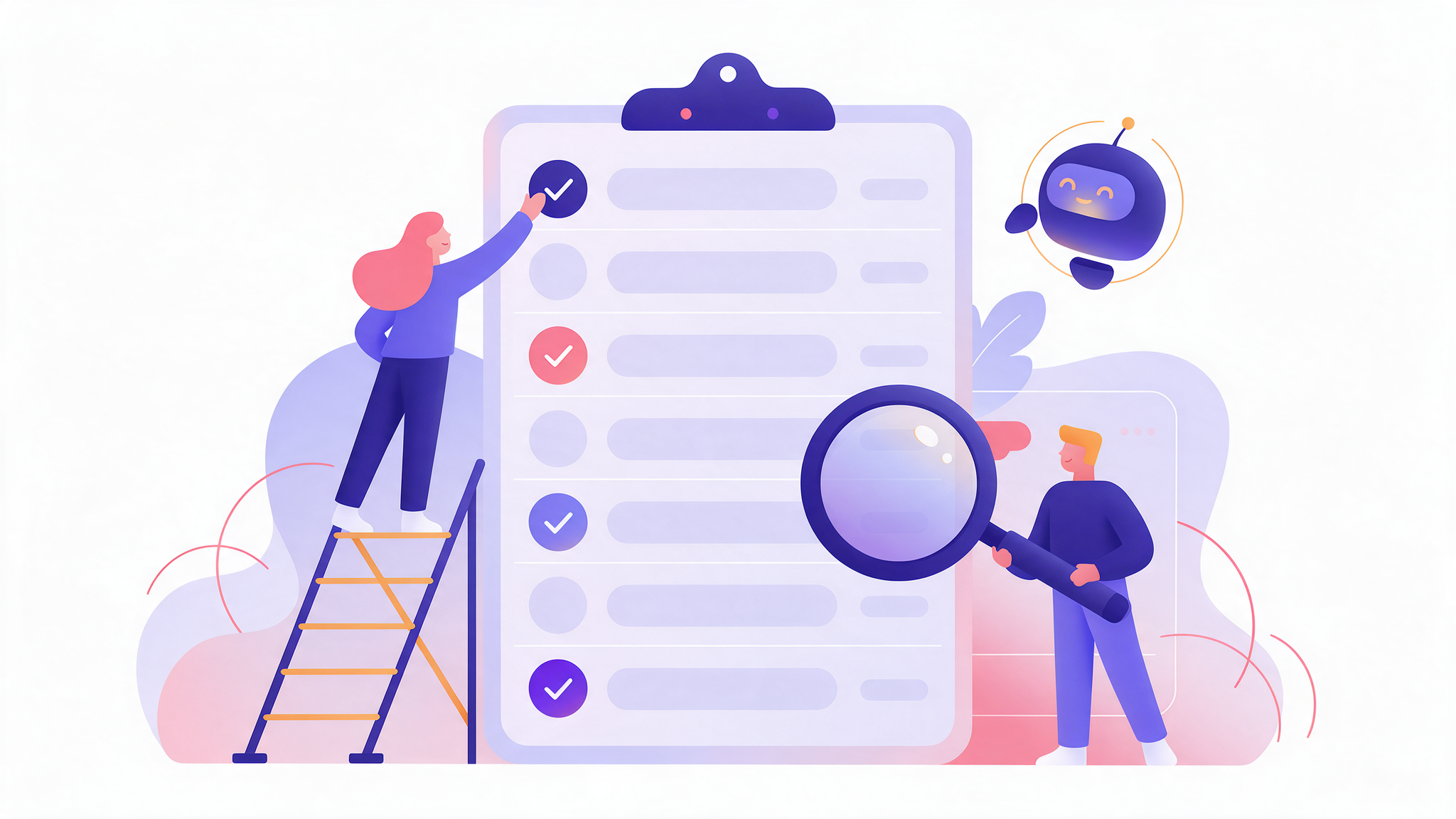
The 30-point AI readiness checklist below gives five yes-or-no items per dimension. Score one point for each “yes” you can prove with a document, a system or a named person. A “yes” based on intent scores zero. The full assessment takes a leadership group about an hour.
Want an outside view on your 30 points?
WebOsmotic runs the AI readiness assessment with your team in one working session and returns the six scores with a ranked fix list.
Add the points for a total out of 30, then look at each dimension’s score out of 5. The weakest dimension matters more than the total. A company scoring 24 overall with a 1 in data is less ready than one scoring 20 with no dimension below 3.
| Total score | Readiness level | What to do next |
| 0 to 10 | Early | Fix strategy and governance before any build |
| 11 to 18 | Partial | Close the weakest dimension, then run a PoC |
| 19 to 25 | Ready for a PoC | Start a scoped proof of concept |
| 26 to 30 | Ready to scale | Plan several use cases on shared tooling |
Apply one override to the AI readiness assessment. Any dimension scoring 0 or 1 caps the result at “Partial” whatever the total says, and in our experience data and budget trigger that cap most often.
Have three people score on their own, then compare. A gap of more than 5 points on the total usually means the leaders hold different pictures of the same project, and that needs settling before anyone scopes a build. Settle that first.
Fix the lowest-scoring dimension first, with the smallest change that moves it to 3 out of 5. Usually the fix is a document or a decision. A low score rarely calls for new software, so a team can lift its weakest area within 4 to 6 weeks.
Typical fixes by dimension:
Then re-run the AI readiness checklist. A move of 4 to 6 points in 6 weeks is normal when one person owns the fixes.
For a wider view of where the company sits over time, the five-stage AI adoption framework tracks progress quarter by quarter.
Enterprise AI readiness adds procurement, vendor risk and scale checks on top of the 30 points. Large US companies need AI systems to pass security questionnaires, connect to single sign-on and logging platforms, and fit model inventories that audit teams review. Those steps add weeks, so they belong in the plan from day one.
Four extra checks matter for enterprise AI readiness:
The governance side of those checks is covered in our guide to building an AI governance framework.
Bring in an AI consultant once your AI readiness assessment total sits at 11 or more and every dimension scores at least 2. Below that, you pay outside rates for work your own team can do in a few weeks. Above it, a consultant shortens the path from a scored use case to a working proof of concept.
Choosing a provider for the assessment itself? Ask four questions:
An AI consulting company that also builds will tie the readiness findings to a delivery plan. That avoids paying twice for discovery.
Scored 11 or more and ready for the next step?
Our AI consultants turn your readiness results into a use-case ranking, an ROI model and a 90-day rollout plan your board can approve.
AI readiness means a company can take an AI idea into daily use without stalling on data, people, rules or money. In practice, that means passing at least 19 of the 30 checks above, with no dimension below 2 out of 5.
The self-assessment takes about 1 hour for a group of three leaders. An outside AI readiness assessment with system reviews usually runs 1 to 2 weeks. That covers interviews with 5 to 10 people and a check of the data behind the first use case.
Include the executive sponsor, the business owner of the first use case, an IT or data lead and someone from security or legal. Four to six people is enough. Larger groups slow the scoring. Keep finance in the loop for the budget questions, since five of the 30 points depend on them.
A checklist shows where the gaps are. Fixing them takes owners. Pair the 30 points with an owner and a date for each “no”, then re-score after 6 weeks. Teams that skip the owners tend to see the same gaps a quarter later, with the budget already spent.
Repeat it every quarter during the first year, then twice a year. Re-score sooner after a major change, such as a new data platform, a merger or a new regulation that affects 1 or more of your AI use cases.