Why Headless Commerce Is No Longer Optional for D2C Brands Crossing $10M
138 Views
Summarize Article



Summarize Article

US retail e-commerce sales reached $326.7 billion in the first quarter of 2026, growing 9.8% year over year, a growth rate that is pushing more D2C brands to evaluate headless commerce development services earlier than they expected. That is more than twice the 3.9% growth rate of total retail, according to the
US Census Bureau’s official release.
E-commerce now accounts for 16.9% of all US retail sales, and that share has climbed every year since 2019. Growth at that pace does not reward a storefront that merely functions.
It rewards the ones that load fast, personalize well, and scale without breaking. Amazon’s own internal findings, cited in Vercel’s engineering blog, found that just 100 milliseconds of extra load time cost the company 1% in sales, the kind of finding that turns headless commerce development services from a nice-to-have into a revenue question.
That is the actual argument for headless commerce development services once a D2C brand crosses roughly $10 million in revenue. The standard theme that worked fine at $500,000 in monthly sales starts costing real money at scale, in lost conversion, in slow iteration, and in a storefront that cannot keep up with the brand’s own growth.
This article covers why that threshold exists, what Shopify headless development cost actually buys, why Nextjs ecommerce architecture has become the default pairing, and what D2C storefront scalability requires that a standard theme was never built to provide. Each of those questions feeds into the same decision: whether headless commerce development services are worth the investment right now.
A brand doing $500,000 a month in sales can absorb a slow theme without much visible damage. A brand doing several million dollars a month cannot.
The same percentage conversion loss from a slow page compounds into real revenue at scale. Amazon’s internal finding, that 100 milliseconds of extra load time cost 1% in sales, is exactly the kind of math that starts to matter once a D2C brand’s traffic and average order value make every fraction of a percentage point in conversion worth pursuing seriously. It is also the math that makes headless commerce development services worth pricing out in the first place.
Shopify’s store themes are only required to hit a minimum average Lighthouse performance score of 60 across the product, collection, and home page, for both desktop and mobile.
That is a reasonable floor for a brand just getting started. It is not a ceiling a brand doing eight figures in revenue should be satisfied with, and it is precisely the gap headless commerce development services are built to close.
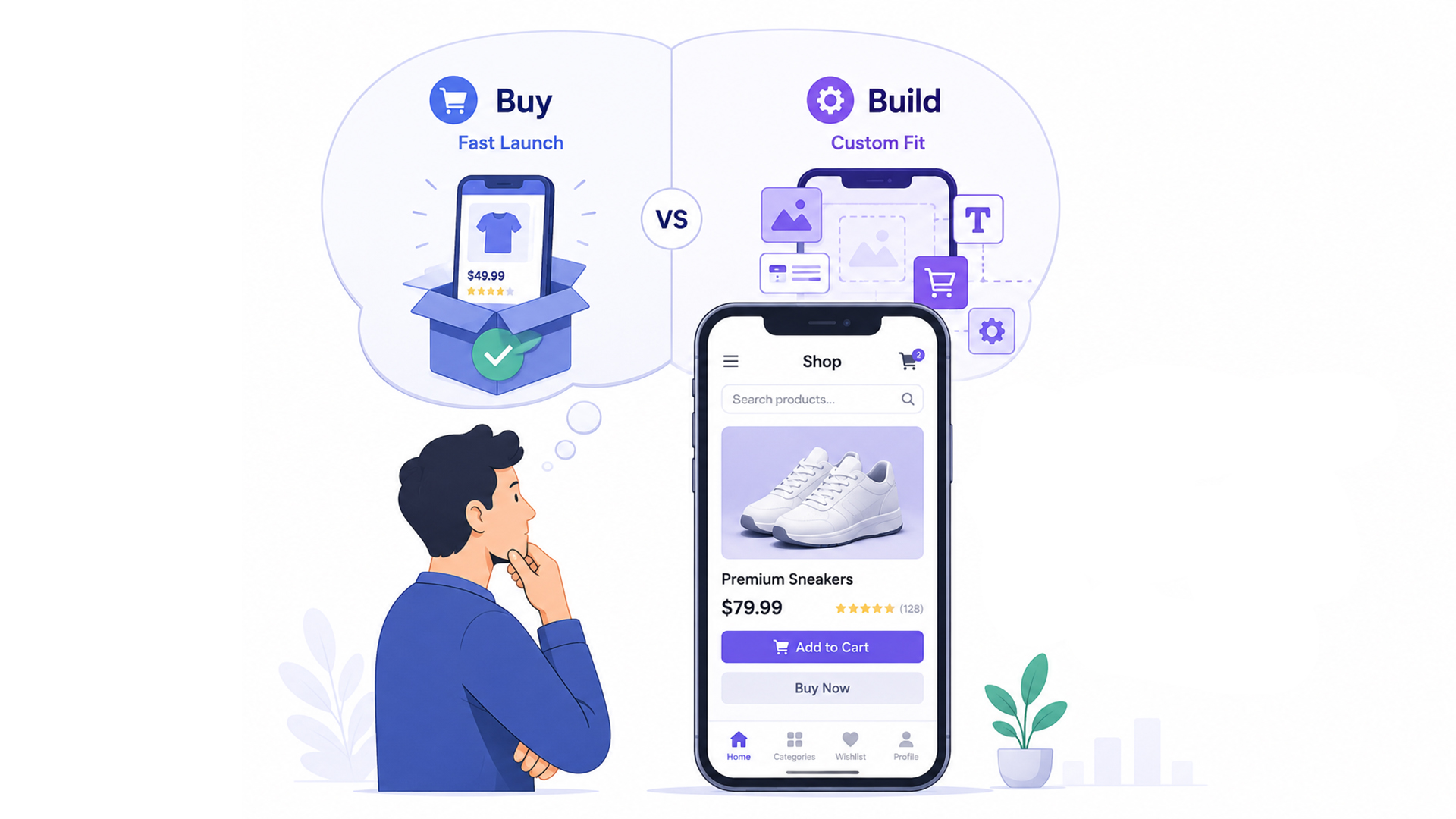
Headless commerce separates the front-end customer experience from the back-end commerce engine, inventory, checkout, and order management. This split is the core mechanic behind every headless commerce development services engagement.
Shopify headless development cost is not paying for a new commerce backend. Shopify’s own admin, inventory, and checkout stay in place. It is paying for a custom-built storefront, using a framework like Hydrogen or Next.js, that can be iterated on, A/B tested, and optimized independently of Shopify’s theme constraints, while still running on the same commerce engine and Shopify Plus checkout the brand already depends on. This is the part of headless commerce development services that actually shows up on an invoice.
Shopify’s own headless offering explicitly supports deploying a production-ready Next.js storefront on Vercel, powered by Shopify’s commerce engine and checkout, alongside Hydrogen as Shopify’s in-house framework option.
Nextjs ecommerce architecture wins out for a lot of D2C teams specifically because of the ecosystem depth: a large developer talent pool, mature tooling for server-side rendering and static generation, and a hosting path on Vercel purpose-built for exactly this kind of high-traffic, performance-sensitive storefront. Most vendors offering headless commerce development services default to this pairing for that reason.
| Trying to decide whether your D2C brand is ready for headless commerce development services? WebOsmotic scopes headless commerce development services against your actual traffic, conversion data, and growth roadmap before recommending a rebuild. |
A brand moving from a standard theme to headless commerce development services should expect a phased rollout, not a single cutover.
A realistic approach to headless commerce development services starts with the highest-traffic pages, typically the homepage and top product listing pages, migrated first and measured against the existing theme’s conversion baseline before the rest of the storefront follows.
This lets a brand validate the performance gains on real traffic before committing the full engineering budget to a complete rebuild, and it gives the team a rollback path if something in the new architecture underperforms expectations.
Most brands that take this phased approach can point to a measurable conversion lift on the migrated pages within the first few weeks, which makes the case for completing the rest of the headless commerce development services rebuild considerably easier to defend internally.
| Signal | Standard Shopify theme is probably fine | Time to evaluate headless commerce development services |
|---|---|---|
| Monthly revenue | Under roughly $500K | Approaching or past $10M |
| Theme Lighthouse score | Comfortably above 60 | At or below Shopify’s own baseline |
| Customer experience iteration | Infrequent, template-driven changes | Frequent A/B testing and custom UX work |
| Engineering capacity | Limited or none dedicated to the storefront | A team available to own headless commerce development services long term |
| Ready to scope headless commerce development services that fit your actual growth stage? WebOsmotic builds Shopify Hydrogen and Next.js storefronts for D2C brands scaling past $10M, with performance benchmarks and Shopify Plus checkout compatibility built in from day one. |
The Census Bureau’s own data shows e-commerce growing nearly twice as fast as retail overall, and Amazon’s own performance research shows exactly how much a slow storefront costs at scale. Both are part of the business case for headless commerce development services.
Neither of those facts changes because a brand is doing $2 million a year instead of $20 million. What changes is whether the cost of a slow, template-constrained storefront is still small enough to ignore.
For most D2C brands, that stops being true somewhere around the $10M mark, which is exactly when headless commerce development services stop being a nice-to-have and start being the more defensible financial decision.
The brands that wait until the theme is visibly broken tend to pay for the migration twice: once in the lost conversion they absorbed while waiting, and again in the rebuild itself.
It is the point where the math typically flips for headless commerce development services. Below that level, the engineering investment in custom headless commerce development services usually costs more than the conversion and iteration speed it recovers. Above it, the compounding cost of a slow, template-constrained storefront, given findings like Amazon’s 100-millisecond-to-1%-sales relationship, tends to outweigh the cost of the rebuild. The exact number varies by brand, but $10M is a reasonable general threshold to start evaluating seriously.
It pays for a custom front-end storefront, built with a framework like Hydrogen or Next.js, along with the engineering work to connect it to Shopify’s Storefront API, replicate cart and checkout flows correctly, and optimize performance beyond what a standard theme achieves. The Shopify backend, admin, inventory, and checkout logic all stay in place. The investment behind Shopify headless development cost, and behind headless commerce development services generally, is entirely in the customer-facing layer and its ongoing maintenance.
Not always. Hydrogen is Shopify’s own React-based framework, deployed free on Oxygen, its global edge hosting, and it is tightly integrated with Shopify’s APIs by design. Next.js on Vercel is officially supported by Shopify as well and tends to appeal to teams with existing Next.js expertise or specific hosting requirements. The right choice for headless commerce development services depends on the team’s existing skills and the brand’s specific technical needs more than any inherent superiority of one over the other.
Compare your theme’s actual Lighthouse performance score against Shopify’s own baseline requirement of 60. A score comfortably above that, combined with a checkout and customer experience that is not obviously limiting conversion, suggests the current setup still has room to run. A score at or below that baseline, paired with revenue approaching or past $10M, is a much stronger signal that the current theme is genuinely constraining growth, and a strong signal it is time to evaluate headless commerce development services.
No, and it should not. A properly scoped headless commerce development services engagement keeps Shopify Plus checkout intact, since that is where Shopify’s compliance, payment processing, and fraud protection live. The headless rebuild replaces the front-end storefront experience, not the checkout and payment infrastructure, and any partner proposing to rebuild checkout from scratch as part of headless commerce development services is taking on risk that is rarely worth the tradeoff.
| Headless commerce development services pay off once the conversion math from a faster storefront outweighs the engineering investment, and that math is worth running before committing to a rebuild. WebOsmotic scopes headless commerce development services with real Lighthouse and conversion data, not a generic pitch. |