Ecommerce app development: build vs. buy in 2026
140 Views
Summarize Article



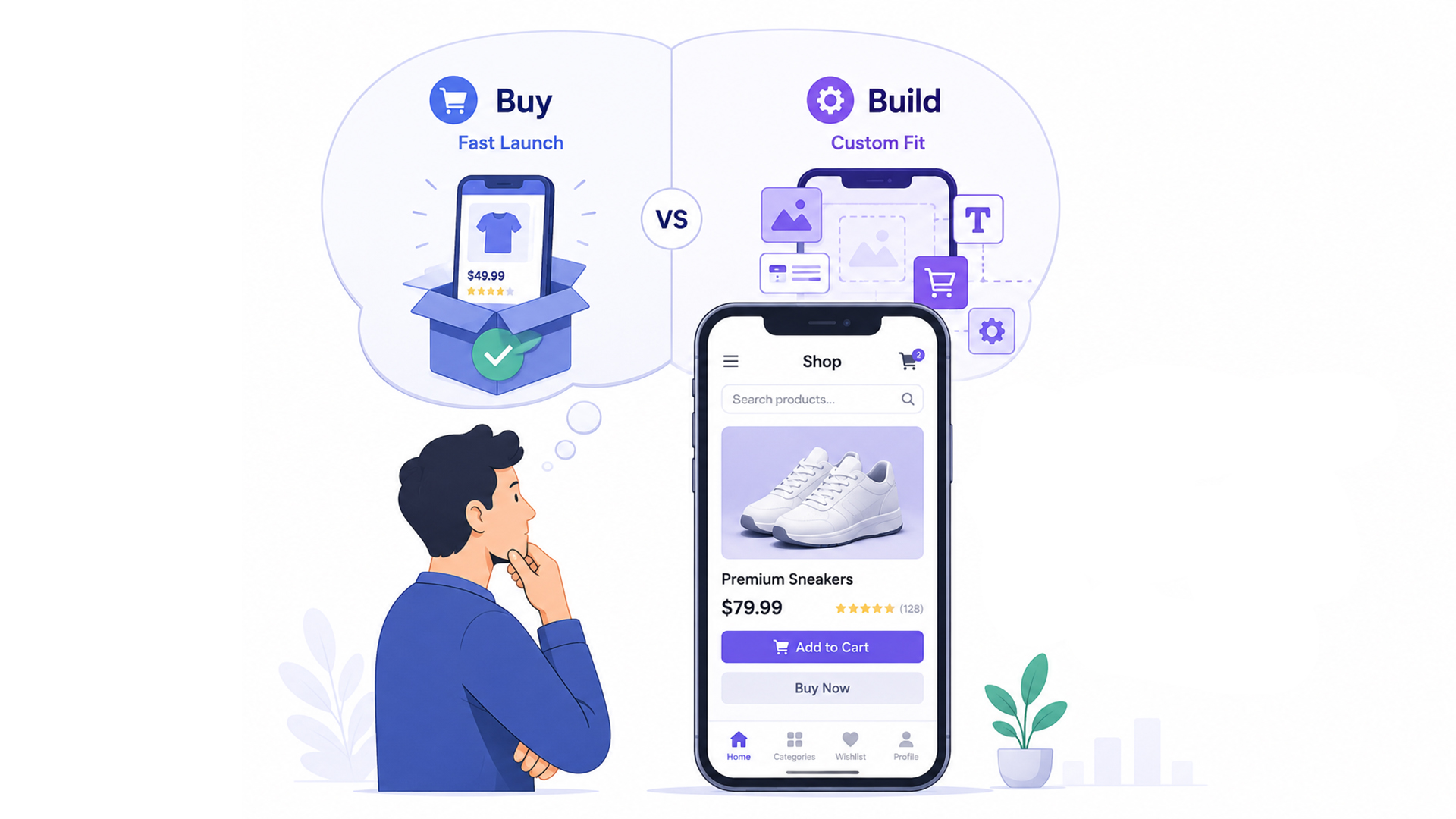
An ecommerce app development company earns its fee only in a specific set of circumstances. Shopify and similar platforms handle 90% of ecommerce use cases at lower cost than any ecommerce app development company would charge for a custom build.
Custom ecommerce app development wins when your brand experience, integration depth, or D2C data strategy requires it. This guide maps how to know which side of that line you are on.
These figures are backed by MarketsandMarkets and Grand View Research, not general estimates, and any ecommerce app development company should be able to cite them.
The ecommerce platform market is maturing in a specific direction: more capability delivered by SaaS platforms at lower marginal cost, covering more of the standard use cases that previously required custom development. This is good for teams with standard requirements, and it narrows the number of brands that genuinely need an ecommerce app development company.
It is disorienting for teams whose requirements are not standard, because the conversation about whether to build or buy now requires a more precise understanding of where the platform ceiling actually is, and whether an ecommerce app development company is even necessary yet.
The global ecommerce platform market is growing from USD 9.08 billion in 2025 to USD 16.51 billion by 2030, per MarketsandMarkets. The global ecommerce market itself reached USD 33.91 trillion in 2025, per Grand View Research.
The platforms are getting better and covering more of the standard use case space. But getting better does not mean unlimited. The ceiling still exists, and that ceiling is where an ecommerce app development company earns its budget.
This guide maps the decision between SaaS ecommerce platforms and custom ecommerce app development across the dimensions that determine which architecture fits which brand, including mobile commerce, D2C strategy, integration depth, and the specific conditions under which a platform migration to a custom ecommerce app development company is worth the cost.
Evaluating custom ecommerce development vs. platform extension for your brand?
WebOsmotic, an ecommerce app development company, builds custom ecommerce applications and D2C mobile apps for brands that require custom checkout flows, proprietary data architecture, or integrations beyond what platform configurations support.
What SaaS Platforms Do Well and Where Custom Development Takes Over
Shopify, Adobe Commerce, WooCommerce, and VTEX have invested significantly in expanding what is achievable through configuration, apps, and APIs rather than custom development. For most ecommerce teams in 2026, one of these platforms covers the required functionality more cheaply and more quickly than building from scratch.
MarketsandMarkets identifies Shopify as leading the platform market with an extensive app ecosystem, scalable solutions for businesses of all sizes, and strong global merchant support. WooCommerce and OpenCart are noted as offering developer-friendly APIs for scalable growth, both are configurable enough to handle complex catalog and pricing requirements.
The question is not whether these platforms are good. It is whether your specific requirements are within their configuration range, or whether you need an ecommerce app development company to go beyond it.
What SaaS Platforms Handle Well
Where SaaS Platforms Reach Their Ceiling
Mobile commerce accounts for the largest share of global ecommerce transaction volume and is growing fastest in the markets, South Asia, Southeast Asia, and Africa, where D2C growth is most rapid and demand for an ecommerce app development company is highest.
The decision between a mobile-optimized website, a progressive web app (PWA), and a native mobile app is the most consequential architecture decision most D2C brands face in 2026, and usually the first question an ecommerce app development company asks.
Compare the four approaches before committing budget or calling an ecommerce app development company:
| Approach | Development Cost | Time to Deploy | Best Suited For |
| Mobile-optimized responsive website | Lowest: part of standard web development scope | Fastest: deploys with the web store | Brands where mobile purchase frequency is moderate and the purchase journey does not require native device capabilities |
| Progressive Web App (PWA) | Low-medium: extends the web store with offline capability and install-to-home-screen | Fast: typically 4-8 weeks additional from responsive web | Brands that want an installable, offline-capable experience without a native app development timeline or app store review cycle |
| Native iOS + Android app | Highest: requires separate iOS and Android codebases or React Native | Slowest: 3-6 months minimum for an MVP native app | D2C brands with high purchase frequency, subscription models, loyalty programs that justify push notifications, or product experiences requiring AR, camera, or biometric authentication, the profile that usually justifies an ecommerce app development company |
| React Native cross-platform app | Medium: single codebase for iOS and Android, 20-30% lower cost than native | Medium: 2-4 months for MVP | Brands that need a native-quality app without the full dual-codebase cost, accepting some limitations on platform-specific UI components |
Whichever row fits your brand, confirm it with an ecommerce app development company before committing engineering budget.
Grand View Research notes that D2C brands leveraging SaaS platforms for scalable launches are driving US market momentum, while growing demand for AI-driven personalization and social commerce is pushing brands toward custom capabilities SaaS configurations cannot match, and toward hiring an ecommerce app development company to build them.
Custom ecommerce development is not the right answer because a brand is large or because SaaS platforms are constraining. It is the right answer in a specific set of circumstances that cannot be resolved through platform configuration, app extension, or API integration.
Teams that have determined custom development is the right path, and have engaged an ecommerce app development company to execute it, face a second set of decisions about the technology stack. The most significant are: headless commerce versus traditional monolithic, the frontend framework, and the API integration architecture.
WebOsmotic’s ecommerce development practice serves brands in D2C, retail, and eCommerce across India and the US. Every ecommerce engagement begins with a build vs. buy assessment before any custom development scope is committed, the same due diligence any credible ecommerce app development company should offer, visible across our case studies.
Ready to scope your ecommerce app development project?
WebOsmotic builds custom ecommerce applications, D2C mobile apps, and headless commerce architectures for brands that have outgrown SaaS platforms. We scope every engagement with a build vs. buy assessment before any development budget is committed, the way any reliable ecommerce app development company should.
→ Get your ecommerce consultation
A one-line test: if you have said ‘the platform can’t do this’ twice this quarter, you need an ecommerce app development company.
Bookmark this list of what to expect from any ecommerce app development company you interview.
A short reference for anyone comparing quotes from an ecommerce app development company:
If any of these five signs match your situation, it is time to talk to an ecommerce app development company rather than looking for another Shopify app. Most brands recognize at least one sign before they recognize the need for an ecommerce app development company itself.
Custom ecommerce development is justified when specific requirements cannot be achieved through Shopify configuration, apps, or API extension. The most common triggers are: checkout logic that requires custom payment splits or complex tax treatment; a proprietary customer data architecture that conflicts with Shopify’s data model.
Also common: integration complexity with legacy ERP or WMS systems that makes middleware more expensive than a custom-built commerce layer; and native mobile app requirements including AR product visualization, camera-based search, or biometric payment that are not achievable through a Shopify PWA.
MarketsandMarkets identifies Shopify as the market leader for standard ecommerce use cases, the question is whether the specific brand’s requirements fall within that standard range or require an ecommerce app development company.
A mobile-optimized responsive website adapts layout for mobile screens but is a website, it runs in the browser, has no offline capability, and cannot access native device features.
A PWA is an installable web application that can be added to the home screen, works offline with cached content, and can send push notifications, but cannot access native device APIs like the camera, AR framework, or biometric authentication.
A native iOS and Android app has full access to device capabilities, runs faster for complex interactions, and supports the deepest loyalty and notification experiences, at significantly higher development cost and a mandatory app store review cycle, and is usually where brands first bring in an ecommerce app development company.
React Native is a cross-platform option that approaches native performance from a single codebase at roughly 20-30% lower cost than dual-native development.
Headless commerce separates the frontend presentation layer from the commerce backend, allowing the brand to build any frontend experience, web, mobile, kiosk, or voice, while the commerce engine handles catalog, pricing, cart, and checkout independently.
It is appropriate for brands that need a significantly differentiated UX that a platform’s standard storefront themes cannot achieve, or for brands serving multiple channels (web, mobile app, wholesale portal) that need a single commerce backend serving different frontends.
The tradeoff is higher development and maintenance cost compared to a standard platform storefront. Teams should have a specific UX or multi-channel requirement that justifies the additional engineering investment, and the budget for an ecommerce app development company, before choosing headless.
Custom ecommerce web development for a mid-complexity project, custom design system, product catalog, cart and checkout, user account management, and two to three backend integrations, typically ranges from $40,000 to $150,000 for initial development. Headless commerce architecture with a custom frontend and API layer adds scope and ranges from $80,000 to $300,000.
Native iOS and Android ecommerce apps run $80,000 to $250,000 for the initial build, with React Native cross-platform development reducing this to $60,000 to $180,000. These ranges exclude ongoing operational costs including hosting, third-party service fees, and engineering maintenance, which typically add 20-30% of initial build cost annually, so ask any ecommerce app development company for both the build quote and the maintenance estimate.
The dominant ecommerce web development stack in 2026 for custom builds is a React or Next.js frontend with a headless commerce backend, either a purpose-built commerce engine like Medusa or commercetools, or a custom-built service layer. This combination gives brands full frontend control, a well-supported component ecosystem, and an API-first architecture that can serve web, mobile, and third-party channels from the same backend.
For teams migrating from a SaaS platform, a common path is to keep the SaaS platform as the commerce engine and replace only the frontend with a custom Next.js storefront, capturing most of the UX differentiation benefit at significantly lower cost than a full custom-backend build, and often at lower cost than a full ecommerce app development company engagement.
WebOsmotic begins every ecommerce engagement with a build vs. buy assessment that maps specific requirements against what the leading SaaS platforms can achieve through configuration. Where platform configuration covers the requirements, we recommend it.
Where specific requirements, checkout logic, data architecture, integration depth, or mobile app capabilities, exceed what platform configuration supports, we scope a custom development path. Custom engagements include technology stack selection, integration architecture design, and a phased development plan that delivers a working MVP before the full build budget is committed, the structure we believe every ecommerce app development company should follow.