How to Improve AI Presence for Brands in 2026 – A Tailored Journey
33 Views
Summarize Article



Summarize Article
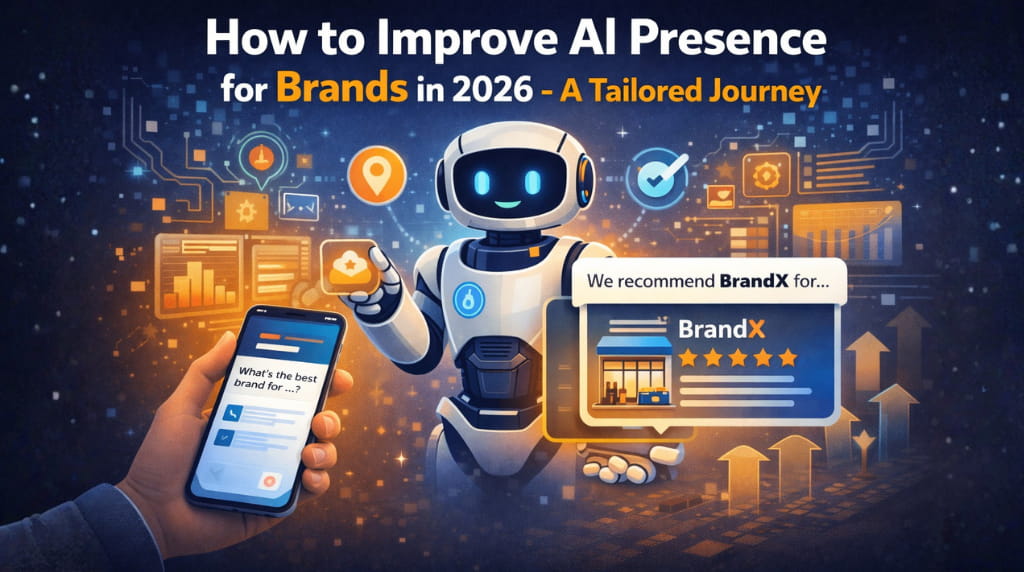
In 2026, brand discovery is not just search and social. A big slice of results are inside “answer engines,” where people ask one question and get one clean reply. If your brand is not a trusted source in that reply, you lose visibility at the exact moment intent is highest.
So, what’s the best way of improving AI presence for brands?
Make it easy for systems to understand who you are, what you sell, where you operate, and why you are credible.
This guide is a tailored journey to help you start at your current stage. Let’s begin to learn how to improve AI presence for brands without chasing random hacks.
AI presence is the likelihood that an answer engine mentions your brand accurately and confidently when a user asks about your category, product, problem, or comparison.
It is not one ranking. It is a bundle of signals that help systems decide three things:
Most brands try to be visible everywhere. That usually leads to shallow content and mixed messaging. A better move is to pick a small set of high-intent query themes and build depth.
Start with these question types:
Once you have a list, map each theme to one strong page that deserves to be cited. If you spread one topic across five thin blogs, answer engines get confused and pick a competitor page that feels clearer.
Many brands leak trust because basic identity details do not match across platforms. That includes small differences in name style, addresses, phone formats, descriptions, etc.
Make one “source of truth” document inside your team. It should include:
Then ensure your website, Google Business Profile (if relevant), social bios, and major directories match that truth.
This step sounds boring, but it reduces misinformation in answers. It also improves the system’s confidence when it needs to connect mentions across the web.
If you want a simple reference page for terms like entities, citations, and assistants, keep the AI glossary linked here.
Answer engines do not read your site like a human. They extract meaning fast. If your site is heavy, messy, or unclear, your best info can get ignored. Google Search Central explains how AI features like AI Overviews work at a site-owner level and what helps content get included safely.
Focus on four things:
Also, put your strongest proof near the top of important pages. If a page hides the key definition or promise halfway down, the system might not pick it.
If you want citations and mentions, you need short sections that look quote-ready. A good pattern is: one direct answer line, then a short expansion.
Example:
“An AI shopping assistant helps a shopper find products faster by asking questions, narrowing options, and explaining differences.”
Then add a short paragraph with how it works, where it fits, and what it does not do.
This is one of the most practical tips for improving brand presence online with AI because it turns your page into a clean reference.
Structured data does not guarantee visibility, but it reduces ambiguity. It helps systems label your page correctly and connect it to your brand entity.
For most brands, these are the basics:
If you want schema, content clusters, and tracking set up as a system, WebOsmotic’s custom AI development services can build the full workflow.
Competitors are winning because they publish like a glossary or a knowledge base. They cover a topic deeply and keep the format consistent, so it feels like a reference library.
You can do the same without copying their style.
Pick one core topic cluster, then build:
This fits the same mindset as future-proof your brand, because consistency beats short-term hacks when platforms shift.
Answer engines lean on the wider web. If only your site says you are the best, that claim is weak. If credible sites mention you, it becomes stronger.
This is where digital PR, partnerships, podcasts, and expert quotes help. The goal is not random backlinks. The goal is brand mentions in places that already carry trust in your niche.
A simple way to start is to publish one piece of data or one mini-study your niche would cite. It can be a benchmark, a pricing snapshot, or a short survey. Keep it honest and easy to reuse.
Reviews influence what people click, but they also influence how systems summarise sentiment. You want a steady, natural flow of reviews, and you want clear responses when something goes wrong.
Two important rules:
If your brand is new, focus on one review platform that matters most in your category, then expand later.
Your best content should exist in more than one format. Not as spam, but as helpful repackaging.
Turn one strong guide into:
Classic SEO metrics are still useful, but AI presence needs extra checks.
Track:
Use this to decide what to fix first. Score each line 1 to 5, then prioritise anything that scores 2 or lower.
| Signal Area | What “Good” Looks Like | Score (1-10) |
| Brand Consistency | Same name, description, and details across major profiles | 10 |
| Page Clarity | One intent per page, clean headings, quick answers early | 10 |
| Structured Data | Organization, Product, FAQ used correctly where relevant | 8 |
| Authority Content | One strong cluster with internal links and depth | 8 |
| Third-Party Mentions | Credible sites mention you in context, not just link drops | 7 |
| Reviews and Sentiment | Steady review flow and thoughtful responses | 7 |
| Technical Health | Fast pages, indexable content, no messy duplicates | 8 |
If you want a short label to remember all this, it is “be easy to understand and easy to trust.”
That is also the heart of best practices for optimizing brand presence in AI answer engines. You are not trying to trick the system. You are reducing friction so it can confidently use your content.
WebOsmotic is a leading AI-related solutions provider. We have helped numerous businesses across various industries in terms of optimizing the search results for today’s AI-based search engines.
Guess what? Up to 98% clients were satisfied in terms of ROI after hiring our services to scale their brand.
If your team wants this done as a repeatable system, WebOsmotic can help you map your priority queries, rewrite key pages into quote-ready “answer blocks,” and build a simple content cluster that stays consistent month after month.
For a thorough discussion, get in touch with us today.
AI visibility is becoming a vital brand asset. Start with identity consistency, then fix page clarity and structured data, then invest in authority content and third-party proof. Do it in that order and your results are easier to measure.
If you want a guided plan instead of trial and error, WebOsmotic can turn this into a practical roadmap your team can execute without chaos.