What Is Gen AI Consulting and What Should It Cost You
176 Views
Summarize Article



Key takeaways
|
The gen AI consulting market is producing two very different experiences. One set of clients leaves an engagement with a prioritized use case list, an implementation roadmap, and a technical team that can begin building. Another set leaves with a detailed strategy presentation that describes what they could build, when they asked for help building it. Both engagements are sold as gen AI consulting. The difference is in the scope, the deliverables, and what the firm is actually capable of delivering after the strategy phase.
Gartner forecasts worldwide generative AI spending at $644 billion in 2025, up 76.4% year over year. Simultaneously, Gartner reports that at least 30% of GenAI projects were abandoned after proof of concept due to poor data quality, inadequate risk controls, escalating costs, or unclear business value. The firms that avoided that 30% outcome typically had consulting partners who were accountable for the project reaching production, not just for delivering the roadmap.
This post explains what each type of gen AI consulting engagement includes, what each should cost, what a completed engagement must produce to be worth the investment, and what questions separate firms that can deliver production AI from those that can only advise on it.
| Looking for gen AI consulting that produces deployable software, not just a strategy deck? WebOsmotic scopes AI consulting engagements from use case prioritization through to production delivery. Every engagement for fintech, healthcare, eCommerce, and logistics clients includes a technical architecture, a phased build plan, and software that runs. |
Gartner’s market definition for generative AI consulting and implementation services is precise: these services help organizations plan and deploy generative AI capabilities, bridging gaps in skills, experience, and technology on the path to generative AI business value. The emphasis on bridging gaps distinguishes consulting from pure advisory. The client does not just need a roadmap. They need someone who can close the capability gap between where they are and where they need to be to run production AI.
The services in this category span a wide range of engagement types. Understanding which type you are buying, and which type your problem requires, is the first decision that determines whether the engagement produces value.
| Engagement type | What it produces | Typical duration | When you need it |
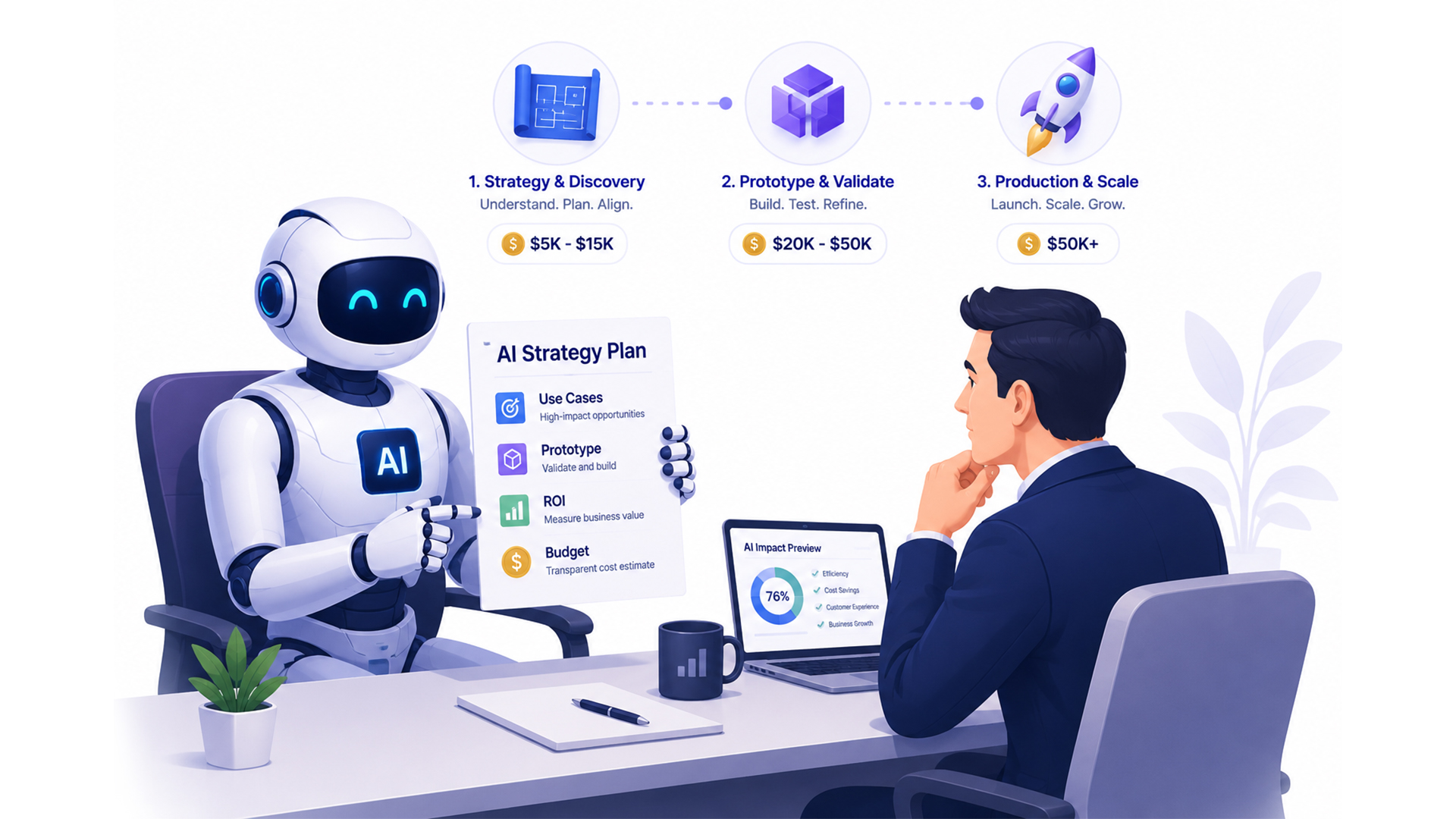
| AI readiness assessment | Current-state workflow audit, data infrastructure gap analysis, identification of AI-ready processes versus processes that need pre-work | 2 to 4 weeks | Before committing any AI investment budget; establishes the factual baseline for what is and is not technically feasible given your current data and systems |
| Use case prioritization and roadmap | Prioritized list of AI use cases scored by impact and implementation effort, a phased 90-day implementation plan, and build vs. buy recommendations for each use case | 4 to 8 weeks | After the readiness assessment confirms feasibility; when leadership needs to align on which AI investments to make before engineering resources are committed |
| LLM selection and architecture | Model evaluation against your specific tasks, infrastructure architecture decisions (cloud platform, self-hosted, managed API), compliance and data handling framework | 2 to 6 weeks | When the use cases are defined and the team needs to select the technical stack before development begins |
| POC build and validation | A working prototype of the highest-priority use case, validated against a representative sample of production data, with performance benchmarks and a go/no-go assessment | 4 to 10 weeks | When the roadmap is approved and you need technical proof that the AI performs adequately on your specific data before committing to full build |
| Production deployment | Fully engineered, tested, monitored, and deployed AI system integrated with existing business systems | 12 to 24 weeks | When the POC has been validated and the business case is approved for full production build |
Gen AI consulting cost is highly variable, determined by scope, the firm’s seniority level, geographic location of the team, and whether the engagement includes only advisory or also includes engineering build. Understanding what drives cost to the upper or lower end of each range prevents overpaying for strategy-only work or underfunding engagements that require engineering depth.
McKinsey’s workplace AI report notes that McKinsey research sizes the long-term AI opportunity at $4.4 trillion in added productivity growth potential, but that over the next three years only 1% of leaders call their companies mature on AI deployment. The gap between that trillion-dollar opportunity and 1% deployment maturity is where gen AI consulting engagements need to operate, and it is why the production deployment stage, not the strategy stage, is where most of the value is ultimately delivered or lost.
The IBM study of 2,000 CEOs found that only 25% of AI initiatives deliver expected ROI and just 16% ever scale across the enterprise. The consulting engagement structure is one of the primary variables that determines which outcome a company gets. A completed engagement that produces business value must deliver four things, regardless of which engagement type it represents.
Most gen AI consulting engagements are sold by firms that are stronger on strategy than on engineering. This is not necessarily a disqualifying factor for a pure strategy engagement, but it is a critical gap if the client needs the consulting firm to carry the project from strategy through to production deployment. These questions reveal which category a firm is in before the engagement starts.
WebOsmotic’s gen AI consulting practice spans use case prioritization through production deployment for clients in fintech, healthcare, eCommerce, and logistics. Every engagement includes a component-level cost breakdown before any development commitment is made, and every build phase delivers working software that the client can evaluate, not only documents that describe what the software will do.
| Ready to scope a gen AI consulting engagement that ends with software in production? WebOsmotic delivers scoped gen AI consulting for companies across India and the US. From use case prioritization and LLM architecture through to production deployment and monitoring, every engagement is designed to produce deployable AI, not strategy documents. We work with teams in fintech, healthcare, eCommerce, and logistics. |
What is gen AI consulting and what does an engagement typically include?
Gartner defines generative AI consulting and implementation services as helping organizations plan and deploy generative AI capabilities, bridging gaps in skills, experience, and technology on the path to business value. A typical engagement includes one or more of the following: an AI readiness assessment that audits current-state workflows and data infrastructure, a use case prioritization and roadmap exercise, an LLM selection and architecture decision, a proof-of-concept build, and a production deployment. The deliverables differ significantly between strategy-only firms and firms that also build, and understanding which type of firm you are engaging is the most important pre-commitment decision.
How much does gen AI consulting cost?
Cost varies by engagement type and firm. An AI readiness assessment for a mid-market company runs $15,000 to $50,000. A use case prioritization and roadmap engagement runs $40,000 to $150,000 depending on scope. LLM selection and architecture design runs $20,000 to $80,000. A proof-of-concept build runs $50,000 to $200,000. Full production deployment runs $100,000 to $1 million or more, depending on system complexity, integrations, and compliance requirements. These ranges reflect real-world pricing across specialist AI firms, regional consultancies, and offshore engineering teams with senior AI capability. Enterprise consulting firms like IBM and McKinsey operate at the upper end.
Why do so many AI consulting engagements fail to reach production?
Gartner reports that at least 30% of GenAI projects were abandoned after proof of concept, citing poor data quality, inadequate risk controls, escalating costs, and unclear business value as the primary causes. IBM’s study of 2,000 CEOs found only 25% of AI initiatives deliver expected ROI, and only 16% ever scale across the enterprise. The common pattern is a strategy engagement that identifies compelling use cases without fully assessing data quality, systems integration complexity, or compliance requirements. The gaps surface after the roadmap is approved and the build budget is committed, at which point the cost of addressing them exceeds the original estimate.
What should a gen AI consulting engagement produce to be worth the investment?
A completed engagement must produce: a working artifact at every phase gate, not just documentation; a prioritization framework your team can apply independently to future use cases; a technical architecture specific enough for an engineering team to execute without a follow-on scoping exercise; and defined success metrics agreed before the build begins. Engagements that produce only strategy documents, without demonstrating technical feasibility on your specific data and systems, have not completed the scope that makes subsequent build investment safe.
What is the difference between an AI strategy consultant and an AI development firm?
An AI strategy consultant assesses your business, identifies use cases, prioritizes them by impact and effort, and produces a roadmap. An AI development firm takes those use cases and builds the systems. Many firms describe themselves as AI consultants but are primarily development shops; many others are primarily strategy advisors without significant engineering capability. The distinction matters because the gap between a roadmap and a deployed system is where most AI investment is lost. Firms that span both strategy and development can be accountable for the full journey. Firms that only do one or the other require a handoff that frequently loses context and momentum.
How does WebOsmotic structure a gen AI consulting engagement?
WebOsmotic structures engage in two phases. The consulting phase delivers a use case prioritization, technical architecture, and build plan with component-level cost estimates. This phase produces a go/no-go decision point before any development commitment is made. The build phase delivers working software in production, with evaluation infrastructure and monitoring included. Both phases are scoped and priced independently, so clients can exit after the consulting phase with a complete roadmap if they choose to build with a different team. We work with companies in fintech, healthcare, eCommerce, and logistics across India and the US.