Business Process Automation: Which 20% to Automate First
195 Views
Summarize Article



Summarize Article
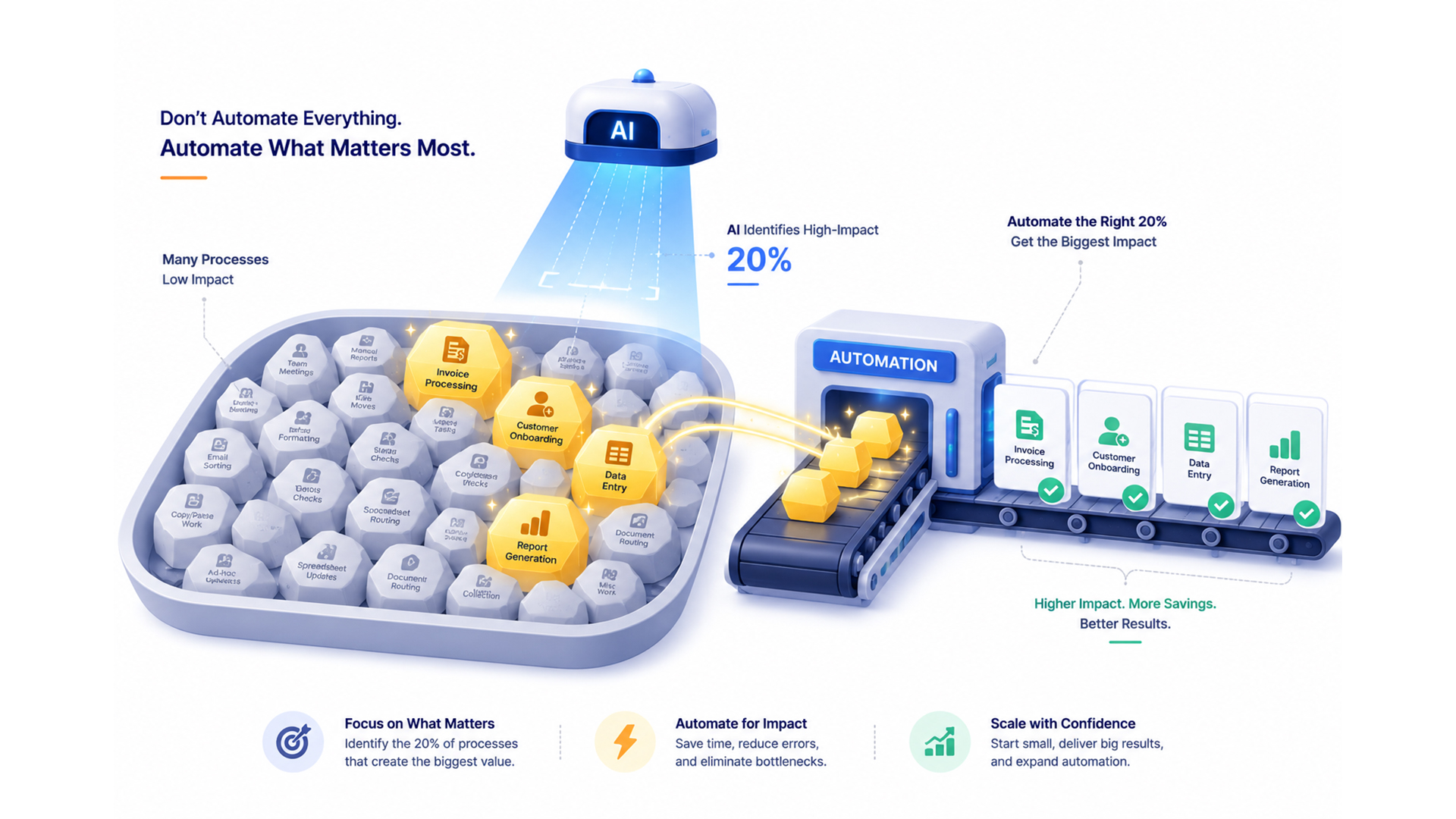
Business process automation AI works best when it targets the right 20% of your process portfolio, not the easiest 20%. This is the single most common mistake in business process automation AI projects: starting with the process that is easiest to automate rather than the process that is most valuable to automate. Ease and value are inversely correlated more often than they are aligned.
The processes that are easiest to automate are typically the ones that are already well-structured, have clean data, and run on modern systems. They are usually not the processes that consume the most human hours or carry the highest error cost.
The 20% that drives 80% of automation ROI is almost always: high-volume processes with high per-transaction labor cost, processes with measurable error rates where errors carry financial or compliance consequences, and processes where variability in human judgment produces inconsistent outcomes.
These processes are often harder to automate than structured data entry workflows, but they are the ones where the returns justify the investment.
Gartner predicts at least 15% of day-to-day work decisions will be made autonomously through agentic AI by 2028, up from 0% in 2024, and forecasts AI agent software spending at $206.5 billion in 2026.
This guide provides the prioritization framework for identifying which processes belong in that 15%, the decision criteria for choosing between RPA and AI agents, and what realistic automation ROI looks like based on IBM’s documented production benchmarks.
Need help identifying which processes in your organization should be automated first?
WebOsmotic runs process discovery and automation scoping engagements for fintech, healthcare, eCommerce, and logistics teams. We score each candidate process by automation ROI before any build begins, and we deliver production automation systems, not just process maps.
Process automation ROI is determined by four variables: the volume of transactions the process handles per period, the cost per transaction under the current manual approach, the error rate and the cost of each error, and the degree to which the process is rule-governed versus judgment-dependent. High-ROI automation candidates score high on all four.
| Process Characteristic | High ROI (Automate First) | Low ROI (Automate Later or Not at All) |
| Transaction volume | High volume: hundreds or thousands of transactions per day or week | Low volume: occasional transactions where automation setup cost exceeds lifecycle savings |
| Per-transaction labor cost | High labor cost per transaction: processes that require significant human time per unit | Low labor cost per transaction: already fast and simple manual processes |
| Error impact | Errors carry financial, compliance, or customer impact: processing errors in accounts payable, insurance claims, patient scheduling | Errors are low-consequence and easily corrected: internal data entry with immediate review |
| Process structure | Rule-governed with defined inputs and outputs, even if complex | Highly unstructured and judgment-dependent throughout: creative work, strategic decisions, relationship management |
| Data quality | Clean, structured, accessible data already available in connected systems | Data exists in PDFs, emails, unstructured formats, or siloed legacy systems that require significant preprocessing |
| Measurability | Outcomes are clearly measurable: cost per transaction, error rate, processing time | Outcomes are difficult to attribute: strategic recommendations, long-term relationship value |
IBM describes the distinction between RPA and AI precisely: RPA does tasks, while AI and machine learning encompass thinking and learning respectively. RPA automates processes that use structured data and logic, following deterministic rules at high volume. AI agents can handle variability, interpret unstructured inputs, reason over ambiguous situations, and make decisions that a rule-based system cannot handle.
IBM’s documentation on intelligent automation, which combines RPA with AI, describes it as an end-to-end intelligent automation solution that provides more accurate and efficient automation than RPA alone. IBM’s case study for IBM RPA documents USD 992,000 in benefits and 124% ROI, establishing the baseline against which AI-augmented automation must be measured.
| Dimension | RPA | AI Agents |
| Input type | Structured data: forms, spreadsheets, databases with defined schemas | Structured and unstructured: emails, PDFs, images, natural language requests, voice |
| Decision making | Rule-based: executes defined logic with no deviation. If the rules change, the bot breaks | Reasoning-based: interprets intent, handles exceptions, adapts to context variations within guardrails |
| Exception handling | Fails or requires human queue for exceptions outside defined rules | Can handle many exceptions autonomously, escalate genuinely ambiguous cases, and learn from escalation patterns |
| Setup complexity | Lower initial setup for well-defined processes. Brittle if processes change frequently | Higher initial setup. More resilient to process variation. Requires LLM, prompt engineering, and evaluation infrastructure |
| Compliance auditability | High: deterministic outputs are fully traceable and reproducible | Requires explicit logging and audit trail design. Agentic systems need per-step decision logging for compliance |
| Best use case | Invoice processing, data entry, structured report generation, scheduled data transfers | Prior authorization, customer service triage, contract review, compliance monitoring, procurement exception handling |
| ROI benchmark | USD 992,000 in benefits, 124% ROI (IBM RPA case study) | Varies by use case. McKinsey documents 20-30% cost reduction in distribution operations from AI-powered automation |
Before committing budget to an AI automation platform or vendor, the most important research finding to internalize is Gartner’s agent washing warning. Gartner’s June 2025 report states directly that many vendors are contributing to hype by rebranding existing products, including AI assistants, RPA, and chatbots, without substantial agentic capabilities. Gartner estimates only approximately 130 of the thousands of agentic AI vendors are real.
The IBM and McKinsey benchmarks for process automation ROI provide the reference range that business cases should be built against. These are production results from deployed systems, not vendor claims.
A business process automation AI business case that will be approved by a CFO requires four elements: a documented baseline of the current process cost and error rate, a specific projection of what automation will change about each cost component, a phased implementation plan with defined investment at each phase, and a measurement methodology that attributes post-implementation cost changes specifically to the automation.
WebOsmotic’s automation practice scores every candidate process by automation ROI before build begins. We define the baseline, project the expected improvement, and design the measurement methodology as part of the scoping engagement, so the business case is validated by a technical team before the investment is committed, visible across our case studies.
We serve clients in fintech, healthcare, eCommerce, and logistics, where the processes with the highest automation ROI typically sit in compliance, operations, and customer service.
Ready to identify the 20% of your process portfolio that drives 80% of automation ROI?
WebOsmotic runs process discovery and automation scoping engagements that score candidate processes by impact, effort, and ROI before any development begins. We build intelligent automation systems using RPA, AI agents, and LLM-powered workflows for enterprise teams in fintech, healthcare, eCommerce, and logistics.
→ Get your automation ROI assessment
IBM draws the distinction precisely: RPA does tasks, while AI and machine learning encompass thinking and learning. RPA automates processes using rule-based software with structured data and defined logic. It executes high-volume repetitive tasks reliably and consistently, but breaks when inputs fall outside its defined rules.
AI-powered automation can handle unstructured inputs including emails, PDFs, and natural language, reason over ambiguous situations, and make routing and exception-handling decisions that a deterministic rule system cannot. IBM describes intelligent automation, which combines RPA with AI, as providing more accurate and efficient automation than either approach alone. The choice depends on whether the process involves exceptions that require judgment.
IBM’s RPA case study documents USD 992,000 in benefits and a 124% ROI as a production benchmark. McKinsey’s distribution operations research documents 20-30% inventory cost reduction, 5-20% logistics cost reduction, and 5-15% procurement spend reduction from AI-powered process automation.
These are production results from deployed systems. The realistic expectation for a well-scoped automation project targeting high-volume, high-labor-cost processes with measurable error rates is positive ROI within 12-18 months of production deployment. Projects that target complex, unstructured processes without defining the exception-handling scope first consistently take longer and cost more than projected.
Gartner defines agent washing as vendors rebranding existing products, including RPA, chatbots, and AI assistants, without substantial agentic capabilities, simply by adding the word ‘agent’ to their marketing. Gartner estimates only approximately 130 of the thousands of agentic AI vendors have genuine agentic capabilities.
To avoid it: require the vendor to demonstrate a specific scenario where the agent makes a decision based on reasoning over variable inputs, not just pattern-matching or rule-triggering. Ask what happens when the input is outside the training distribution. Ask to see logs of actual agent decisions from a production deployment, not a demo environment.
The highest-ROI automation candidates share four characteristics: high transaction volume, high per-transaction labor cost, measurable error rates where errors carry financial or compliance consequences, and rule-governed structure with defined inputs and outputs.
Processes that combine all four, such as invoice processing, prior authorization, claims intake, order management exceptions, and compliance monitoring, are the ones where automation investment is returned fastest. Processes that are easy to automate because they are already simple and fast rarely justify the automation investment. Start with the processes that are painful, not the ones that are convenient.
A well-structured engagement includes process discovery, where the automation team baselines each candidate process by volume, cost, error rate, and data quality; automation design, where the team decides between RPA, AI agents, or a hybrid approach for each process and defines the exception-handling logic.
It also includes a proof-of-concept build on a subset of the process volume; production deployment with integration into existing business systems; and a monitoring and measurement framework that tracks the actual versus projected ROI after deployment.
Engagements that skip the process discovery phase frequently produce automation systems that solve the wrong problem or encounter data and integration issues that were not scoped.
WebOsmotic starts every automation engagement with a process scoring exercise that rates each candidate process by volume, cost impact, error impact, and automation feasibility. This produces a ranked list of processes with projected ROI for each, so the build budget is allocated to the highest-return targets first.
We design the automation architecture, specifying whether each process needs RPA, AI agents, or a hybrid approach, and we define the exception-handling scope and escalation logic before any development begins. Production deployments include monitoring infrastructure and a measurement framework that tracks actual ROI against the projection made in the scoping phase.