AI Automation Services: What the ROI Numbers Say in 2026
218 Views
Summarize Article



Summarize Article
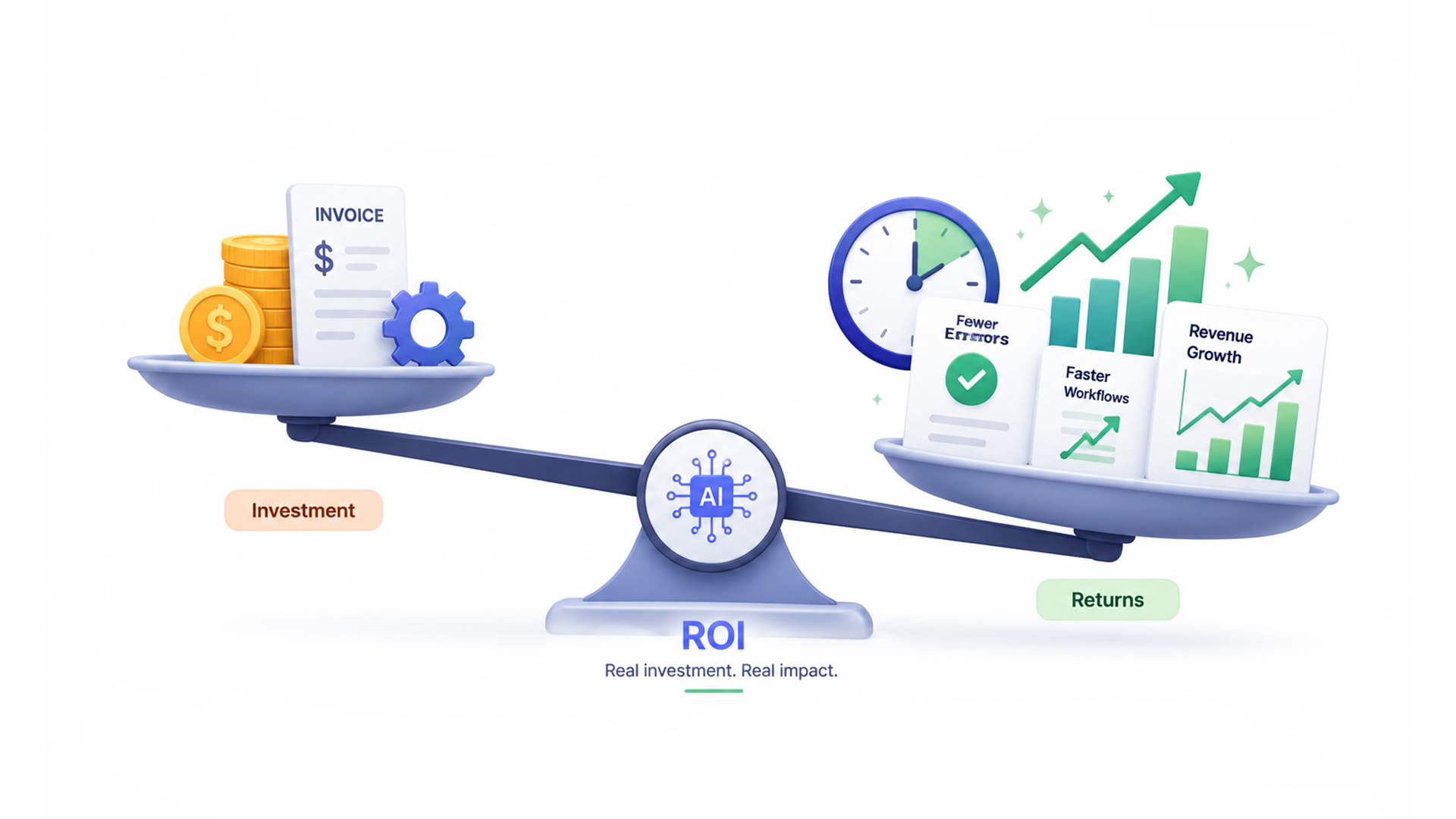
AI automation services produced two conflicting headlines in 2026, and both are correct at the same time. IBM found that 66% of enterprises report real productivity gains from AI, and McKinsey found that 51% of executives expect revenue increases above 5% over the next three years.
At the same time, IBM’s C-suite study found only 25% of AI initiatives deliver expected ROI. Gartner’s infrastructure and operations survey put the fully-successful rate at 28%. Across both surveys, AI automation ROI and AI automation services move together: the gains are real, and the success rate is lower than the spending volumes suggest.
This gap is where AI automation services either earn their investment or fail to. This guide explains what the production ROI data actually shows, drawing on IBM, McKinsey, and Gartner’s 2026 research, and covers the specific factors that decide which side of the gap a deployment lands on.
| Building a business case for AI automation services and need to benchmark against production results? WebOsmotic scopes AI automation engagements with defined ROI targets, process baselines, and measurement frameworks before any development begins. We work with fintech, healthcare, eCommerce, and logistics teams across India and the US. |
IBM’s “Race for ROI” report, published October 2026 from a survey of 3,500 senior executives across the UK, Germany, France, UAE, Saudi Arabia, Spain, Italy, Poland, Sweden, and the Netherlands, is the most complete enterprise-level benchmark available for AI automation services from a primary institutional source.
These figures put real numbers behind AI workflow automation results that used to be reported only as anecdotes.
Against this optimistic picture sits the correction: IBM’s C-suite study found only 25% of AI initiatives have delivered expected ROI, and just 16% have scaled enterprise-wide.
IBM’s Think Circle findings name the primary constraints on AI automation services as culture, governance, workflow design, and data strategy. Only 29% of executives can measure AI ROI confidently today, while 79% see productivity gains. The operational value exists. The financial measurement methodology has not caught up.
Gartner’s April 2026 survey of 782 I&O leaders puts a number on the success rate: only 28% of AI use cases in infrastructure and operations fully succeed and meet ROI expectations. 20% fail outright.
The remaining 52% deliver partial results. For AI automation services, partial results may satisfy some operational goals, but they do not meet the ROI expectations that justified the investment in the first place.
Gartner’s research names the main success factor for AI automation services: integration into existing workflows and systems, plus full support from business executives. The organizations that succeed are not running more sophisticated models. They have better integration and stronger executive alignment.
Gartner’s separate survey of 350 global business executives found a counterintuitive result in autonomous business deployments: about 80% of organizations piloting or deploying autonomous AI technologies report workforce reductions, but those reductions do not appear to translate into ROI.
Workforce reduction rates were close between high-ROI and low-ROI respondents. Gartner concludes that the organizations that improve ROI from AI automation services are not the ones that cut headcount. They are the ones that invest in the skills, roles, and operating models that let people guide and scale autonomous systems.
McKinsey’s 2026 workplace AI survey captures the executive expectation for AI automation services: 51% of executives anticipate gen AI will deliver revenue increases above 5% over the next three years, with 17% expecting increases above 10%. 92% plan to increase AI spending.
McKinsey notes that early AI excitement is giving way to pressure for demonstrable ROI. McKinsey describes this as a turning point: companies must move from exploration to measurable results.
IBM, Gartner, and McKinsey’s findings converge on a consistent picture of what drives ROI from AI automation services. The deciding factors are not model selection or tool sophistication. They are structural and organizational, and they hold whether the vendor is an internal team or an outside automation AI company.
Business automation AI projects that score well on these factors tend to repeat their first win in a second process within a year. AI automation services that score poorly rarely get a second budget cycle.
The table below breaks these factors down for AI automation services at each end of the ROI range.
| Factor | High-ROI AI automation services | Low-ROI AI automation services |
|---|---|---|
| Business case definition | ROI targets, measurement methodology, and baseline metrics defined before deployment begins | ROI defined after deployment, or not defined at all, making it impossible to confirm whether targets were met |
| Workflow integration depth | AI embedded into the actual workflow system people use, with output that feeds the next step directly | AI output delivered as a report or dashboard that requires manual action to affect the process |
| Executive sponsorship | CEO or functional C-suite sponsor committed to the organizational changes required to capture value | IT-led initiative without a business mandate to change workflows, staffing, or performance metrics |
| Data readiness | Structured, accessible, quality data the AI can use without manual preprocessing per inference | Data in silos, legacy systems, or formats that need heavy preparation before AI produces reliable output |
| Process selection | High-volume, high-labor-cost processes with measurable error rates and rule-governed structure | Low-volume or unstructured processes where automation complexity outweighs the value |
| Measurement infrastructure | Automated tracking of pre-defined KPIs before and after deployment, with attribution methodology | No systematic measurement; value reported anecdotally or inferred without financial quantification |
IBM and McKinsey’s production benchmarks give the reference ranges a business case should use instead of vendor claims. These ranges also work as a sanity check on any AI services cost savings estimate a vendor hands you before signing.
WebOsmotic’s AI automation practice scores every candidate project by projected ROI before build begins. We define the baseline, project the expected improvement, and design the measurement methodology during scoping, so the business case is validated before development investment is committed. We serve clients in fintech, healthcare, eCommerce, and logistics, where the highest-ROI opportunities for AI automation services typically sit in compliance, operations, and customer service.
| Ready to build the business case for your next AI automation services investment? WebOsmotic scopes AI automation ROI before development begins. We define baselines, project returns, and design measurement frameworks, so the investment decision is supported by data. We work with teams across India and the US. |
IBM’s “Race for ROI” survey of 3,500 executives found 66% report significant productivity gains, with 20% already realizing ROI goals and 42% expecting ROI within 12 months across cost reduction (41%), time savings (45%), and quality improvements. Gartner’s I&O survey found 28% of AI use cases fully succeed and meet ROI expectations. McKinsey documents 20-30% inventory cost reduction, 5-20% logistics cost reduction, and 5-15% procurement savings from AI-powered distribution operations in production. IBM documents 70% call containment saving USD 5.50 per call for customer service AI. These results share one prerequisite: high-volume processes with clear baselines and measurement frameworks.
IBM’s Think Circle findings name culture, governance, workflow design, and data strategy as the main constraints, not technology limits. Gartner found that success in I&O AI ties mainly to integration into existing workflows and executive support, not model sophistication. IBM’s C-suite study found only 29% of executives can measure AI ROI confidently, which means many AI automation services with real operational value cannot show financial value because the measurement infrastructure was never built. Gartner’s finding that workforce reduction does not drive ROI reflects a common pattern: automating steps within a process without redesigning the end-to-end process in a way that actually cuts operating cost.
Customer service call containment is among the fastest-payback AI automation services at scale. IBM’s documented USD 5.50 per contained call at 70% containment produces monthly savings that can return implementation cost within weeks at high volume. Software engineering productivity tools are among the most consistently cited in McKinsey’s annual survey data for immediate, measurable cost benefit. RPA with intelligent automation applied to high-volume back-office processes, such as invoice processing, claims intake, and compliance document processing, typically produces positive ROI within 12-18 months. McKinsey’s distribution operations data, showing 20-30% inventory reduction, represents the scale of returns available from AI automation services applied to high-volume, high-working-capital processes.
Gartner’s and IBM’s research point to the same prerequisite: baseline measurement has to happen before deployment, not after. Define the current cost per transaction, error rate, and processing time for the target process. Define the threshold for success, what percentage reduction in cost, error rate, or time counts as the target. Design the attribution methodology before launch, so changes in KPIs after deployment can be confidently attributed to the AI automation services rather than to other concurrent changes. IBM notes that only 29% of executives can measure AI ROI confidently today, largely because measurement infrastructure was never set up at deployment. IBM frames this as a governance and workflow design gap, not a technology gap.
Traditional process automation, mainly RPA, uses rule-based software to perform defined tasks with structured data at high volume. AI automation services add reasoning, natural language understanding, and the ability to handle variable, unstructured inputs that rules-based systems cannot process. IBM describes the distinction as RPA doing tasks while AI thinks and learns. The commercial difference is that AI automation services can handle the exceptions and edge cases that RPA routes to human queues, extending automation coverage past the structured core of a process into the variability that traditionally needed human judgment. IBM documents intelligent automation, the combination of RPA and AI, as more accurate and efficient than either approach alone.
Every WebOsmotic engagement for AI automation services starts with a process scoring phase that baselines each candidate process by transaction volume, labor cost, error impact, and automation feasibility, producing a ranked list of processes by projected ROI. We define the measurement methodology before development begins, design the automation architecture around measurable operational targets, and build monitoring infrastructure into every production deployment, so actual ROI is tracked against the projection made at scoping. We work with fintech, healthcare, eCommerce, and logistics clients in India and the US.
| A business case for AI automation services holds up when the ROI targets, baselines, and measurement framework are set before development starts, not after. WebOsmotic scopes every engagement this way for fintech, healthcare, eCommerce, and logistics teams. |