AI Medical Scribe: How It Works, Accuracy, HIPAA and Build vs Buy
5 Views
Summarize Article



Summarize Article
Physicians at The Permanente Medical Group used an AI medical scribe in 2,576,627 patient encounters between October 2023 and December 2024. Kaiser Permanente’s research division puts the documentation time saved at nearly 16,000 hours. Adoption at that scale settles one question. Clinicians will use these tools.
The open questions are harder. How often is the note wrong? Who is liable when it is? And should a health system or health tech company build its own tool or license one?
This guide answers each, with the study data and the federal rules behind them.
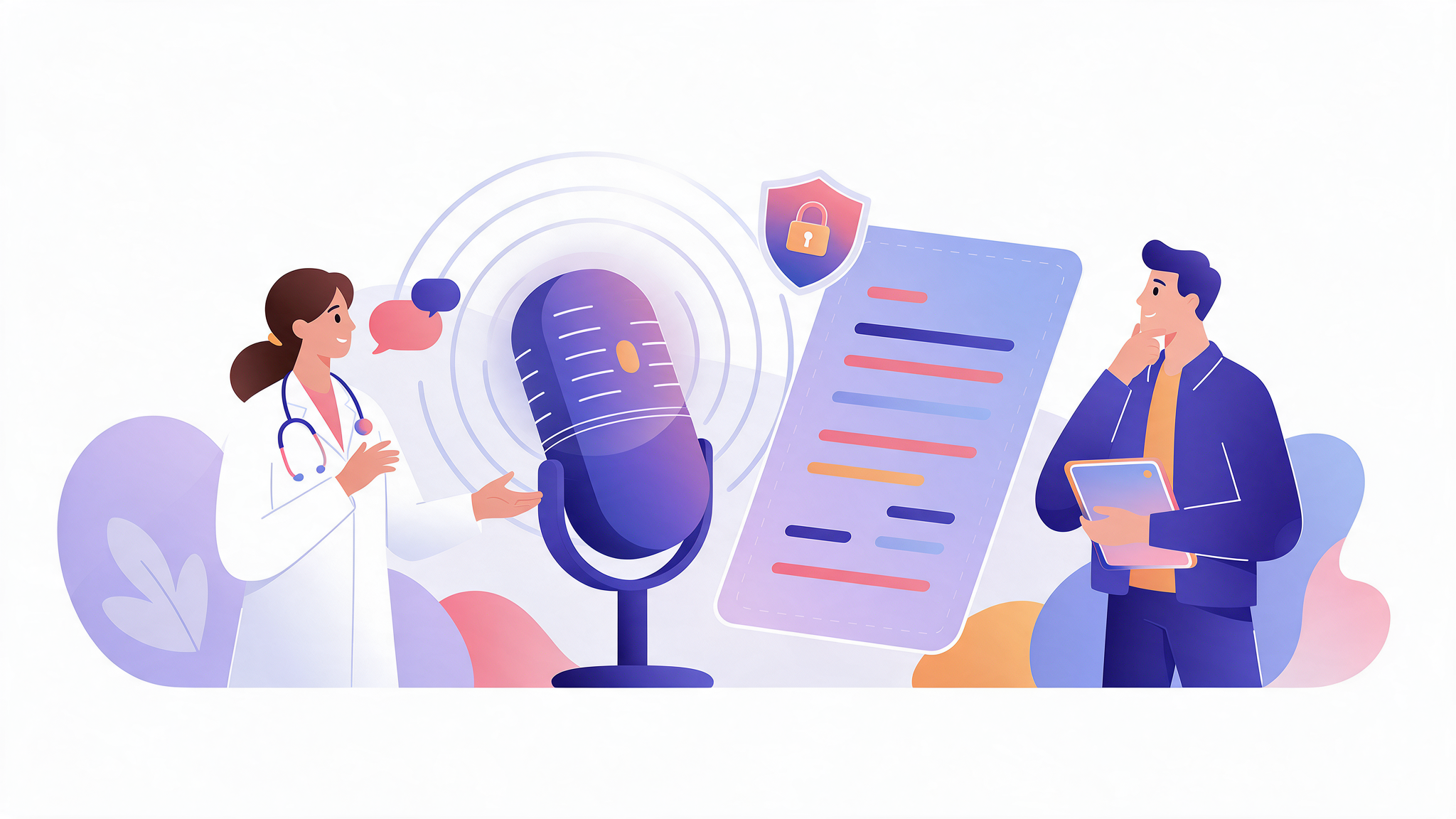
An AI medical scribe is software that listens to a clinical visit and drafts the note. The software records the conversation, turns speech into text and uses a language model to write a structured note, such as a SOAP note. The clinician edits and signs it. The scribe never signs anything.
Vendors also call this ambient clinical documentation, since the tool works in the background of a normal visit. The clinician talks to the patient. No dictation and no typing during the visit.
An AI medical scribe works in five stages. A phone or room microphone captures the visit. Speech recognition turns audio into a transcript and labels each speaker. A language model pulls out symptoms, history, exam findings and plans. It then writes a draft note in the clinic’s template. The clinician reviews it, and the note moves to the EHR.
| Stage | What happens | Where errors creep in |
| Capture | Microphone records the visit, with patient consent | Background noise, masks, cross-talk |
| Transcription | Speech recognition produces a speaker-labeled transcript | Drug names, accents, invented words |
| Extraction | Language model finds clinical facts in the transcript | Missed details, facts given to the wrong speaker |
| Drafting | Model writes the note in the clinic’s template | Wrong section, made-up exam findings |
| Review and filing | Clinician edits and signs, note goes to the EHR | Rushed review, sync failures |
Test speech recognition on its own, before judging the notes. A study of OpenAI’s Whisper, “Careless Whisper”, found invented text in about 1% of transcriptions. Of those invented passages, 38% carried harms, such as made-up violence or false claims of authority. The comparison of Deepgram vs Whisper covers how speech engines differ on noisy audio.
AI medical scribes make frequent errors, and omissions lead the list. In a 2025 MedStar Health study, 70% of draft notes from two commercial products had at least one error. The researchers counted 127 errors across 44 notes. Every draft still needs clinician review before signing, and the review needs to be careful.
The MedStar study used 11 scripted outpatient visits, so real clinics may see different rates. Accuracy research on ambient clinical documentation is still young, and the pattern matters more than the exact figure. An omission is the hardest error to catch, because the reviewer must recall what the patient said at the end of a long clinic day and notice it is missing.
| Study | Setting | Key finding |
| MedStar Health, JMIR, 2025 | 2 products, 44 draft notes | 70% of notes had at least one error. Omissions were 83% of one product’s errors |
| Careless Whisper, 2024 | Speech-to-text on recorded speech | About 1% of transcripts had invented text, and 38% of those were harmful |
| Rotenstein et al., JAMA, 2026 | 8,581 clinicians at 5 academic health systems | 16.0 fewer documentation minutes per 8 scheduled patient hours |
| Permanente Medical Group, 2025 | 7,260 physicians, 2.58 million encounters | Nearly 16,000 documentation hours saved |
The time savings are real but modest. The JAMA study found 13.4 fewer minutes of total EHR time per 8 scheduled patient hours. Only about 32% of adopters used the AI scribe medical teams were given in half or more of their visits. Those heavy users saw the largest gains.
Testing an AI scribe before rollout?
WebOsmotic builds evaluation sets from your own specialties and note templates, then scores each draft for omissions and invented facts before clinicians see it.
A HIPAA compliant AI medical scribe protects audio and notes as protected health information at every stage. Each vendor in the chain must sign a business associate agreement. That covers the speech engine, the language model host and the cloud. Encryption, access controls, audit logs and a documented risk analysis complete the picture.
HHS business associate guidance requires a written contract with any vendor that creates, receives or stores PHI for a covered entity. For an AI scribe medical audio counts. So does the transcript, the draft and any log that holds a patient’s words.
Controls to check before signing a contract:
Ask about model training directly. Some contracts allow de-identified data to improve the product. Your privacy officer needs to approve that in writing. The guide to HIPAA-compliant voice AI covers voice data handling in more depth.
Patients should consent before any visit is recorded. State law decides the minimum. A one-party state lets a single person consent. All-party states need everyone in the room to agree. California’s Penal Code 632 makes recording a confidential conversation without all parties’ consent a crime. Build consent into the visit workflow.
Clinics usually ask in one of two ways. One method adds consent to intake forms. The other has the clinician ask aloud and record a yes in the chart. A verbal check at the visit catches patients who skimmed the form. The clinician can also pause the recording when a patient raises a sensitive topic they want kept off the record. The app should log consent with a timestamp. It should also stop recording at once if the patient says no.
Buy an AI medical scribe when you need one for general outpatient care. Commercial products often ship with EHR connections already built. Build one when your specialty, language mix or workflow falls outside what vendors handle well, or when the scribe is part of your own product. Building takes about four to eight months.
| Option | Build time | Team | Loaded labor cost |
| Buy and configure | 4 to 8 weeks | Clinical lead, IT analyst, vendor team | Per-clinician license fees, quoted by vendor |
| Build a pilot for one specialty | 16 weeks | 2 developers, 1 data scientist, 1 QA, half-time designer | About $245,000 |
| Build a production scribe with EHR write-back | 32 weeks | 4 developers, 2 data scientists, 1 QA, half-time designer | About $842,000 |
The labor math uses federal wage data. The median software developer earned $135,980 in May 2025, and the median data scientist earned $120,230. Wages were 68.5% of employer cost in June 2026, according to the BLS compensation release. Loaded hourly rates come to about $95 for developers, $84 for data scientists, and $73 for QA and design.
An AI scribe medical teams build in-house also needs speech and model API fees, plus an ongoing evaluation set. The guide to HIPAA-compliant AI development covers the security side of a custom build.
Building a scribe into your health product?
Our healthcare engineers connect speech, language models and EHR write-back under signed BAAs, with an error review loop your clinicians can trust.
For routine outpatient visits, often yes. The clinician still reviews every note, though. A human scribe catches context the software misses, such as a gesture or a look between patient and parent. In the 2025 MedStar study, 70% of AI drafts had at least one error, so review time stays.
The 2026 JAMA study of 8,581 clinicians found 16.0 fewer documentation minutes per 8 scheduled patient hours, and heavy users saved more. At Kaiser Permanente, physicians saved nearly 16,000 hours across about 2.58 million visits. Savings depend on how often clinicians actually switch it on.
The consumer ChatGPT app is unsuitable for patient visits because it comes with no business associate agreement. Some enterprise AI services offer BAAs for specific products. Any scribe built on a language model needs a signed BAA covering that model, plus encryption and access logs, before it hears a single patient. Pilot a BAA-covered tool for 30 days first.
Specialties with heavy jargon, many speakers, or long exams find more errors. Behavioral health sessions often run close to an hour and carry sensitive detail. Pediatrics adds a parent’s voice. Emergency rooms add noise. Test each specialty with 20 to 30 of its own recorded visits before rollout.
The clinician who signs the note owns its content. That is why review matters. Health systems should set a written policy on review, train clinicians to spot omissions, and keep the original audio for a short, defined period. Contracts should spell out the vendor’s duties, including breach notice within 60 days.