Enterprise AI Strategy: How to Build One That Survives the First Pilot
3 Views
Summarize Article



Summarize Article

Stanford’s 2026 AI Index reports that 88% of surveyed organizations used AI in 2025, and 70% used generative AI in at least one business function. AI agent deployment, by contrast, stayed in the single digits across nearly every function. Adoption is broad. Depth is rare.
An enterprise AI strategy is a written plan that links AI investment to specific business goals and ranks the use cases worth funding. It also sets the data and team structure needed to run them. A good one fits in a short board paper while still giving engineering enough detail to schedule work.
The real test comes after the first pilot. A good plan says what happens next and who pays. This guide covers use-case scoring, sourcing decisions and KPIs. It closes with a 12-month roadmap a CTO can reuse.
An enterprise AI strategy should cover seven parts: business goals, a ranked use-case portfolio, the data foundation, a build, buy or partner rule, governance, an operating model and KPIs. Each part needs an owner. Leave any one out and the plan stalls at the point that part was needed.
The US federal government offers a useful template. OMB memo M-25-21, issued April 3, 2025, required each CFO Act agency to publish an AI strategy within 180 days. The memo asks for current and planned use cases plus a maturity assessment with plans for data and infrastructure, among other items. A private company can borrow that enterprise AI strategy structure almost line for line.
| Part | Question it answers | Typical owner |
| Business goals | Which 2 to 4 company goals should AI move? | CEO or COO |
| Use-case portfolio | Which projects get funded, in what order? | AI steering group |
| Data foundation | Which data must be clean and reachable first? | CDO or data lead |
| Build, buy or partner | Who builds each capability? | CTO |
| Governance | What rules keep AI use safe and lawful? | Risk or legal lead |
| Operating model | Who runs AI day to day? | CTO with business heads |
| KPIs | How do we know it is working? | CFO |
Think of this table as the AI strategy framework. The sections below fill in each row.
AI use case prioritization works best as a weighted score across the five criteria below. Rate each candidate from 1 to 5 on every criterion, multiply by the weight, and fund from the top. The math matters less than the debate it forces between business and technical leaders.
| Criterion | Weight | What a 5 looks like |
| Business value | 30% | Clear saving or revenue gain above $500,000 a year |
| Data readiness | 25% | Labeled, reachable data for the task already exists |
| Time to value | 15% | Measurable result inside 90 days |
| Risk (inverted) | 15% | Low harm if the model is wrong |
| Strategic fit | 15% | Directly supports a top-3 company goal |
Here is an illustrative example: three candidates for a hypothetical mid-sized US distributor, scored with the weights above.
| Use case | Value | Data | Time | Risk | Fit | Weighted score |
| Invoice data extraction | 4 | 5 | 5 | 4 | 3 | 4.25 |
| Demand forecasting | 5 | 3 | 2 | 4 | 5 | 3.90 |
| Customer service agent | 4 | 3 | 3 | 2 | 4 | 3.25 |
Invoice extraction wins the first slot in this AI use case prioritization. Demand forecasting carries more value, but its data needs two quarters of cleanup. Fund the quick win first and start the data work for the bigger one in parallel.
Repeat the AI use case prioritization every quarter. Data readiness changes as the foundation improves, and a project that scored 2 in January can lead the list by July.
Buy when the capability is common across industries and a vendor product meets 80% of the need. A custom build pays off when your own data creates an advantage competitors cannot copy. Partner when you need to build but lack the team, or when speed matters more than owning every line of code.
| Situation | Choice | Example |
| Common task, standard data | Buy | Meeting transcription, code assistants |
| Your data is the advantage | Build | Pricing models trained on your own transaction history |
| Need to build, short on staff | Partner | Custom agent connected to an ERP and CRM |
| Regulated data, strict control | Build or partner | Claims triage on protected health data |
Write the rule into the enterprise AI strategy, so new requests are decided the same way. For bought tools, ask for a current SOC 2 Type II report before any company data goes in. Our guide to custom AI development: build vs buy walks through the cost side of the decision in detail.
Need a second opinion on your use-case ranking?
WebOsmotic scores your candidate use cases against your real data and systems, then hands back a ranked portfolio with a build, buy or partner call for each.
The strategy needs one reachable, governed dataset for each of the first funded use cases, plus a short set of rules for safe AI use. Avoid starting with a company-wide data lake, because those projects often run for a year or more before a single AI use case can draw on the result. Build the data foundation use case by use case, so every dollar spent on data serves a funded project.
Four data decisions belong in the strategy itself:
Governance should match the company’s maturity. Two AI systems need little more than a use policy and a review step. By twenty, add a model inventory with risk tiers and regular audits. The NIST AI Risk Management Framework gives a free structure to grow into, and our guide to the AI governance framework shows how to set one up.
An enterprise usually runs AI through a hub-and-spoke model. A small central team owns standards, shared tools and the use-case pipeline. Business units own their use cases and the people who use them. The central team stays small, often 3 to 8 people for a company of a few thousand employees.
The hub handles the model gateway, evaluation tooling, vendor contracts and the AI inventory. Each spoke has a business owner who decides whether a use case is working, and a production owner who keeps it running.
Decision rights need writing down. Name who approves a new AI vendor and who can switch a model off. Those two answers prevent months of friction. For capabilities the hub cannot staff, artificial intelligence consulting services can fill the gap while the internal team grows.
Measure an enterprise AI strategy with a mix of leading and lagging KPIs reviewed every quarter. Leading indicators, such as time from idea to production, show whether delivery works. The payoff appears later, in measures like dollars saved per use case. Report both to the board.
| KPI | Type | Example target for year one |
| Days from approved idea to production | Leading | Under 120 days |
| Share of staff using approved AI tools weekly | Leading | 40% of knowledge workers |
| Use cases in production with a measured baseline | Leading | 3 to 5 |
| Annual savings or revenue per production use case | Lagging | Above the build cost within 18 months |
| AI incidents reported and closed | Risk | 100% closed within 30 days |
Every production use case should carry its own scorecard against the baseline recorded at the proof-of-concept stage. After two missed quarters in a row, the steering group makes a fix-or-stop call.
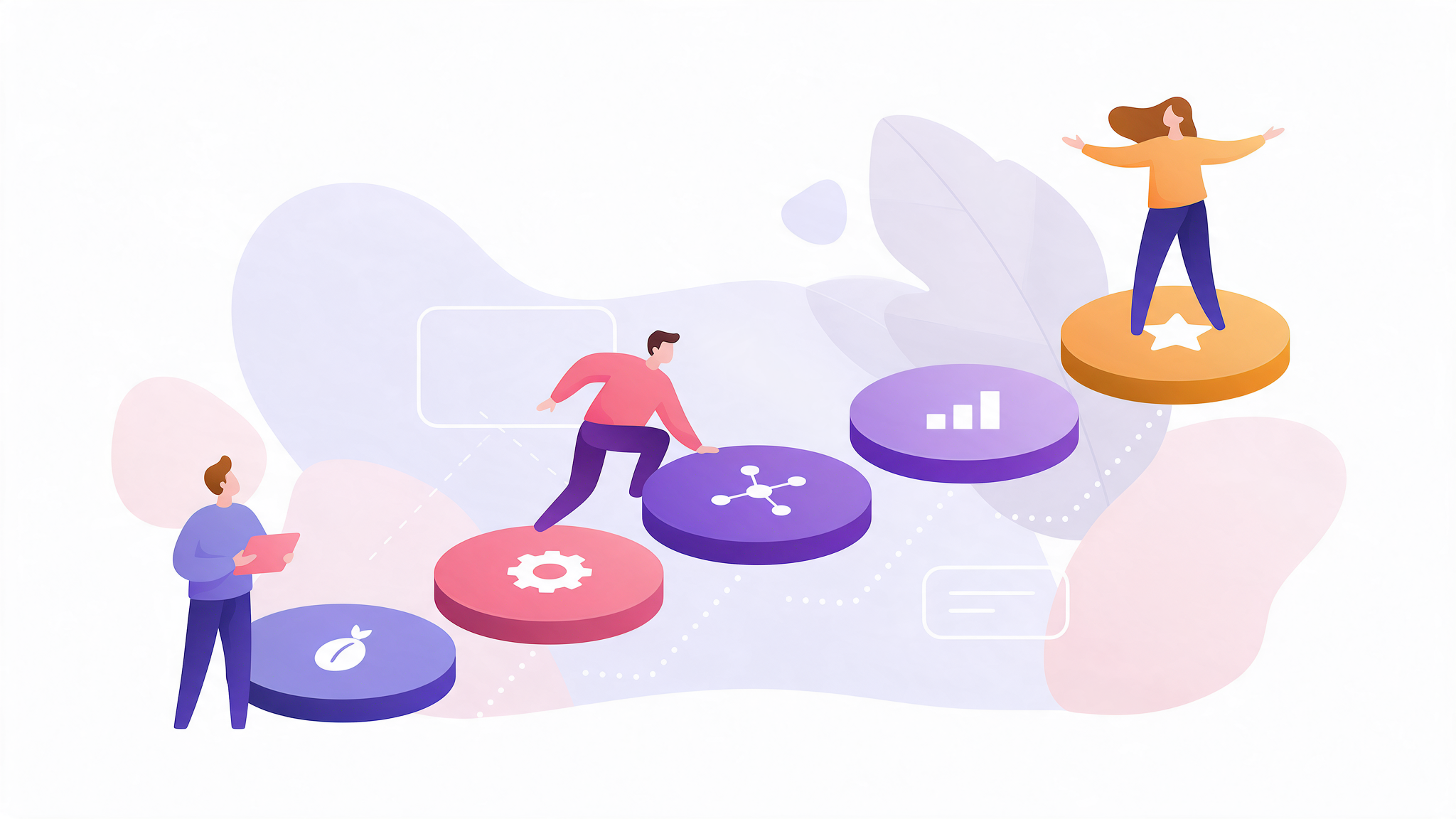
A 12-month AI strategy roadmap starts with foundations and two proofs of concept in the first quarter. The second quarter delivers the first production launch, the third scales to several use cases, and the fourth reviews results and sets next year’s portfolio. Every quarter ends with a decision. That stops drift.
| Quarter | Focus | Output by quarter end |
| Q1 | Foundations | AI policy, inventory, scored portfolio, 2 PoCs started |
| Q2 | First production | 1 use case live with a baseline, data pipeline monitored |
| Q3 | Scale | 3 to 4 use cases on a shared gateway and evaluation suite |
| Q4 | Review | KPI report to the board, refreshed portfolio, year-two budget |
Plans change mid-year. Keep a reserve of about 15% of the AI budget unallocated at the start of the year. New models and new ideas arrive every quarter, and the strategy should absorb them without a full re-plan.
The roadmap assumes the company has passed a basic readiness check. If not, run the AI readiness assessment first, then start this enterprise AI strategy at Q1.
Want the 12-month roadmap built around your systems?
Our AI team turns your scored portfolio into a quarter-by-quarter delivery plan, then builds the first production use case with you.
Six to ten weeks is typical for a company with 500 to 5,000 employees. Interviews and the use-case inventory take 2 to 3 weeks, scoring and data checks another two, and the rest on the roadmap and board review. Smaller firms can finish in four weeks.
A named executive, often the CTO or a Chief AI Officer, should own it. That person chairs a steering group of 5 to 7 people, including finance and two or three business unit heads. Avoid splitting ownership between IT and the business.
An AI strategy framework sets out the parts a strategy must cover, such as goals and governance. An AI strategy roadmap schedules the work over time, usually by quarter. You need the framework first. The roadmap then puts dates and owners against it for the next 12 months.
Fund 2 proofs of concept in the first quarter of an enterprise AI strategy and aim for 3 to 5 production use cases by year end. More than that usually spreads data and engineering teams too thin, and none of the projects reach a measured result.
Budgets vary with size, so tie the number to the portfolio. A flat percentage of revenue says little. Price the first 3 to 5 use cases from their PoC estimates, add the shared platform cost, and hold about 15% in reserve for new ideas during the year.