Model context protocol (MCP): the integration standard every AI team needs now
203 Views
Summarize Article



Summarize Article
Key takeaways
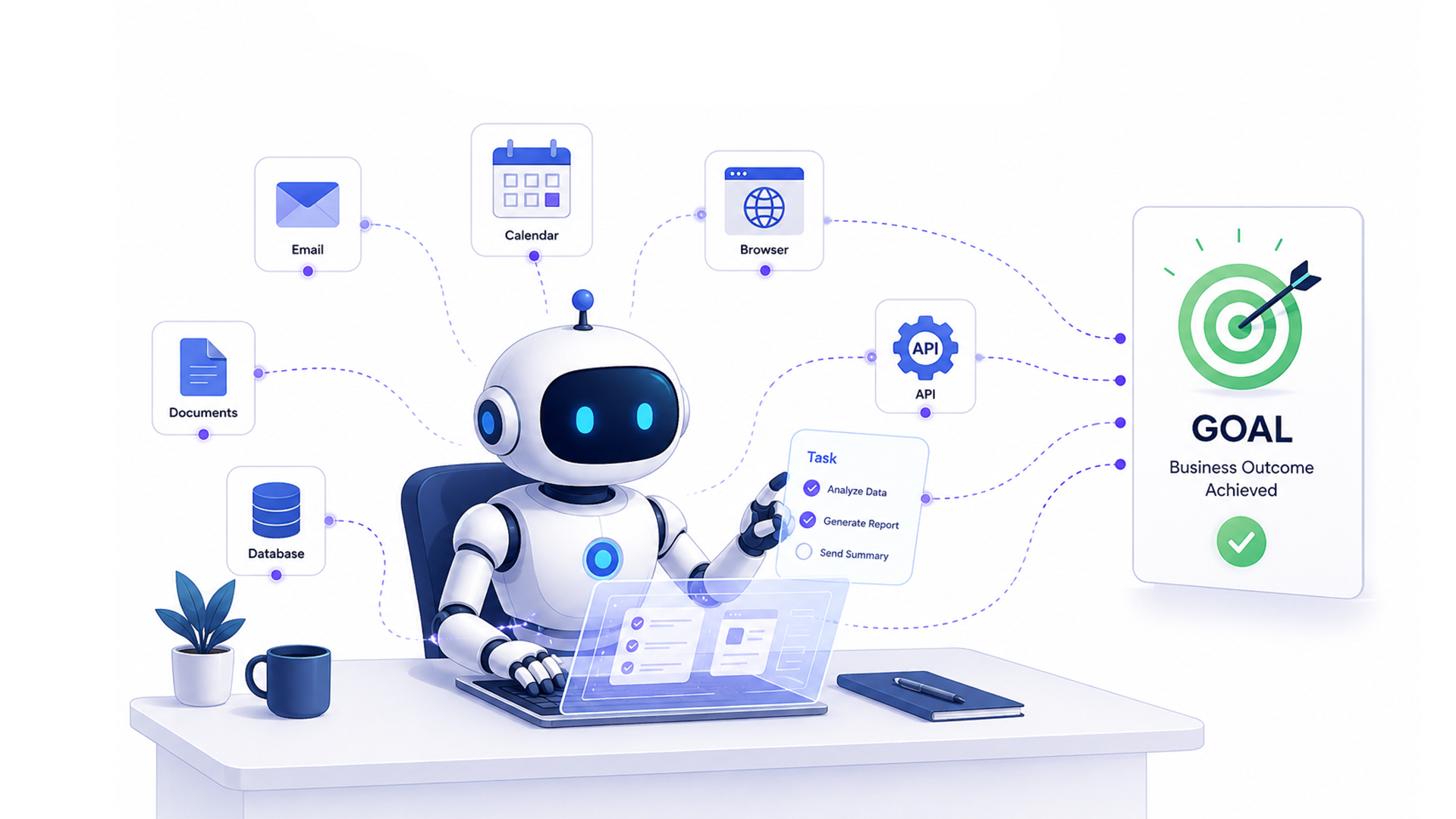
Every AI team building production agents hits the same wall. The agent needs to read from a CRM, query a database, call an internal API, and write back to a ticketing tool. Each connection requires a custom integration with its own authentication flow, schema mapping, and error handling. Before long, engineers are spending most of their sprint capacity maintaining connectors rather than improving the intelligence of the agent itself.
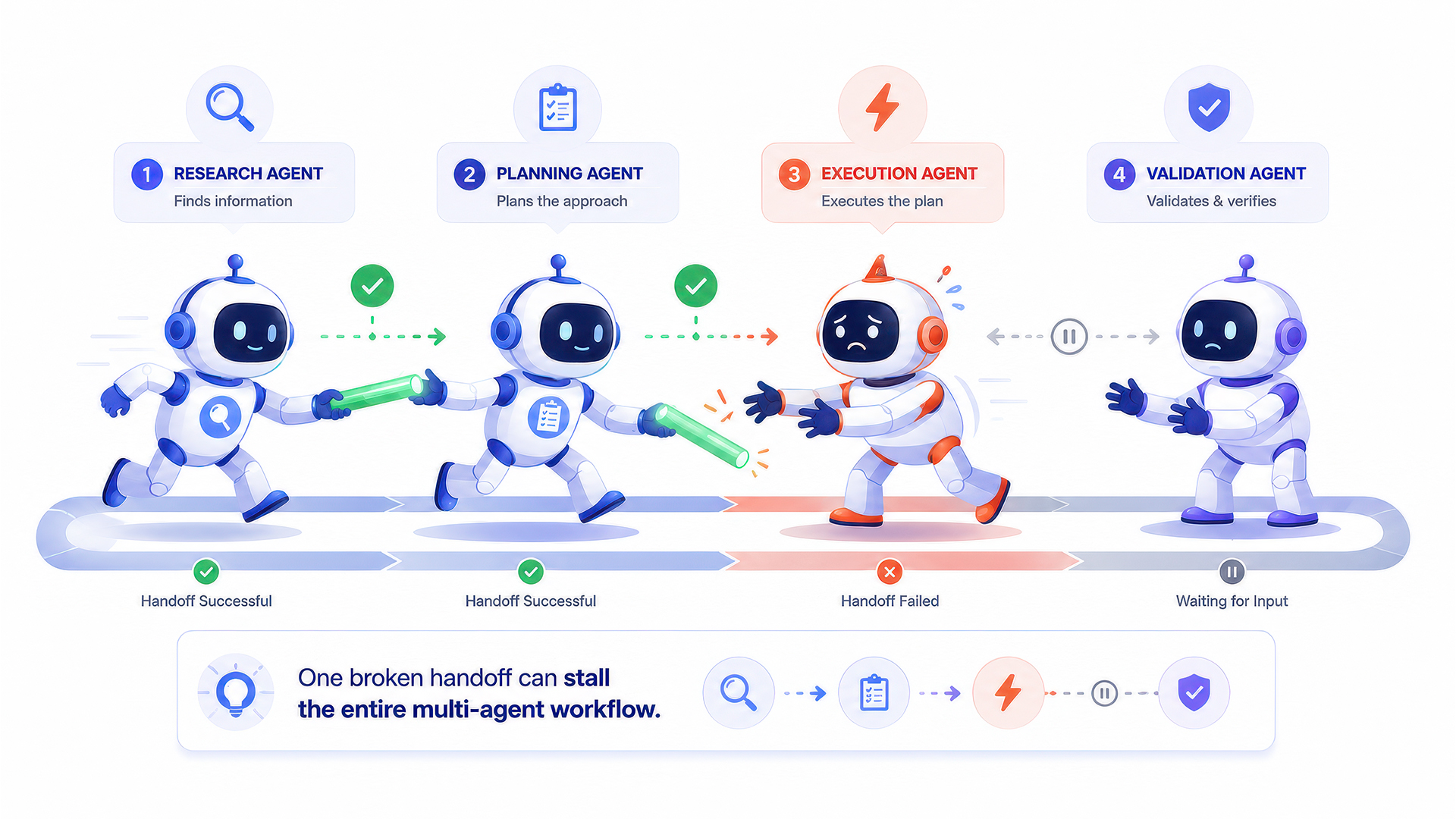
This is not a staffing problem. It is a structural one. REST APIs were designed for human developers who write deterministic code. When an AI agent attempts the same task, it cannot reliably infer what endpoint to call or how to sequence calls. The result is brittle pipelines that break when schemas change and fail silently when context is missing.
Anthropic introduced MCP in November 2024 as a universal open standard for connecting AI systems with data sources, replacing fragmented integrations with a single protocol. Since launch, Anthropic has confirmed that MCP counts more than 10,000 active public servers and has been adopted by every major AI platform, including ChatGPT, Gemini, Microsoft Copilot, and Cursor.
| Already building AI agents and hitting integration walls? WebOsmotic’s AI team helps engineering leads map their existing stack to MCP, scope the right servers to build first, and move from proof of concept to production without accumulating integration debt. |
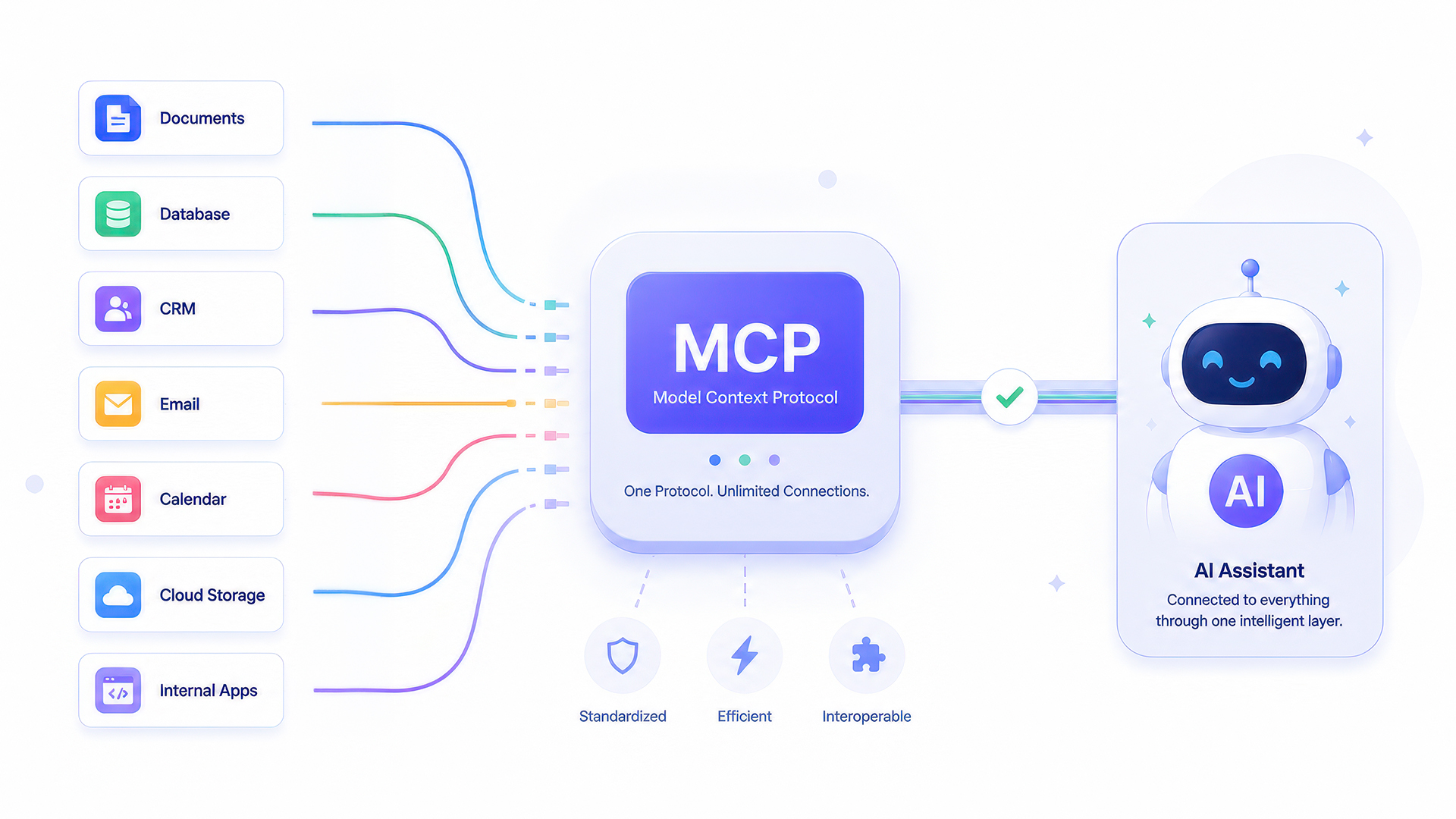
Model context protocol MCP is an open standard defining how an AI agent communicates with external tools, APIs, and data sources. Each service publishes a standardized description of its capabilities, and the agent reads those descriptions at runtime to decide how to act. As IBM explains, this allows for plug-and-play tool usage rather than writing custom integration code for each tool.
The architecture uses a client-server model over JSON-RPC 2.0. Each MCP server exposes four capability types:
BCG describes MCP as enabling agents to evolve from pre-set prompt chains to truly autonomous agents, with MCP supporting complex, session-based interactions that reference previous activity, helping agents act more dynamically than REST APIs allow.
An MCP server is a lightweight process sitting between an AI agent and the service it needs to access. It handles authentication, translates the agent’s intent into the service’s native format, and returns structured responses the agent can reason over. Setting one up involves four steps:
Microsoft has embedded MCP across its enterprise product line, from Dynamics 365 ERP to Azure AI Agent Service. IBM has published an enterprise architecture guide, verified by Anthropic, making MCP central to its agentic AI infrastructure strategy.
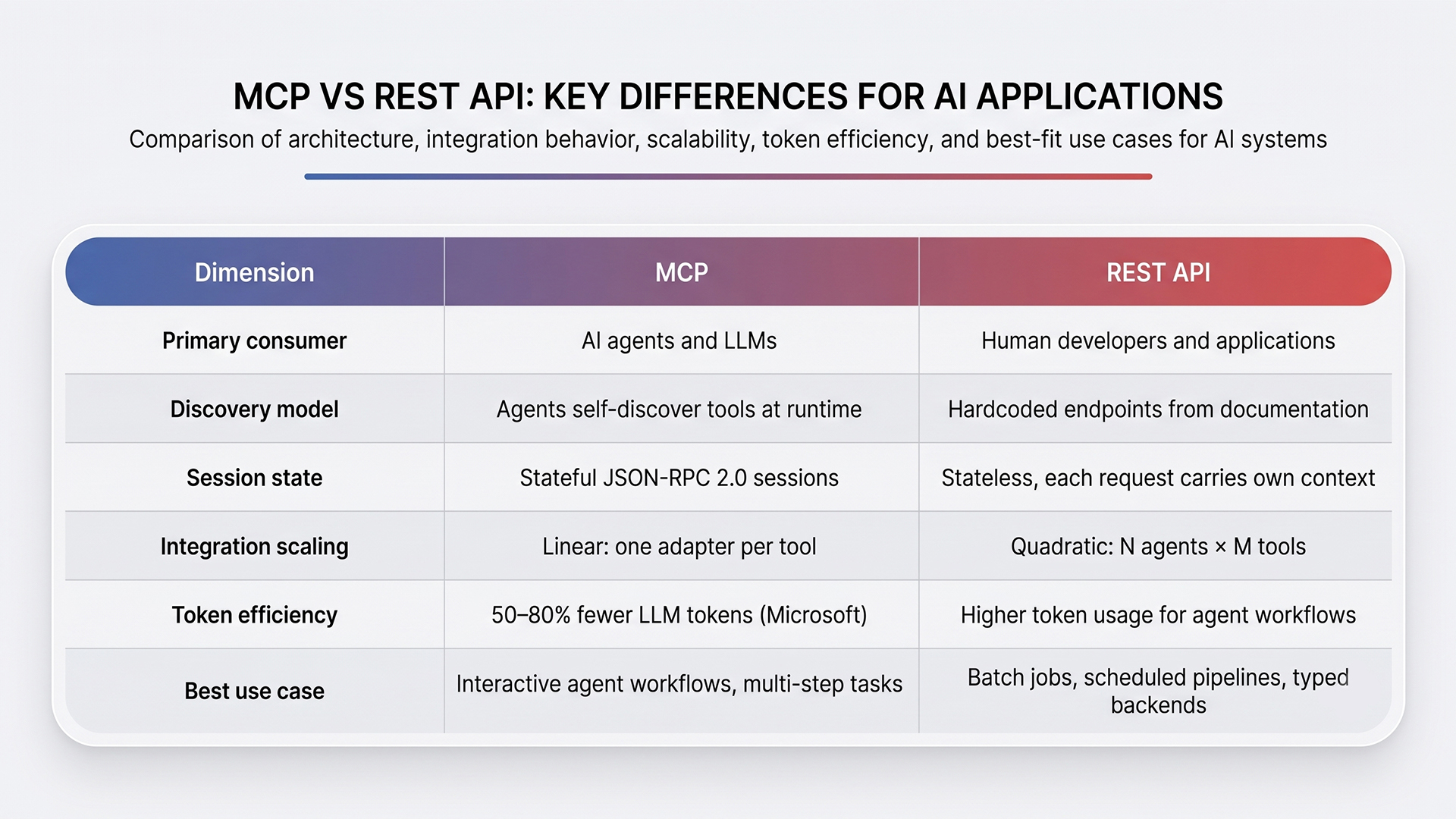
IBM clarifies that MCP is not a replacement for REST APIs but a standardized layer that complements them. REST remains the right choice for many workloads. MCP adds the semantic and session-aware layer that AI agents specifically need. As Microsoft’s architecture analysis documents, MCP delivers 50–80% fewer LLM tokens than REST but runs 15–25% slower due to JSON-RPC overhead, making the choice workload-dependent.
LangChain MCP compatibility is one of the most frequently searched questions in this space. IBM addresses it directly: MCP can complement orchestration frameworks like LangChain, LangGraph, and LlamaIndex, but it does not replace them. MCP does not decide when a tool is called or for what purpose. That remains the orchestration layer’s responsibility.
Model context protocol enterprise adoption has moved faster than most open standards. The timeline below, drawn from official announcements by Anthropic, Microsoft, IBM, and Gartner, captures the key milestones:
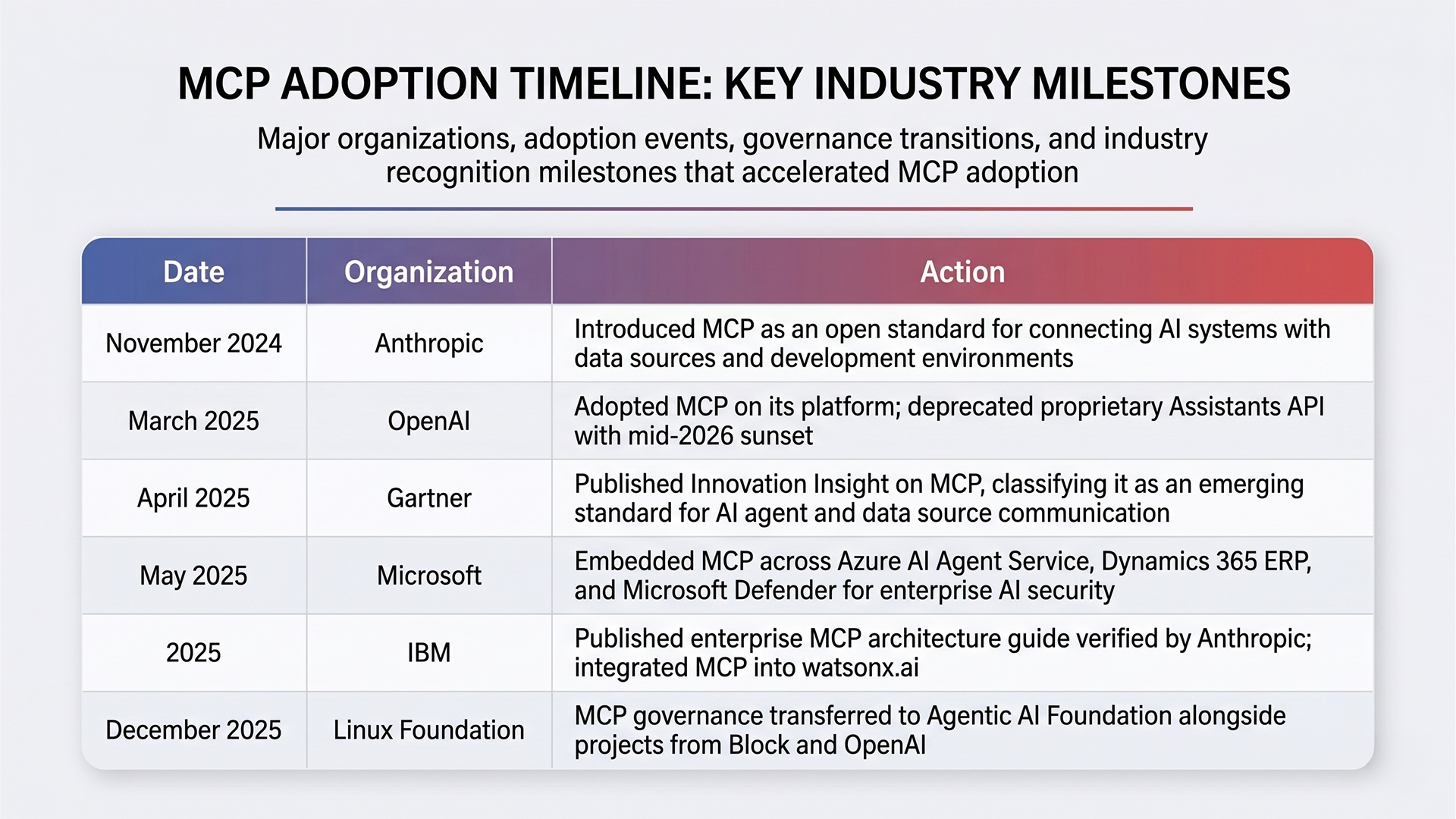
For companies in eCommerce, logistics, and fintech looking to move AI agents from proof-of-concept to production, this level of institutional backing from Microsoft, IBM, Google, OpenAI, and Anthropic removes the single greatest adoption risk: protocol obsolescence.
| See how WebOsmotic has helped 200+ companies ship production AI From eCommerce personalization agents to logistics automation, WebOsmotic’s engineering team has built MCP-ready AI systems across industries. Explore our services and see what is possible for your stack. |
MCP security is where enthusiasm has most clearly outrun preparation. The NSA AI Security Center published its first formal cybersecurity guidance on MCP in May 2026, flagging serialization vulnerabilities, trust boundary failures, and agent misuse vectors as active risks. Gartner predicts that 25% of all enterprise GenAI applications will experience at least five minor security incidents per year by 2028, up from 9% in 2025, citing MCP’s interoperability-first design as a primary contributing factor.
WebOsmotic’s AI development practice treats MCP security architecture as a first-class deliverable. For clients in fintech and healthcare, building governance controls into the MCP layer at project start is substantially cheaper than retrofitting them after a security review.
WebOsmotic works with product teams and engineering leads at each stage of the MCP adoption curve, from the first proof of concept through to production-scale deployment:
The teams that move earliest on model context protocol MCP will define how AI agents operate in their industries. The protocol’s governance is in the hands of the Linux Foundation. Microsoft, IBM, Google, and OpenAI have standardized on it. The NSA has documented what to watch for. The remaining variable is execution speed.
| Ready to move from evaluating MCP to building with it? WebOsmotic’s engineers have delivered MCP-ready AI agent systems for companies in eCommerce, logistics, fintech, and healthcare. Whether you are starting your first proof of concept or scaling an existing agent to production, we can help you build it right the first time. |
Is model context protocol MCP a replacement for REST APIs?
No. IBM clarifies that MCP is a standardized integration layer that complements REST APIs, not one that replaces them. REST remains the better choice for high-throughput batch jobs, scheduled pipelines, and typed backend services. MCP is the right choice when the consumer is an AI agent that needs to discover and invoke tools dynamically at runtime.
Which major platforms have adopted model context protocol MCP?
Per Anthropic’s official announcements, MCP has been adopted by ChatGPT, Gemini, Microsoft Copilot, Cursor, and Visual Studio Code. Microsoft has embedded MCP into Azure AI Agent Service and Dynamics 365 ERP. IBM has integrated it into watsonx.ai and published a verified enterprise architecture guide. OpenAI deprecated its proprietary Assistants API in favour of MCP with a mid-2026 sunset.
What are the main security risks of deploying MCP in an enterprise?
Gartner and the NSA AI Security Center both flag prompt injection, tool poisoning, OAuth misconfiguration, and supply chain attacks as the primary risks. Gartner specifically advises treating any use case that combines agent access to sensitive data, ingestion of untrusted content, and external communication in the same flow as a high-risk pattern requiring a formal security review.
How does MCP relate to LangChain?
They operate at different layers. LangChain is an orchestration framework that manages the agent loop, memory, and step sequencing. MCP is a tool protocol that standardises how the agent accesses external services once it has decided to act. The two are complementary. Teams using LangChain can use the langchain-mcp-adapters library to call MCP servers directly, keeping LangChain’s orchestration capabilities while gaining MCP’s tool portability across any compatible client.
How long does it take to build and deploy a custom MCP server?
For a well-documented enterprise service with an existing REST API, a basic MCP server that defines tools, configures resources, and handles transport can typically be built in days rather than weeks. The bulk of the effort shifts from integration plumbing to security configuration, particularly OAuth delegation, RBAC, and logging for compliance. WebOsmotic’s engineering team handles both, so teams can validate their first MCP proof of concept quickly before committing to a wider rollout.
Is MCP suitable for regulated industries such as fintech and healthcare?
Yes, provided it is deployed with appropriate governance controls. The protocol’s centralized access control surface, OAuth 2.1 support, and tool invocation logging make it well-suited to regulated environments once those controls are properly configured. The risk, as Gartner and the NSA both note, is that MCP was designed for interoperability first. Teams in fintech and healthcare should build the governance layer in from the start rather than retrofitting it after deployment. WebOsmotic’s work with clients in these sectors is structured to address this from day one.