Multi-Agent AI: 4 Patterns and When Each One Breaks
260 Views
Summarize Article



Key takeaways
|
Multi-agent AI architecture is the fastest-growing area in enterprise AI. Gartner reports a 1,445% surge in multi-agent system inquiries from Q1 2024 to Q2 2025. The same organisation simultaneously predicts that over 40% of agentic AI projects will be cancelled by the end of 2027 due to escalating costs, unclear business value, and inadequate risk controls.
The gap between those two numbers is the gap between picking a pattern because it looked right in a demo and understanding where it breaks under production load.
Most teams building multi-agent AI systems today are making their architectural decisions too late. The framework is chosen before the pattern is defined. The pattern is defined before the failure modes are mapped. By the time a cascading failure propagates across a chained agent workflow in production, the cost of redesigning the system is substantially higher than the cost of getting the architecture right in the first place.
This post maps the four core multi-agent AI architecture patterns that Microsoft, IBM, and LangChain recognise, examines where each one breaks, and explains which frameworks align to which patterns so the selection decision is made on architecture grounds rather than familiarity.
| Designing a multi-agent system and not sure which pattern fits your use case? WebOsmotic’s engineering team works with CTOs and product leads to define multi-agent architecture before the first framework decision is made. We build production agent systems for fintech, eCommerce, logistics, and healthcare. |
A single AI agent is straightforward to reason about. It has a prompt, a set of tools, and a loop. When it fails, the failure is isolated. IBM’s agentic architecture analysis confirms this directly: single-agent systems are easier to design, debug, and monitor precisely because there is no inter-agent communication to go wrong.
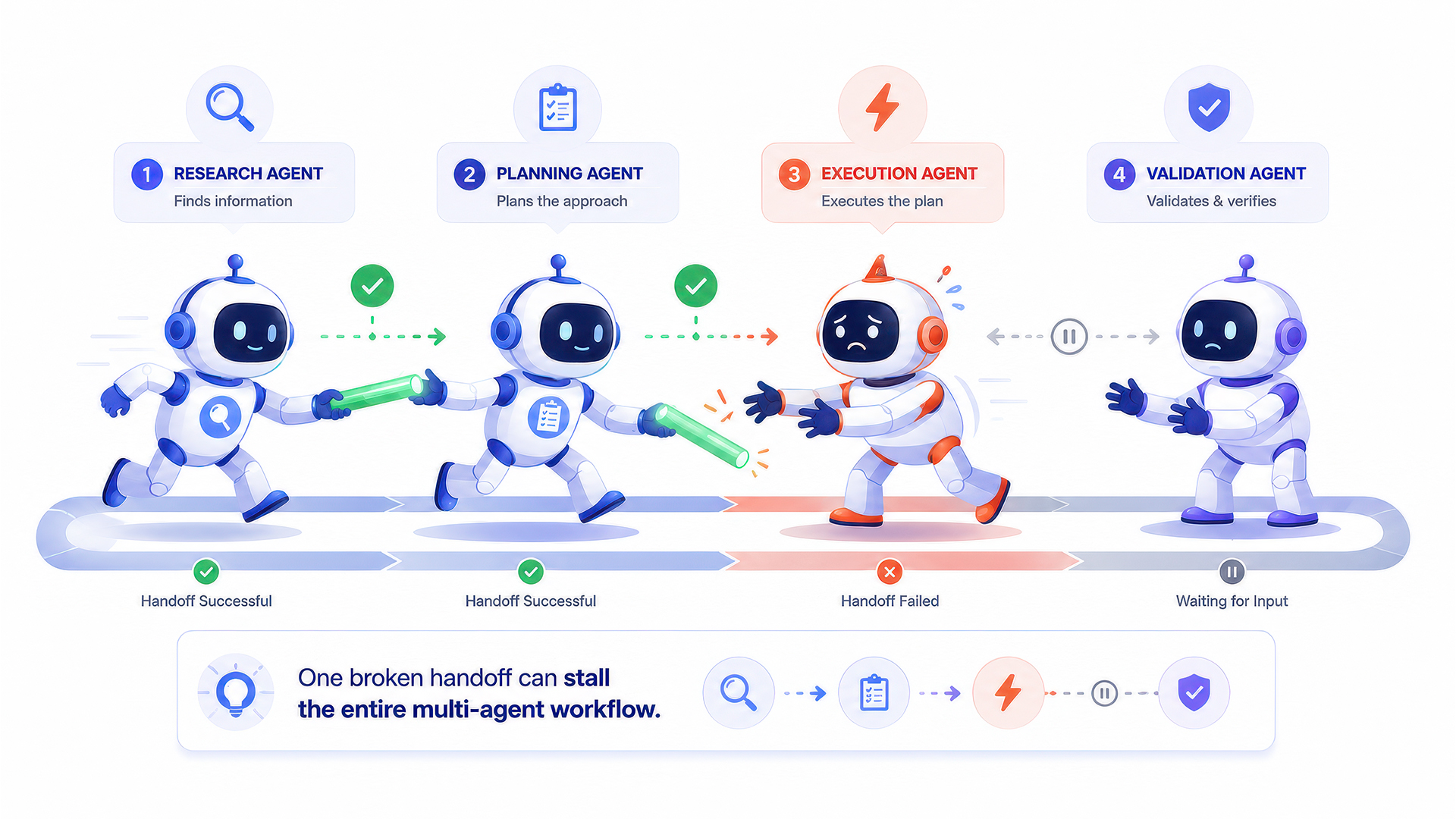
Multi-agent systems break this property. As IBM’s CIO playbook for multi-agent AI states, a collection of individually safe agents does not guarantee a safe collection. The interactions between agents create emergent behaviours and failure modes that extend beyond any individual component. Infinite loops that lock up resources, cascading failures where one error propagates across the system, content drift that produces hallucinations downstream, and resource exhaustion that drives up cloud costs unpredictably are all systemic risks that do not exist in single-agent deployments.
Microsoft’s Security Blog published a formal taxonomy of failure modes in agentic AI systems in 2025, classifying novel failure modes unique to multi-agent environments, including failures that occur specifically in the communication flow between agents. These are not edge cases. Microsoft states that real-world examples of agents behaving in unexpected ways, including leaking sensitive information, acting outside intended boundaries, and causing confirmed business harm, were already occurring in 2025 deployments.
Microsoft’s Azure Architecture Center identifies four fundamental orchestration patterns for multi-agent systems. These are not framework-specific. As Microsoft explicitly notes, the patterns apply whether you are building with LangGraph, CrewAI, the OpenAI Agents SDK, or a custom implementation. The framework is the implementation vehicle; the pattern is the architectural decision.
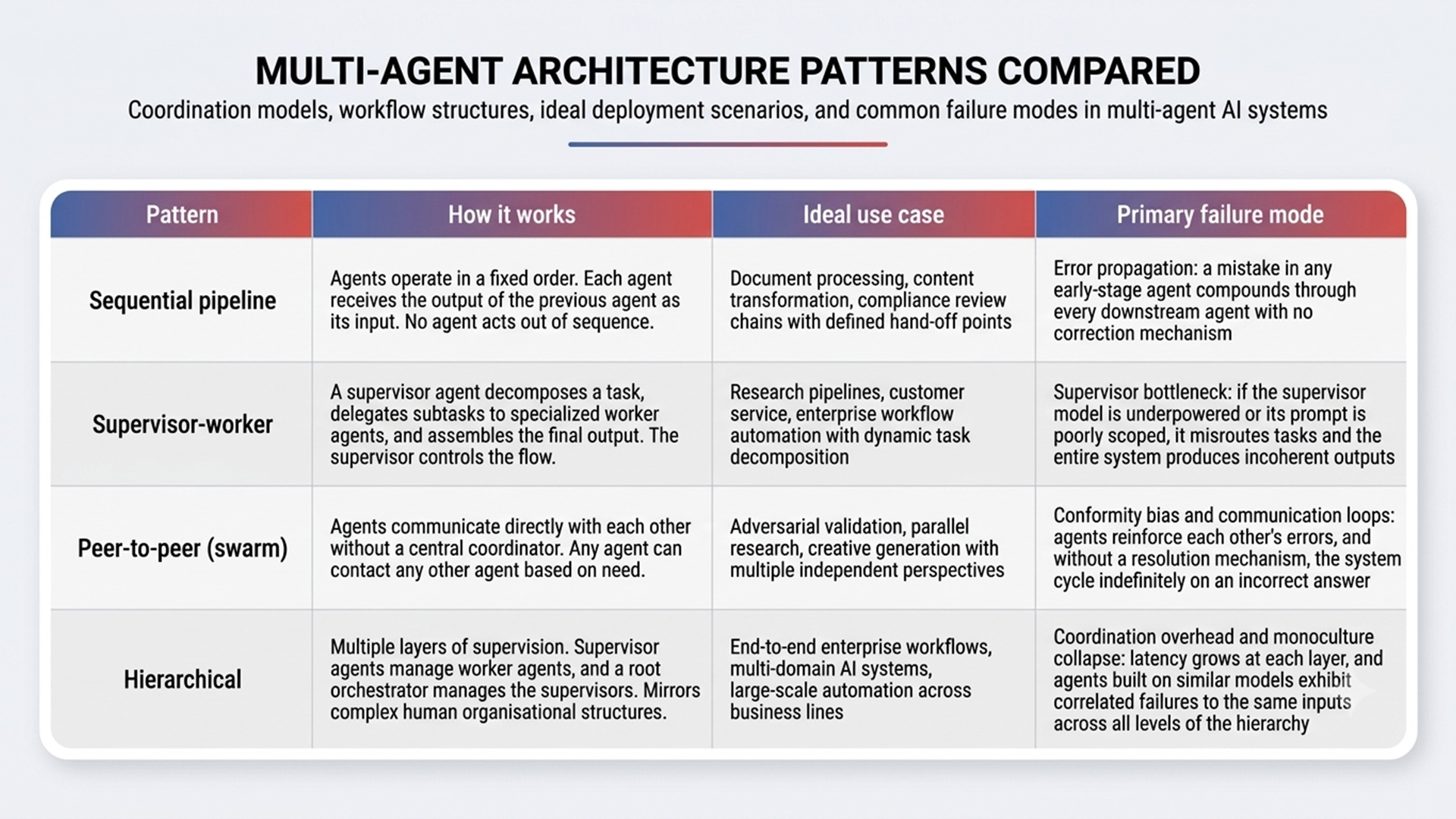
The sequential pipeline is the most intuitive multi-agent pattern and the most commonly chosen by teams building their first multi-agent system. Each agent is responsible for one stage of a larger process: extract, classify, summarise, format, validate. The output of each stage becomes the input for the next.
The supervisor-worker pattern is the most widely deployed multi-agent architecture in enterprise settings. Microsoft’s own Azure AI Foundry implementation is built on this pattern, which Microsoft describes as an orchestrator-worker model closely aligned with Anthropic’s lead agent and subagents approach. A supervisor agent receives the user’s request, decomposes it into subtasks, delegates each to a specialized worker agent, and synthesises the outputs into a coherent response.
The peer-to-peer pattern, sometimes called a swarm, removes the central coordinator entirely. Agents communicate directly with each other based on need. Any agent can initiate a request to any other agent. The system’s coherence emerges from the interactions rather than being imposed by a supervisor.
The hierarchical pattern extends the supervisor-worker model into multiple layers. A root orchestrator manages domain supervisors, which in turn manage specialized worker agents. This mirrors how cross-functional enterprise teams are structured and is the architecture Microsoft recommends for end-to-end enterprise workflow automation across multiple business lines.
| The pattern decision is more expensive to reverse than it looks WebOsmotic has shipped multi-agent systems across logistics dispatch, eCommerce operations, fintech compliance, and healthcare triage. We help engineering teams choose the right pattern before the architecture is committed and the wrong one is in production. |
Framework selection follows pattern selection. The three most widely deployed multi-agent frameworks in 2025 have distinct architectural philosophies that align naturally with specific patterns. Choosing the wrong framework for a pattern does not make the pattern impossible, but it does require fighting the framework’s abstractions rather than working with them.
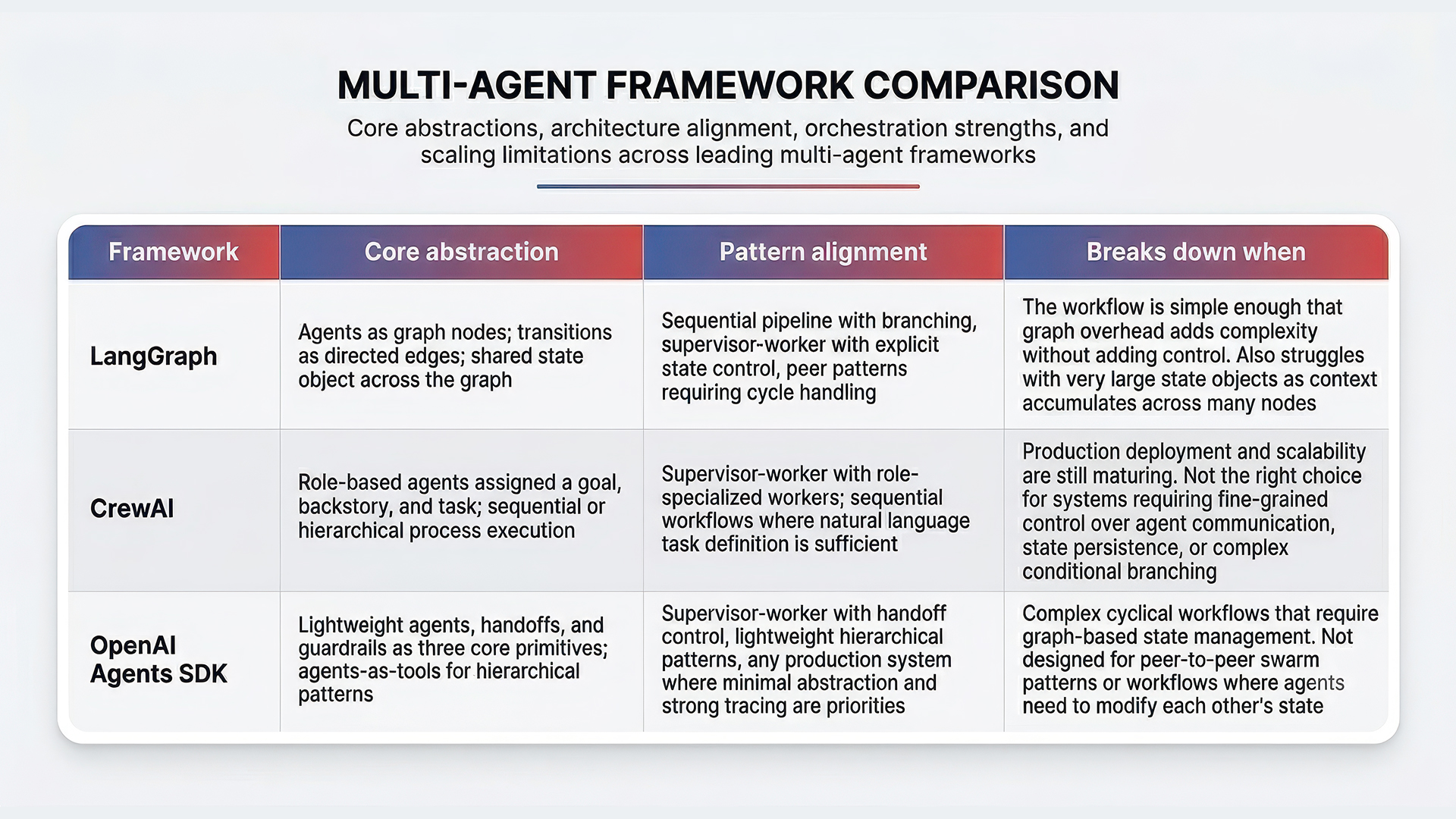
As IBM’s framework comparison notes, LangGraph excels at orchestrating complex workflows for multi-agent systems with its graph architecture, while CrewAI’s role-based structure is most intuitive for crews of specialized workers collaborating on defined tasks. Neither is universally superior. The decision belongs at the architecture stage.
WebOsmotic’s AI development engagements for multi-agent systems follow the same sequencing: pattern before framework, observability before optimisation, failure mode mapping before the first agent is deployed. The teams that engage WebOsmotic are not building proof-of-concept demos. They are building systems that handle real business processes in logistics, fintech, eCommerce, and healthcare, where a cascading failure or an infinite loop has a direct commercial cost.
| Ready to build a multi-agent system that holds up in production? WebOsmotic engineers multi-agent AI architecture for enterprise teams. Whether you are starting from a blank slate or rescuing a proof of concept that has stalled before production, we can help you choose the right pattern, the right framework, and the right observability layer. |
What is multi-agent AI architecture?
Multi-agent AI architecture is the design of systems where multiple independent AI agents, each with its own prompt, tools, and reasoning loop, collaborate to complete tasks too complex or too large for a single agent. The agents are connected through an orchestration pattern that defines how they communicate, how tasks are distributed, and how outputs are assembled. Microsoft’s Azure Architecture Center identifies four fundamental orchestration patterns: sequential pipeline, supervisor-worker, peer-to-peer, and hierarchical, and notes that each pattern introduces distinct coordination challenges, latency costs, and failure modes.
When should a team move from a single agent to a multi-agent system?
IBM’s analysis identifies the key threshold: a single agent is the right choice when the task has a narrow scope, a defined set of tools, and predictable inputs. Multi-agent systems become justified when a task requires domain-specific expertise across multiple areas that cannot be compressed into one context window, when subtasks can run in parallel to reduce total processing time, or when a single-agent system has reached the limits of what it can reliably accomplish. The decision should be made deliberately, not as a default. IBM explicitly notes that multi-agent systems are more expensive to maintain, monitor, and debug than single-agent systems.
What is the difference between LangGraph and CrewAI for multi-agent systems?
LangGraph represents agents as nodes in a directed graph with shared state, making it well-suited to complex, cyclical workflows where control flow needs to be precisely managed and state needs to persist across many agent interactions. CrewAI uses a role-based architecture where agents are defined by their role, goal, and backstory, and is most intuitive for supervisor-worker patterns where task specialisation can be expressed in natural language. IBM describes LangGraph as excelling at orchestrating complex workflows for multi-agent systems and CrewAI as providing the most intuitive approach to role-based multi-agent collaboration.
What is the OpenAI Agents SDK and how does it compare to LangGraph?
The OpenAI Agents SDK is a lightweight, production-focused framework built on three primitives: agents, handoffs, and guardrails. It is designed for teams that need a working production system with minimal abstraction overhead and strong built-in tracing and debugging capabilities. LangGraph offers more control over graph structure, state management, and complex conditional branching, but requires more configuration. The OpenAI Agents SDK is the right choice for supervisor-worker and lightweight hierarchical patterns where the priority is rapid deployment and reliable observability. LangGraph is the right choice for complex workflows with cyclical agent interactions, conditional state transitions, and fine-grained orchestration requirements.
What are the most dangerous failure modes in multi-agent AI systems?
Microsoft’s 2025 failure mode taxonomy whitepaper identifies cascading failures, inter-agent communication loops, monoculture collapse, and conformity bias as the most significant novel failure modes in multi-agent systems. Cascading failures occur when an error in one agent propagates through the entire system before any correction mechanism can trigger. Communication loops occur when two agents enter a correction or clarification cycle with no convergence condition. Monoculture collapse occurs when agents built on similar models exhibit correlated failures to the same inputs across the entire system. Conformity bias occurs when agents reinforce each other’s errors rather than providing genuine independent evaluation. All of these are architectural risks, not implementation bugs, meaning they must be addressed at the pattern and design stage, not patched after deployment.
Why do so many agentic AI projects fail before reaching production?
Gartner predicts that over 40% of agentic AI projects will be cancelled by the end of 2027, attributing this to escalating costs, unclear business value, and inadequate risk controls. The root cause is almost always a sequencing problem rather than a technology problem. Teams choose a framework before defining a pattern, define a pattern before mapping failure modes, and deploy before implementing the observability infrastructure needed to debug multi-agent behaviour in production. The Gartner analysis notes that most agentic AI projects are early-stage experiments driven by hype, which blinds organisations to the real cost and complexity of deploying agent systems at scale. The solution is to treat multi-agent architecture with the same rigour applied to any production-grade distributed system.