AI Automation ROI: Why Most Businesses See Zero Returns
193 Views
Summarize Article



Summarize Article

TLDR: 42% of companies scrapped most of their AI automation initiatives in 2025, up from 17% the year before, yet 85% simultaneously raised their AI budgets. Enterprise-wide implementation delivers just 5.9% ROI against a 10% capital cost. Most organizations aren’t losing because the technology fails. They’re losing because the strategy never existed.
Only 21% of S&P 500 companies could cite a measurable benefit from AI automation at all in 2025, even as hyperscalers tracked toward $675 billion in AI infrastructure spending for 2026. That math is broken. 80% of organizations report running generative AI in at least one business function, while only 39% report any enterprise-level EBIT impact.
The spend is real. The results aren’t. Most organizations treat AI automation as a purchasing decision instead of an operating model change, which is exactly why results stay flat.
This guide explores where AI automation ROI collapses, what the top 5% of performers do differently, and what concrete steps move a business from pilot to profit.
Most companies aren’t failing because AI automation doesn’t work. They’re failing because they treat it as a product purchase rather than a process overhaul. Technology isn’t the problem. The strategy gap is.
Only 15% of US employees report that their workplaces have communicated a clear AI strategy, yet 92% of executives plan to increase AI automation budgets in the next three years. That gap is where ROI disappears.
Deploying AI automation without a defined problem statement is the fastest way to waste both time and capital.
Marina Danilevsky, Senior Research Scientist of Language Technologies at IBM, puts it directly: “People said, Step one: we’re going to use LLMs. Step two: What should we use them for?”
That inversion costs companies millions in lost time and resources.
That gap between tool selection and problem definition is exactly where returns collapse before they get measured.
50% of generative AI budgets flow to sales and marketing even though back-office AI automation delivers faster payback periods, with successful implementations generating $2-10M annually in BPO cost reductions.
The companies seeing real returns are prioritizing finance, compliance, and operations automation over public-facing tools that look impressive in boardroom demos.
88% of AI automation pilots never reach production, and over 80% fail outright. That AI project failure rate is double the failure rate of non-AI IT initiatives, according to RAND Corporation. For large enterprises, the average cost per abandoned AI automation initiative reached $7.2 million in 2025.
In 2025, global enterprises invested $684 billion in AI automation and related AI initiatives. Over $547 billion of that failed to deliver intended business value, and the AI project failure rate worsened year-over-year because organizations kept spending without fixing the execution model. The table below puts the full scale in one view.
Enterprise AI Failure: Quick-Glance Summary:
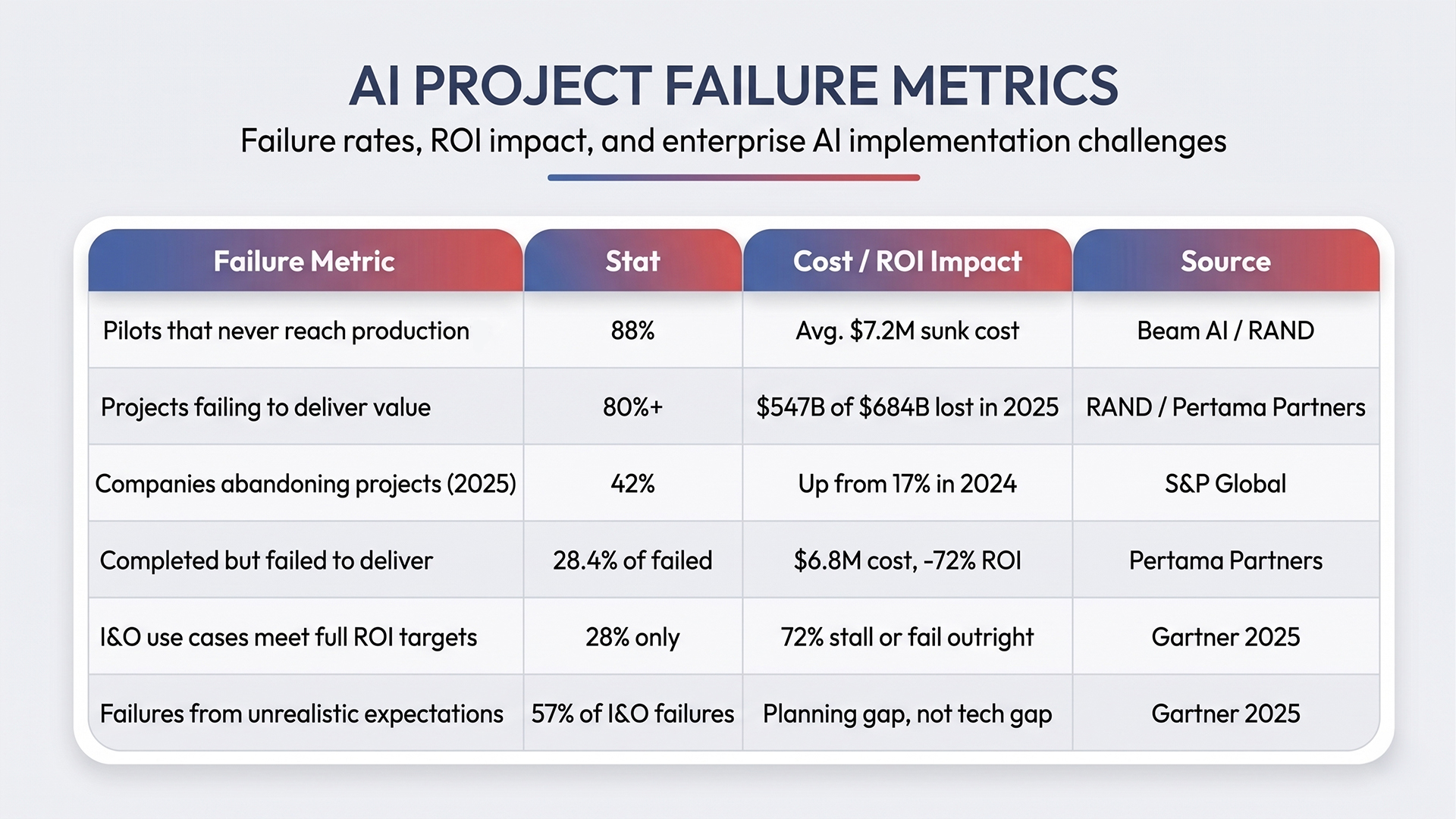
A pilot that works in a sandbox means nothing without a path to production. Without clear cross-functional ownership, AI automation pilots stay stuck in experimentation mode indefinitely. The AI project failure rate for pilot-phase projects stands at 88%, meaning most prototypes never become operational capabilities.
Gartner’s 2025 survey of 782 I&O leaders found that 57% of those reporting at least one failure said their initiatives failed because they “expected too much, too fast.” That is a planning failure, not a technology one.
While only 40% of companies provide official AI automation subscriptions, workers from over 90% of surveyed organizations report regular personal AI tool usage for work tasks. That exposes a fundamental flaw in enterprise deployment design.
If workers are solving their own problems with consumer tools, it confirms the AI project failure rate is a deployment strategy failure, not an adoption failure.
Companies that committed early to AI automation report $3.70 in value for every dollar invested, with top performers achieving $10.30 returns per dollar. The difference isn’t budget size. It’s execution discipline.
MIT’s 2025 study found that roughly 80% of the work required to move AI automation from pilot to production is data engineering, governance, workflow integration, and measurement infrastructure. That’s not a technology problem. It’s a readiness problem.
General-purpose tools like copilots and chatbots spread impact across many roles but make it nearly impossible to measure. McKinsey found nearly 70% of Fortune 500 companies use Microsoft 365 Copilot, but only 40% of workers find it even marginally helpful.
XPO deployed targeted AI automation for route optimization with pre-defined KPIs and achieved an 80% reduction in linehaul freight diversions and a 45.5% year-over-year reduction in purchased transportation costs in Q4 2025. The differentiator was measurement infrastructure built before launch, not after.
MIT’s The GenAI Divide report found that purchasing AI automation from specialized vendors succeeds about 67% of the time, while internal builds succeed only one-third as often.
Gartner confirms that among the 28% of AI use cases that fully succeed, the primary factor is integrating AI into existing workflows with full executive support, not building proprietary models.
Most AI automation ROI failures trace back to three fixable gaps: poor use-case selection, missing KPI frameworks, and no integration with existing systems. WebOsmotic closes all three before a single line of code is written.
WebOsmotic has delivered 1,000+ custom AI automation solutions across healthcare, fintech, logistics, eCommerce, and HR. Their AI-OMS system cut 80+ staff hours per month for a multi-location US cafe chain.
Our consulting-to-production pipeline starts with use-case identification and feasibility analysis, ensuring every AI automation initiative has a clear ROI roadmap from day one.
WebOsmotic operates across six core service lines: Custom AI Development, AI Agents, AI Chatbots, Generative AI Solutions, AI Consulting, and Workflow Automation, each built to support measurable outcomes from day one.
The AI automation ROI problem is a strategy and measurement problem, not a technology one. Most organizations report satisfactory ROI within two to four years, far longer than the seven to twelve-month payback period expected for standard technology investments. Most businesses deploy AI automation without defining what returns should look like, which is why the AI project failure rate stays stubbornly at 80%.
Fix the use case. Fix the metrics. Fix the integration. The businesses doing all three are already on the right side of the divide.
Ready to move from experimentation to real returns? Let’s talk about building an AI strategy that actually performs. Book a quick conversation with WebOsmotic.
Most businesses report satisfactory returns from AI automation within two to four years, significantly longer than the seven to twelve-month payback typical for standard technology investments. Back-office automation tends to return faster than customer-facing deployments. (Deloitte)
88% of pilots never reach production. The primary driver is the high AI project failure rate caused by unclear objectives and no defined KPIs at kickoff. This AI project failure rate doubles that of standard IT initiatives and costs large enterprises an average of $7.2M per abandoned AI automation project. (Beam AI / RAND)
Horizontal tools like general copilots work across multiple roles but deliver diffuse benefits that are hard to measure. Vertical AI automation targets a specific use case and delivers traceable results. Vertical deployments consistently outperform on measurable AI automation ROI.
Hyperscalers alone are on track to spend $675 billion on AI automation infrastructure in 2026, up 63% from the prior year. Despite that level of spend, only 21% of S&P 500 companies can cite a measurable benefit, and the AI project failure rate keeps rising. (Terminal X)